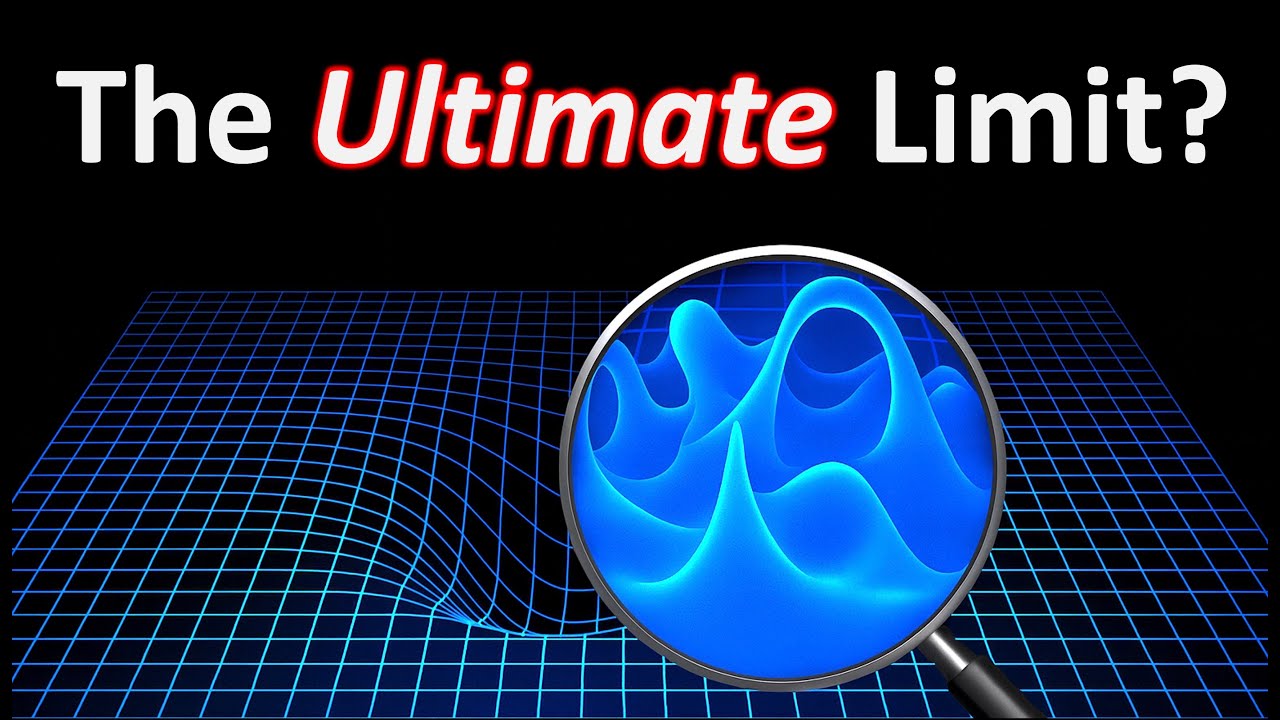
What ACTUALLY Happens at the Planck Length?
Keywords
Summary
184 words
Critical Evaluation
The video is an excellent example of science communication that does not shy away from mathematical rigor. It provides a clear and logical progression from basic wave mechanics to the profound implications of the Planck length. The argumentation is solid: it starts with the well-established de Broglie relation and the energy-wavelength scaling, then applies these to particle accelerators, and finally introduces the gravitational collapse limit. The key insight—that probing smaller distances requires higher energy, which eventually leads to black hole formation—is explained intuitively and backed by calculations. The video correctly emphasizes that this is an operational limit, not necessarily a fundamental discreteness of spacetime, and it carefully distinguishes between what is known and what is speculative. The sources cited are authoritative (Mead, Garay, Polchinski, Rovelli, Tong), and the video’s content aligns with current understanding in theoretical physics. The only minor weakness is that it does not delve into the nuances of different quantum gravity approaches, but that is beyond its scope. The title is accurate, and the content is of high quality. Overall, this is a top-tier educational video that is both informative and intellectually stimulating.
186 words
Title / Content Match
The title accurately reflects the content: the video explains what happens at the Planck length, focusing on the operational limit of probing distances and the formation of black holes.
Quality & Reliability
9/10
The video presents a rigorous, mathematically grounded explanation of the Planck length, drawing on established physics (Heisenberg uncertainty, de Broglie wavelength, general relativity) and referencing key literature (Mead, Garay, Polchinski, Rovelli). The reasoning is clear and the sources are credible. Minor caveat: the video is educational and simplifies some aspects, but it does not misrepresent the science.
Key Moments
Markers derived by PSI from the transcript: the creator did not define chapters.
- Introduction: Can we zoom into nature forever?
- How we see: light scattering and wavelength resolution
- Einstein's photons and the energy-wavelength relation
- De Broglie matter waves and electron microscopes
- Calculating energy to resolve atoms with electrons
- Ultra-relativistic limit: energy scales as hc/Δx
- Probing nuclear and subnuclear scales: SLAC and LHC
- The limit: energy to probe Planck length creates black hole
- Conclusion: Planck length as operational boundary, need for quantum gravity
Cited Sources
- Brilliant (sponsor) — Sponsor of the video, offering interactive math and science courses.
Concurring Sources
- Possible Connection Between Gravitation and Fundamental Length — C. A. Mead (1964) - referenced in the video description, supports the idea of a fundamental length.
- Observable Consequences of Fundamental-Length Hypotheses — C. A. Mead (1966) - referenced in the video description, discusses observable effects of a fundamental length.
- Quantum Gravity and Minimum Length — Luis J. Garay (1994) - referenced in the video description, discusses minimum length in quantum gravity.
- Quantum Gravity at the Planck Length — Joseph Polchinski - referenced in the video description, discusses quantum gravity at the Planck scale.
- Quantum Gravity — Carlo Rovelli - referenced in the video description, a standard textbook on quantum gravity.
Contribution & Novelties
The video provides a clear, step-by-step derivation of the Planck length as an operational limit, connecting quantum mechanics and general relativity in an accessible way. It emphasizes that the limit arises from the energy required to probe small distances, leading to black hole formation. This is a valuable educational contribution.
Pour aller plus loin :
- Planck length - Wikipedia — Overview of the Planck length and its significance.
- Quantum gravity - Wikipedia — Introduction to the theoretical frameworks aiming to unify quantum mechanics and gravity.
- Heisenberg’s uncertainty principle - Wikipedia — Fundamental principle underlying the energy-distance trade-off.
- Black hole - Wikipedia — Concept of black holes and their formation from energy concentration.
- String theory - Wikipedia — One proposed framework for quantum gravity, mentioned in the video.
127 words
Radar Profile
The radar profile shows high scores across all dimensions, with a slight dip in technical level, indicating that the video is highly informative, reliable, and technically rich, but still accessible to a broad audience.
💬 Très positif. Sur les 30 commentaires analysés, les spectateurs expriment une admiration générale pour la clarté des explications, la profondeur du contenu et la qualité de la vulgarisation, avec des remarques humoristiques et des remerciements.