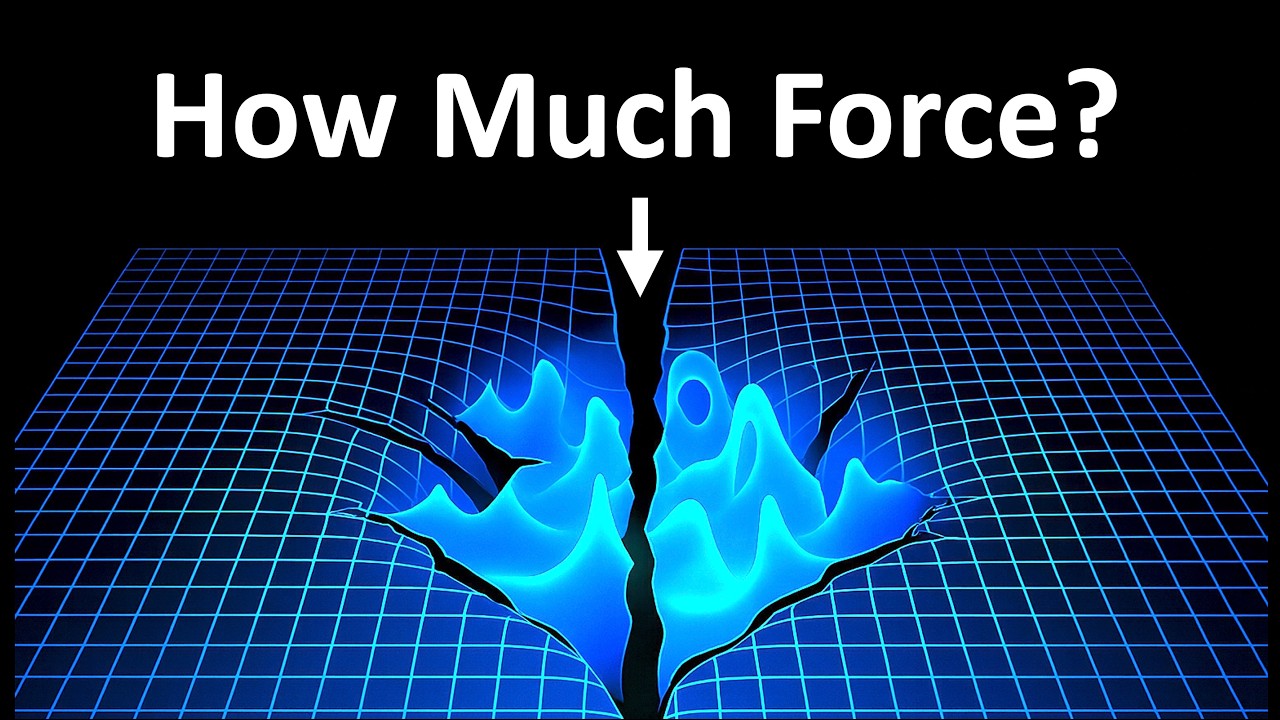
Can You ACTUALLY Break Spacetime?
Keywords
Summary
214 words
Critical Evaluation
The video excels in its pedagogical approach, breaking down complex concepts into digestible steps while maintaining scientific rigor. The presenter’s use of analogies (e.g., spacetime as an elastic material) is effective for intuition, but it is carefully qualified as an approximation. The derivation of spacetime stiffness from gravitational-wave energy is well-motivated and follows standard physics, though the analogy to Young’s modulus is heuristic and not a fundamental property. The application of Griffith’s fracture criterion to spacetime is a bold speculative leap, but the presenter transparently labels it as such and grounds it in recent theoretical work (Tello & Strong 2025). The conclusion that the Planck force emerges as the breaking threshold is compelling and consistent with other maximum force bounds in the literature (Barrow & Gibbons 2015). The video’s strength lies in its clear narrative and the integration of multiple sources, including peer-reviewed papers. However, the speculative nature of the central question means that the argument relies on assumptions that are not empirically testable at present. The presenter does not overstate the certainty, which is commendable. The inclusion of a sponsor segment is clearly separated and does not detract from the content. The title accurately reflects the content, and the video delivers on its promise. Overall, this is an excellent example of science communication that balances accessibility with depth, making it valuable for both enthusiasts and students.
227 words
Title / Content Match
The title is engaging and accurately reflects the core question explored in the video, which investigates the theoretical possibility of breaking spacetime by combining gravitational-wave physics, fracture mechanics, and the Planck scale.
Quality & Reliability
8/10
The video presents a rigorous, well-structured argument grounded in established physics (general relativity, gravitational waves, elasticity theory) and cites multiple peer-reviewed sources. The speculative extension to spacetime fracture is clearly framed as theoretical, and the presenter uses high-school-level math to maintain accessibility without oversimplifying. The inclusion of recent papers (Tello & Strong 2025, Wieland 2025) adds credibility. Minor caveats: the analogy between spacetime and elastic materials is heuristic, and the presenter acknowledges assumptions (e.g., linear elasticity). Overall, high reliability with clear scientific grounding.
Key Moments
Markers derived by PSI from the transcript: the creator did not define chapters.
- Introduction: LIGO's detection of gravitational waves and the question of breaking spacetime.
- Explanation of how gravitational waves stretch and squeeze spacetime using rings of masses.
- Definition of strain and its application to LIGO measurements.
- Sponsor segment (Henson Shaving) - approximately 2 minutes.
- Discussion of the tiny strain measured by LIGO (10^-21) and its implications.
- Introduction of the concept of spacetime stiffness, referencing Rainer Weiss's estimate.
- Derivation of Young's modulus and its application to spacetime.
- Application of Griffith's fracture theory to estimate the critical stress for spacetime.
- Emergence of the Planck force as the breaking threshold and comparison with other bounds.
- Conclusion: implications for quantum gravity and the speculative nature of the result.
Cited Sources
- Breaking spacetime — Recent paper by Tello & Strong (2025) that directly addresses the possibility of breaking spacetime, providing the theoretical basis for the video's central question.
- What is the Stiffness of Spacetime? — Paper by Kirk T. McDonald (2018) that discusses the effective stiffness of spacetime, referenced for the concept of spacetime stiffness.
- Mechanics of spacetime — A Solid Mechanics perspective on the theory of General Relativity — Paper by Tenev & Horstemeyer (2018) that treats spacetime as a solid, providing a framework for applying elasticity concepts.
- Gravitation — Classic textbook by Misner, Thorne, and Wheeler (1973), cited as a foundational reference for general relativity and gravitational waves.
- Maximum tension: with and without a cosmological constant — Paper by Barrow & Gibbons (2015) that discusses maximum force bounds, relevant to the Planck force result.
- Remarks on the maximum luminosity — Paper by Cardoso et al. (2018) that examines maximum luminosity bounds, related to the Planck scale limits.
- Evidence for Planck luminosity bound in quantum gravity — Paper by Wieland (2025) that provides evidence for a Planck luminosity bound, supporting the idea of fundamental limits.
Concurring Sources
- Breaking spacetime — Directly supports the video's central thesis that spacetime could break under extreme conditions.
- What is the Stiffness of Spacetime? — Provides the concept of spacetime stiffness that the video builds upon.
- Mechanics of spacetime — A Solid Mechanics perspective on the theory of General Relativity — Offers a solid mechanics perspective on general relativity, aligning with the video's approach.
Dissenting Sources
- Maximum tension: with and without a cosmological constant — While this paper supports the existence of a maximum force, it does not specifically address the breaking of spacetime, and the video's application of fracture mechanics to spacetime is an extrapolation not directly covered in this source.
External References
Contribution & Novelties
The video’s original contribution lies in synthesizing gravitational-wave physics, elasticity theory, and fracture mechanics to explore the speculative but intriguing question of whether spacetime can break. It presents a clear derivation that leads to the Planck force as the natural breaking threshold, connecting disparate concepts in a novel way. The inclusion of recent papers (Tello & Strong 2025, Wieland 2025) ensures the content is up-to-date.
Pour aller plus loin :
- Griffith’s fracture criterion — The theory used to estimate the critical stress for spacetime fracture.
- Planck force — The derived breaking threshold, a fundamental unit in Planck scale physics.
- LIGO — The observatory that detected gravitational waves, providing the empirical foundation.
- Quantum gravity — The theoretical framework needed to fully understand spacetime at the Planck scale.
126 words
Radar Profile
The radar profile shows high scores in quantity and quality of information, with a strong technical level and good reliability. The video is information-dense and well-sourced, making it a valuable resource for those interested in advanced physics concepts.
💬 Très positif : les commentaires expriment une admiration générale pour la qualité du contenu et la clarté des explications, avec quelques critiques constructives sur les hypothèses et la circularité potentielle de l'argumentation. Sur les 30 commentaires analysés, la majorité est positive, saluant la pédagogie et la rigueur, tandis qu'une minorité soulève des points de discussion scientifique.