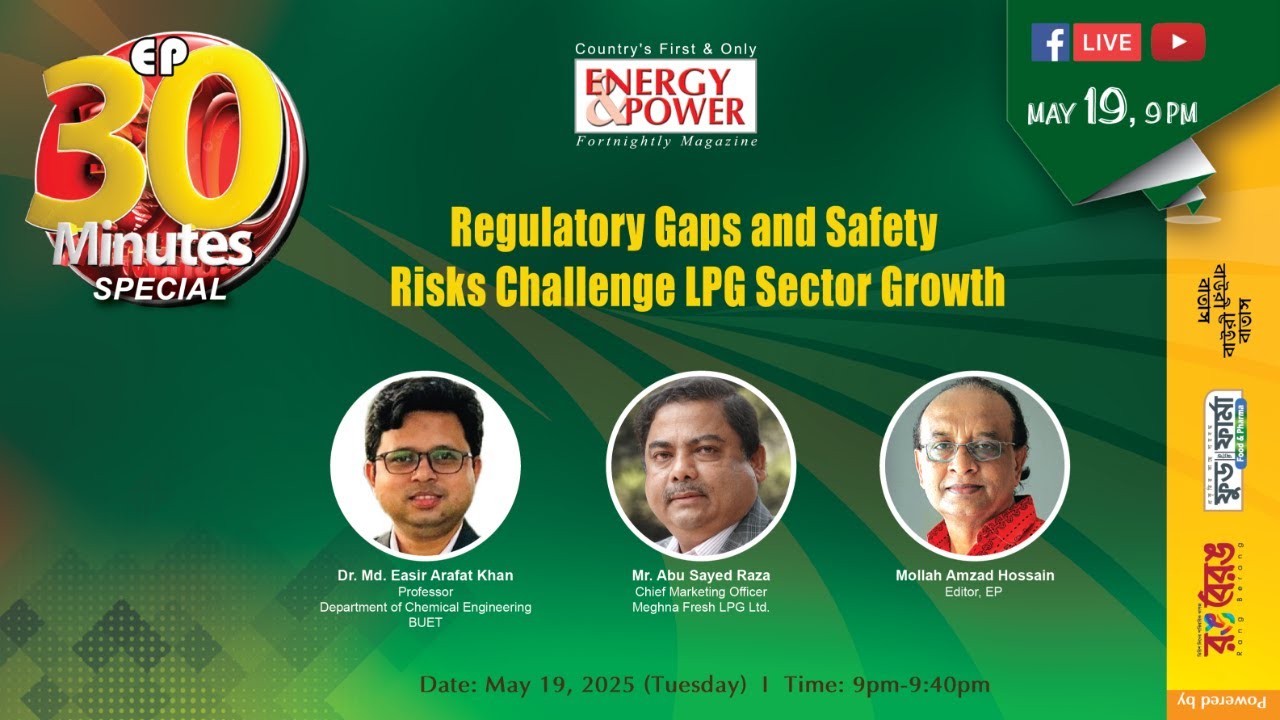
EP 30 Minutes Special 221: Regulatory Gaps and Safety Risks Challenge LPG Sector Growth
Keywords
Summary
164 words
Critical Evaluation
Value of the Information & Strength of the Argument
The discussion provides valuable insights into the LPG sector’s regulatory and safety challenges in Bangladesh. The arguments are based on practical experience and specific examples, such as the 2022 industrial accident and the lack of training for drivers. However, the argumentation is sometimes repetitive and lacks quantitative data to support claims. The panelists present differing perspectives, with the industry representative focusing on enforcement issues and the academic emphasizing systemic gaps. The value lies in the identification of concrete problems and potential solutions, such as differentiated coupling systems to prevent cross-filling and the need for expert opinions in policy revision.
Scientific Rigor, Source Quality, Title Accuracy
The discussion references specific regulations (LPG Rules 2000, Rule 125) and incidents, but does not provide verifiable sources or data. The title accurately reflects the content, focusing on regulatory gaps and safety risks. The quality of sources is moderate, as the panelists are credible but the information is largely anecdotal. The discussion would benefit from citing official reports or studies to strengthen the arguments.
178 words
Title / Content Match
The title accurately reflects the content, focusing on regulatory gaps and safety risks in the LPG sector.
Quality & Reliability
6/10
The discussion features credible experts (a BUET professor and an LPG industry CMO) and references specific regulations and incidents, but lacks verifiable data and relies on anecdotal evidence.
Key Moments
Markers derived by PSI from the transcript: the creator did not define chapters.
- Introduction to the topic and guests.
- Discussion on existing regulations and enforcement challenges.
- Professor Khan highlights technical safety issues and training needs.
- Debate on unlicensed auto-gas stations and compliance.
- Proposal for technical solutions like different coupling systems.
- Discussion on the need for expert opinions in policy revision.
- Consideration of multi-fuel stations and future safety guidelines.
- Comparison with India's regulatory manpower and suggestions for improvement.
Cited Sources
- LPG Rules 2000 — Mentioned as the primary regulation governing LPG safety and penalties.
Concurring Sources
- LPG Rules 2000 — Referenced as the existing regulation, but its enforcement is questioned.
Contribution & Novelties
The video contributes to the discourse on LPG safety in Bangladesh by bringing together industry and academic perspectives. It highlights specific regulatory gaps, such as the lack of enforcement and the need for technical solutions. The discussion proposes actionable measures like forming task forces and improving training. For further exploration, consider the following:
- Liquefied petroleum gas — Overview of LPG properties and uses.
- Process safety management — Framework for managing hazards in industrial processes.
- Bangladesh Energy Regulatory Commission — Regulatory body overseeing energy sectors in Bangladesh.
86 words
Radar Profile
The radar profile shows moderate scores across all dimensions, indicating a balanced but not exceptional discussion. The highest score is in quantity of information, reflecting the breadth of topics covered, while technical depth and reliability are slightly lower due to the lack of detailed data.