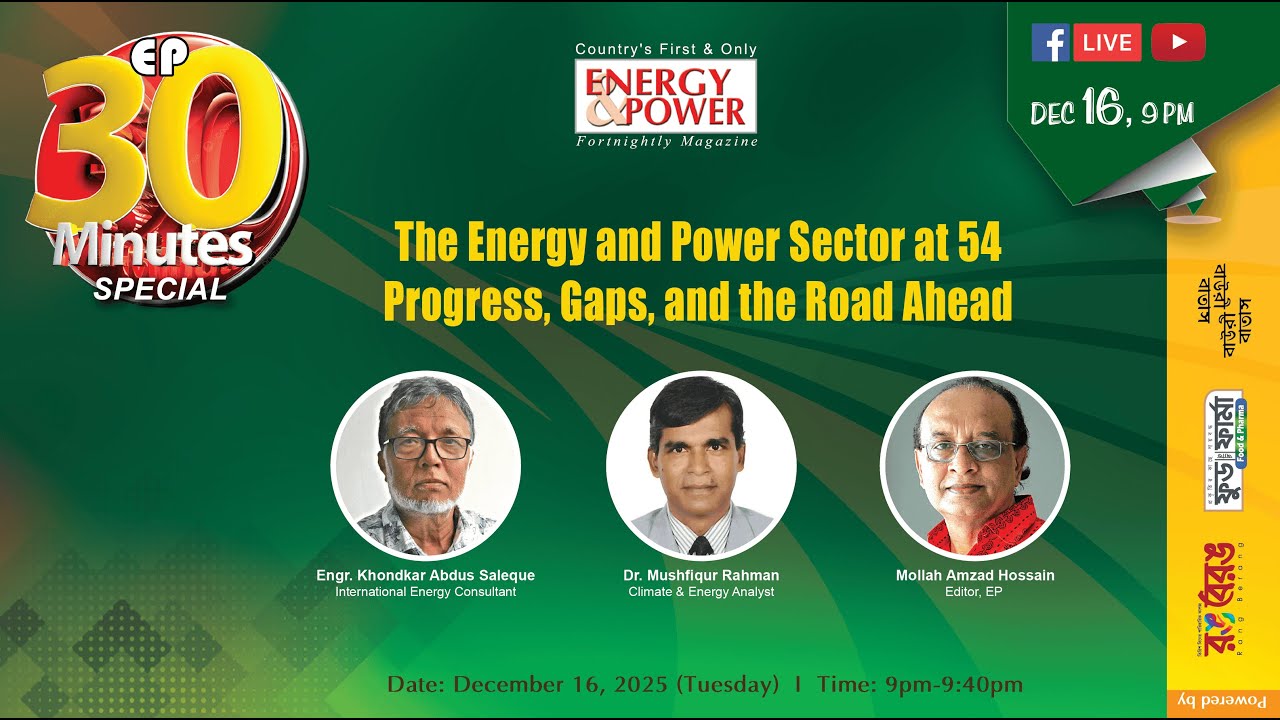
EP 30 Minutes Special 201: The Energy and Power Sector at 54 Progress, Gaps, and the Road Ahead
Keywords
Summary
214 words
Critical Evaluation
Value of the Information & Strength of the Argument
The video provides valuable insights from two experienced professionals in Bangladesh’s energy sector. The discussion is grounded in specific data, such as installed capacity figures, gas reserve estimates, and renewable energy statistics, which adds credibility. The argumentation is coherent, with both guests agreeing on the main challenges and offering complementary perspectives. However, the arguments are largely based on personal experience and opinion rather than rigorous scientific analysis or cited research. The debate format allows for a comprehensive overview, but the lack of structured evidence and occasional digressions weaken the overall argumentative strength.
Scientific Rigor, Source Quality, Title Accuracy
The scientific rigor is moderate. The guests reference official statistics and reports (e.g., SREDA data, IEA reports) but do not provide specific citations or URLs. The discussion is more of an expert opinion than a systematic review. The title accurately reflects the content, which is a retrospective and forward-looking analysis of the energy sector. The video includes a sponsorship segment, but it is brief and does not affect the content’s integrity. No comments were provided for analysis.
184 words
Title / Content Match
The title accurately reflects the content, which reviews 54 years of progress and gaps in Bangladesh's energy sector and discusses future strategies.
Quality & Reliability
6/10
The discussion features two experts with decades of experience in the energy sector, providing informed opinions and specific data points. However, the claims are not systematically backed by cited sources, and the format is a conversational debate rather than a rigorous scientific review.
Key Moments
Markers derived by PSI from the transcript: the creator did not define chapters.
- Introduction and context: 54 years of independence, challenges in energy sector.
- Dr. Mushfiqur Rahman discusses progress in installed capacity and ongoing issues.
- Discussion on gas dependency and import infrastructure limitations.
- Sufi emphasizes the need for political commitment and long-term planning.
- Debate on election manifestos and the need for concrete action plans.
- Discussion on coal resources and the future of Barapukuria mine.
- Renewable energy challenges: land constraints and storage costs.
- Global fossil fuel trends and implications for Bangladesh.
- Call for integrated policies and urgent action to avoid crisis.
Cited Sources
- SREDA statistics on renewable energy — Mentioned by Dr. Mushfiqur Rahman when discussing renewable energy capacity.
- IEA report on fossil fuel dominance — Referenced in the discussion about global fossil fuel trends.
Concurring Sources
- Electricity sector in Bangladesh — Provides general information on the sector's development and challenges.
Contribution & Novelties
The video offers a comprehensive overview of Bangladesh’s energy sector from the perspective of two seasoned experts, highlighting the gap between installed capacity and actual generation, the depletion of domestic gas reserves, and the challenges of expanding renewables. It uniquely ties the energy crisis to political decision-making and electoral promises, suggesting that future governments must present actionable plans. The discussion also touches on the global context of fossil fuel use, providing a balanced view on the energy transition.
Pour aller plus loin :
- Bangladesh Power Sector — Provides background on the country’s electricity generation and challenges.
- Barapukuria Coal Mine — Details on the only coal mine in Bangladesh, its reserves, and operational issues.
- Renewable Energy in Bangladesh — Overview of renewable energy sources and policies in the country.
128 words
Radar Profile
The radar profile shows moderate scores across all dimensions, with a slight peak in quantity of information. This indicates a balanced but not exceptional presentation, with room for improvement in technical depth and source rigor.