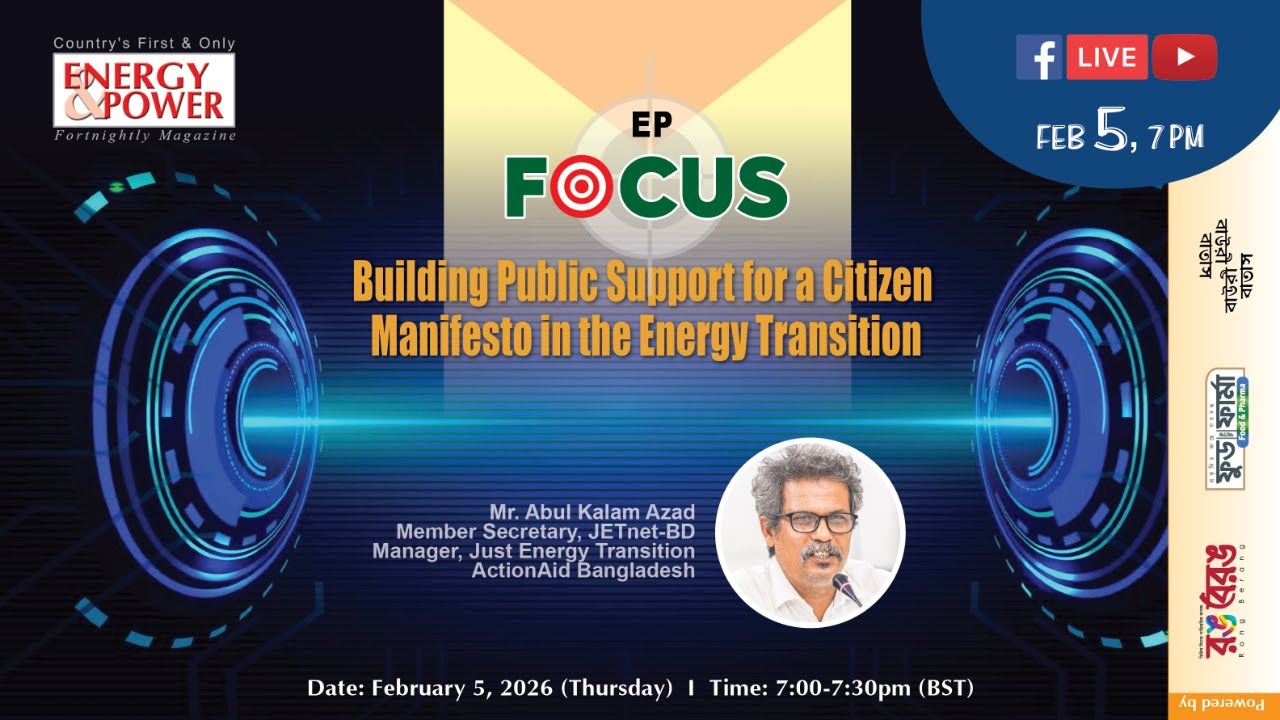
EP FOCUS: Building Public Support for a Citizen Manifesto in the Energy Transition
Keywords
Summary
164 words
Critical Evaluation
Value of the Information & Strength of the Argument
The video provides valuable insights into the advocacy efforts for energy transition in Bangladesh, presenting a clear set of policy proposals and the rationale behind them. The argumentation is coherent, emphasizing the urgency of climate action and the economic benefits of renewable energy. However, it relies heavily on the guest’s opinions and lacks concrete data or evidence to support claims about feasibility and public support. The discussion is persuasive but not deeply analytical, with limited exploration of potential counterarguments or implementation challenges.
Scientific Rigor, Source Quality, Title Accuracy
The video does not cite specific sources or provide references to scientific studies. The guest mentions a national energy transition policy draft from 2024 and a study on two villages, but no details or links are given. The title accurately reflects the content, focusing on building public support for the manifesto. The discussion is based on the guest’s expertise and organizational experience, but the lack of verifiable sources reduces the scientific rigor. No comments were provided for analysis.
175 words
Title / Content Match
The title accurately reflects the content, which focuses on building public support for a citizen manifesto in the energy transition.
Quality & Reliability
6/10
The video presents an expert opinion from a representative of ActionAid Bangladesh, discussing a citizen manifesto for energy transition. It includes specific policy proposals and references to ongoing campaigns, but lacks detailed data or verifiable sources. The discussion is largely qualitative and advocacy-oriented, with limited critical examination of the proposals.
Key Moments
Markers derived by PSI from the transcript: the creator did not define chapters.
- Introduction and context of the citizen manifesto
- Discussion on the need for a national energy transition policy
- Comparison of renewable energy targets with India and China
- Advocacy for decentralized energy systems and examples from Pakistan
- Challenges and opportunities for the garment sector in decarbonization
- International advocacy and campaigns by ActionAid
- Analysis of political parties' manifestos and engagement
- Challenges facing the next government in the energy sector
- Role of public support and future plans for the campaign
Contribution & Novelties
The video offers an insider perspective on the development and promotion of a citizen manifesto for energy transition in Bangladesh, highlighting the importance of public engagement and political advocacy. It introduces specific policy proposals and campaign strategies, such as the ‘decarbonize, decentralize, and decorporatize’ framework. The discussion provides a unique view of how civil society organizations are working to influence energy policy in a developing country context.
Pour aller plus loin :
- Just Transition — Concept central to the manifesto, focusing on fairness in the shift to a low-carbon economy.
- Renewable energy in Bangladesh — Overview of the current state and potential of renewables in Bangladesh.
- Net zero emissions — Target discussed in the video, with global context and challenges.
120 words
Radar Profile
The radar profile shows moderate scores across all dimensions, with slightly higher scores in information quantity and quality, reflecting the video's informative but not deeply technical nature. The low technical level and moderate reliability suggest a general audience focus with limited scientific depth.