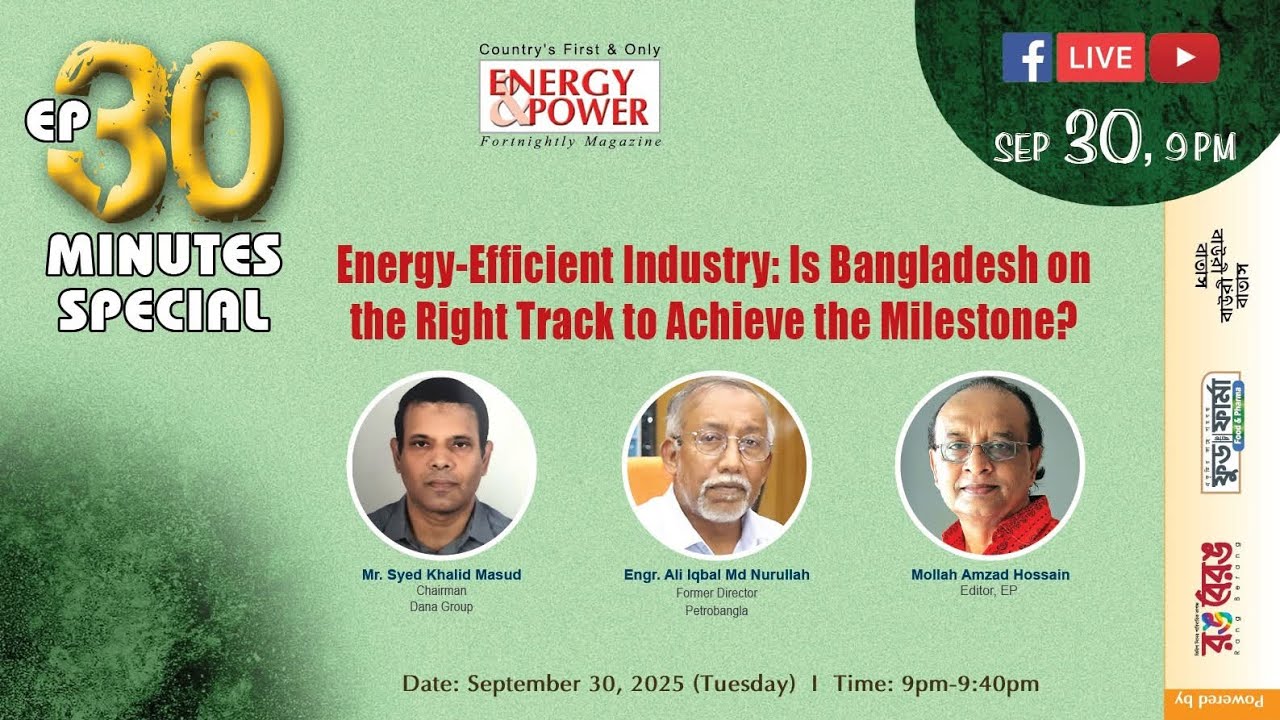
EP 30 Minutes Special 190: Energy-Efficient Industry: Is Bangladesh on the Rt Track to Ach. the Mil?
Keywords
Summary
215 words
Critical Evaluation
Value of the Information & Strength of the Argument
The discussion provides valuable insights into the practical challenges and opportunities for energy efficiency in Bangladesh’s industrial sector. The guests, with their extensive experience, offer concrete examples and data points, such as the potential to save 100 million cubic feet of gas per month through cogeneration. They argue convincingly that the lack of regulatory enforcement and financial incentives are major obstacles. However, the argumentation is largely anecdotal, relying on personal experiences rather than systematic studies. The guests also present a clear case for policy changes, but the lack of quantitative evidence and formal citations weakens the overall argumentation.
Scientific Rigor, Source Quality, Title Accuracy
The discussion is based on the professional experience of the guests, but no specific sources are cited. The title accurately reflects the content, focusing on Bangladesh’s progress towards energy efficiency in industry. The lack of formal citations and reliance on anecdotal evidence reduces the scientific rigor. The guests mention the Energy Efficiency Roadmap 2015 and the Bangladesh Bank’s green banking fund, but these are not elaborated with specific data. Overall, the content is informative but not rigorously sourced.
191 words
Title / Content Match
The title accurately reflects the content, which focuses on the energy efficiency of Bangladesh's industrial sector and its progress towards achieving energy efficiency milestones.
Quality & Reliability
6/10
The discussion features two industry experts with direct experience in the energy sector, providing practical insights and specific examples. However, the lack of verifiable data, reliance on anecdotal evidence, and absence of formal citations reduce the overall reliability.
Key Moments
Markers derived by PSI from the transcript: the creator did not define chapters.
- Introduction of the topic and guests.
- Discussion on the current state of energy efficiency in Bangladesh's industries.
- Examples of cogeneration and waste heat recovery in industries.
- Comparison with Malaysia and India's regulatory approaches.
- Challenges of energy audits and lack of enforcement.
- Discussion on financial incentives and subsidies for energy-efficient technologies.
- Potential of heat pumps, thermal batteries, and organic Rankine cycle turbines.
- Import duties on lithium-ion batteries and their impact on energy storage adoption.
- Call for policy implementation and immediate action.
Contribution & Novelties
The video provides a unique perspective from industry insiders on the practical barriers to energy efficiency in Bangladesh, such as the lack of enforcement of cogeneration requirements and the absence of financial incentives. It highlights specific opportunities, like the potential to save significant amounts of gas through cogeneration and waste heat recovery. The discussion also touches on emerging technologies like heat pumps and thermal batteries, which are not yet widely adopted in Bangladesh.
Pour aller plus loin :
- Cogeneration — Overview of combined heat and power systems.
- Waste heat recovery — Technologies and applications.
- Organic Rankine cycle — A technology for converting low-temperature heat into electricity.
- Energy audit — Process of assessing energy use and efficiency.
- Bangladesh Bank Green Banking — Official page on green banking initiatives.
127 words
Radar Profile
The radar profile shows moderate scores across all dimensions, with quantity of information being the highest. This indicates a balanced but not exceptional presentation, with room for improvement in reliability and technical depth.