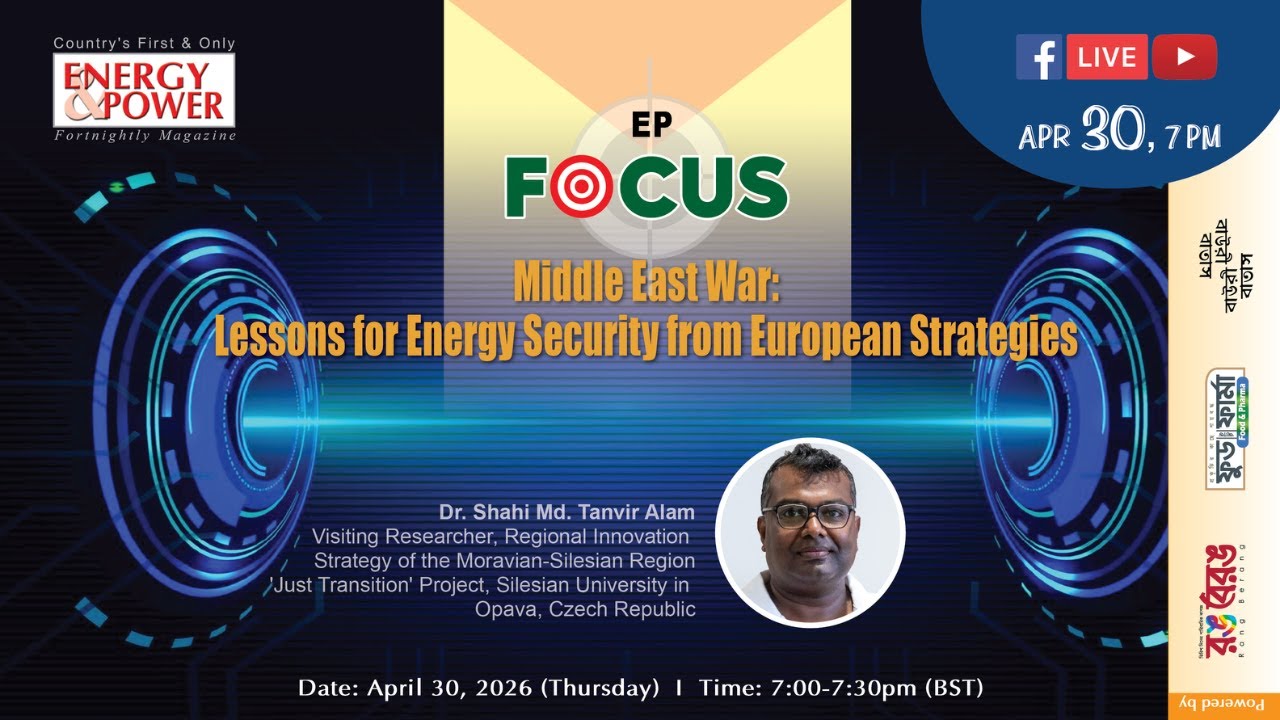
EP FOCUS: Middle East War: Lessons for Energy Security from European Strategies
Keywords
Summary
143 words
Critical Evaluation
Value of the Information & Strength of the Argument
The video provides valuable insights into European energy security strategies, particularly the shift from single-supplier dependence to a diversified global market approach. The guest’s argumentation is coherent, emphasizing diversification, renewables, efficiency, and storage. He effectively uses examples like Germany’s vertical solar panels and India’s auction success to support his points. However, the discussion lacks quantitative data and specific references, relying more on general knowledge and personal experience. The argument for competitive auctions in Bangladesh is well-reasoned, but the lack of concrete evidence weakens the overall persuasiveness.
Scientific Rigor, Source Quality, Title Accuracy
The video does not cite specific sources in the description, and the guest references general knowledge and his PhD thesis. The title accurately reflects the content, focusing on lessons from European strategies. The discussion is based on expert opinion rather than rigorous scientific evidence. No comments were provided for analysis.
151 words
Title / Content Match
The title accurately reflects the content, which focuses on lessons for energy security from European strategies in the context of the Middle East war.
Quality & Reliability
6/10
The video features an expert guest with a PhD in renewable energy, providing informed opinions and references to European strategies. However, claims lack specific data citations, and the discussion is largely qualitative. The host and guest discuss geopolitical and economic impacts, but no primary sources are cited in the description.
Key Moments
Markers derived by PSI from the transcript: the creator did not define chapters.
- Introduction of the topic and guest
- Guest outlines three challenges for Europe: supply, price, geopolitical
- European strategies: diversification, renewables, efficiency, storage
- Discussion on solar plus storage costs in Europe vs Bangladesh
- Bangladesh's renewable targets and LOI review
- Role of gas and coal as transition fuels
- Recommendations for Bangladesh: auctions, policy stability, project pipeline
- EU-funded Bangladesh Renewable Energy Facility and potential collaboration
Contribution & Novelties
The video offers a comparative analysis of European energy security strategies and their applicability to Bangladesh, emphasizing the importance of competitive auctions and policy stability. It provides a practical perspective from a researcher with experience in both regions.
Pour aller plus loin :
- International Energy Agency — Relevant for global energy data and analysis.
- European Green Deal — Official EU strategy for climate neutrality.
- Bangladesh Renewable Energy Policy — Official government site for energy policies.
75 words
Radar Profile
The radar profile shows moderate scores across all dimensions, indicating a balanced but not highly technical or rigorously sourced content. The video is informative but relies on expert opinion rather than data-heavy analysis.