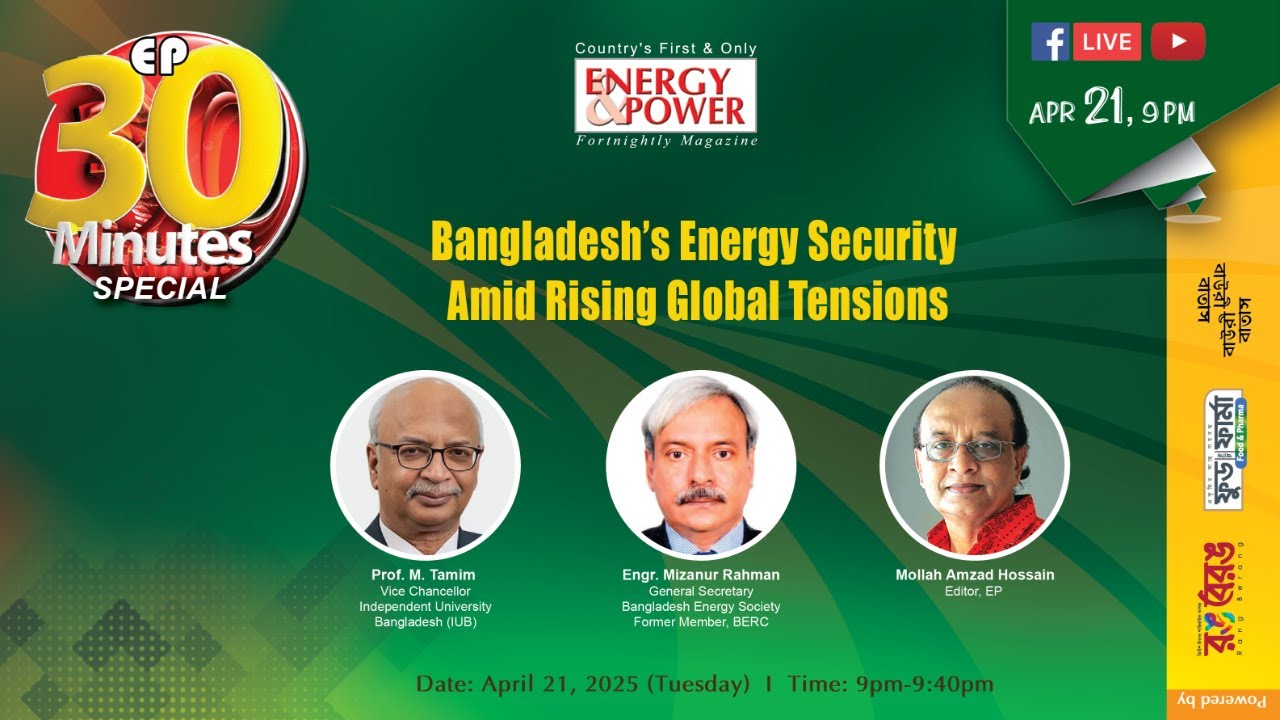
EP 30 Minutes Special 217: Bangladesh’s Energy Security Amid Rising Global Tensions
Keywords
Summary
168 words
Critical Evaluation
Value of the Information & Strength of the Argument
The value of the information lies in the direct insights from two experienced professionals in Bangladesh’s energy sector. They provide a nuanced analysis of the fuel crisis, distinguishing between panic-driven shortages and actual supply issues. The argumentation is generally solid, with logical reasoning about the need for price adjustments to prevent hoarding and the importance of restoring public trust. However, some claims are based on personal observation rather than hard data, and the discussion occasionally lacks depth on certain technical aspects.
Scientific Rigor, Source Quality, Title Accuracy
The discussion is rigorous in its reliance on the speakers’ professional experience, but it lacks explicit citations to external sources. The title accurately reflects the content, focusing on Bangladesh’s energy security amid global tensions. The adéquation between title and content is good, as the conversation directly addresses the impact of international conflicts on domestic energy supply and pricing.
154 words
Title / Content Match
The title accurately reflects the content, which focuses on Bangladesh's energy security challenges in the context of global tensions.
Quality & Reliability
6/10
The discussion features two experts (a professor and a former energy regulator) providing informed opinions, but the content is largely conversational and lacks rigorous data citations. Some claims are unverified and the format is a live debate, which limits the overall reliability.
Key Moments
Markers derived by PSI from the transcript: the creator did not define chapters.
- Introduction of guests and topic: Bangladesh's energy security amid global tensions.
- Discussion on fuel price hikes and their impact on supply and demand.
- Analysis of the diesel crisis and its implications for food security and transport.
- Debate on the adequacy of fuel pump numbers in Dhaka and the role of panic buying.
- Discussion on the need for price adjustments to prevent hoarding and black market activities.
- Examination of government subsidies and the proposal to increase electricity tariffs.
- Long-term solutions: reducing import dependence and boosting domestic gas production.
- Challenges in attracting foreign investment for oil and gas exploration.
- Impact of coal supply shortages on power generation and load shedding.
- Concluding remarks on the need for professional energy management and policy reforms.
Contribution & Novelties
The video provides a timely and expert perspective on Bangladesh’s energy security challenges during a period of global geopolitical tension. It offers practical insights into the immediate crisis management and long-term strategic needs, such as diversifying energy sources and improving regulatory frameworks.
Pour aller plus loin :
- Bangladesh Energy Regulatory Commission — Official regulator’s site for understanding the regulatory framework.
- International Energy Agency — Global energy analysis and policy recommendations.
- Energy and Power Magazine — The channel’s website with related articles and reports.
83 words
Radar Profile
The radar profile shows moderate scores across all dimensions, indicating a balanced but not exceptional discussion. The quantity of information is relatively high, but the quality and technical depth are moderate, reflecting the conversational format and lack of rigorous data.