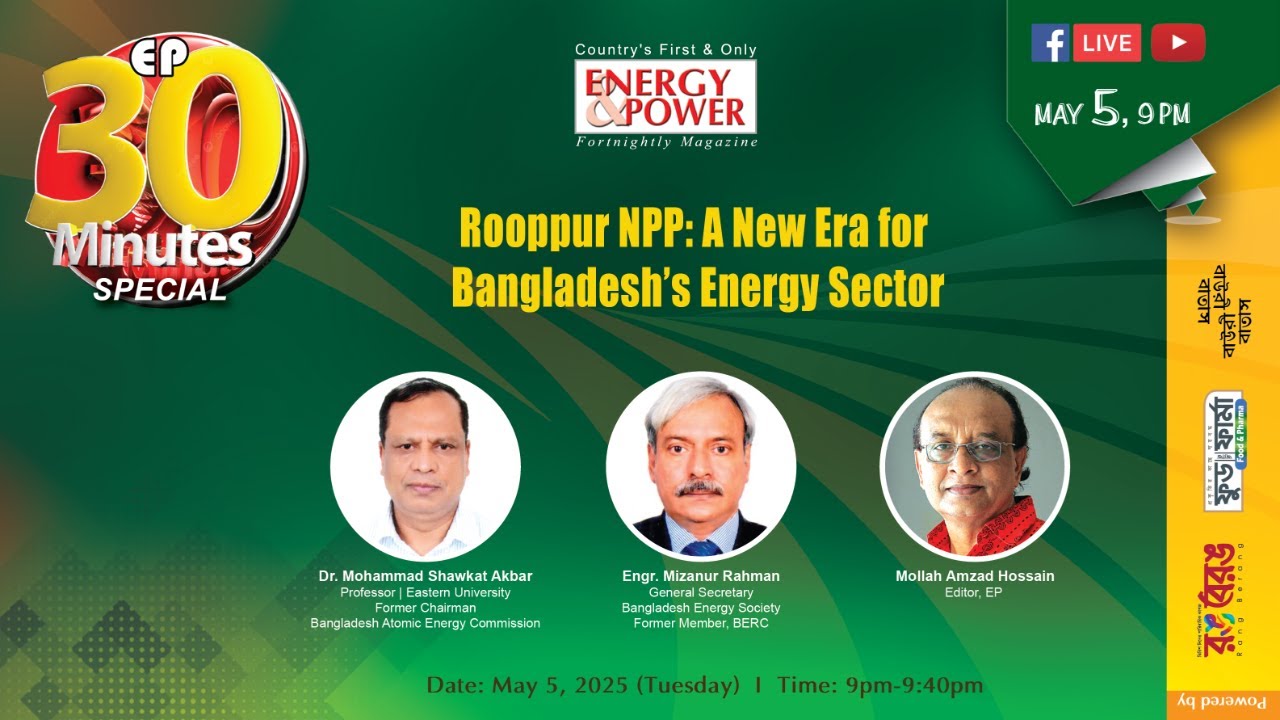
EP 30 Minutes Special 219: Rooppur NPP: A New Era for Bangladesh’s Energy Sector
Keywords
Summary
187 words
Critical Evaluation
Value of the Information & Strength of the Argument
The video provides valuable insights into the Rooppur NPP project, including its strategic importance, cost structure, and operational challenges. The argumentation is solid, based on the experts’ direct involvement in the project. They present a balanced view, acknowledging both the benefits and the concerns, such as the high upfront cost and the need for a skilled workforce. The discussion on the fixed-price contract and the comparison with international projects strengthens the credibility of their claims. However, the lack of specific data and the occasional technical interruptions weaken the overall argumentation.
Scientific Rigor, Source Quality, Title Accuracy
The scientific rigor is moderate, as the experts rely on their professional experience rather than citing specific studies or reports. The quality of sources is limited, with no external references mentioned. The title accurately reflects the content, focusing on the Rooppur NPP and its implications for Bangladesh’s energy sector. The discussion is well-structured, but the lack of citations and the technical issues during the broadcast reduce the overall rigor.
174 words
Title / Content Match
The title accurately reflects the content, which focuses on the Rooppur NPP and its implications for Bangladesh's energy sector.
Quality & Reliability
7/10
The discussion features two experts with direct involvement in the Rooppur project, providing credible insights. However, the lack of citations and the technical interruptions reduce the overall reliability.
Key Moments
Markers derived by PSI from the transcript: the creator did not define chapters.
- Introduction of guests and topic.
- Discussion on the significance of fuel loading and grid connection.
- Analysis of the project cost and comparison with international projects.
- Discussion on the fixed-price contract and its benefits.
- Debate on the cost of electricity generation and the need for a Power Purchase Agreement.
- Discussion on the operational workforce and licensing requirements.
- Strategies for retaining skilled personnel and ensuring long-term operation.
- Potential for expansion with additional units and cost reduction.
- Discussion on small modular reactors (SMRs) and future technology.
- Concluding remarks and summary.
Contribution & Novelties
The video offers a unique perspective on the Rooppur NPP, providing insights from experts directly involved in the project. It highlights the strategic importance of nuclear energy for Bangladesh’s energy security and the challenges of implementing such a complex project. The discussion on the fixed-price contract and the cost comparison with international projects adds value to the understanding of nuclear energy economics.
Pour aller plus loin :
- Nuclear Power in Bangladesh — Provides an overview of the Rooppur project and its background.
- IAEA - Nuclear Power — Official information on nuclear power technology and safety.
- Small Modular Reactors — Overview of SMRs and their potential role in future energy systems.
110 words
Radar Profile
The radar profile shows high scores in quantity of information and reliability, reflecting the detailed discussion and expert opinions. The technical level is moderate, suitable for a general audience. The quality of information is good, but the lack of citations and occasional technical issues slightly reduce the overall score.