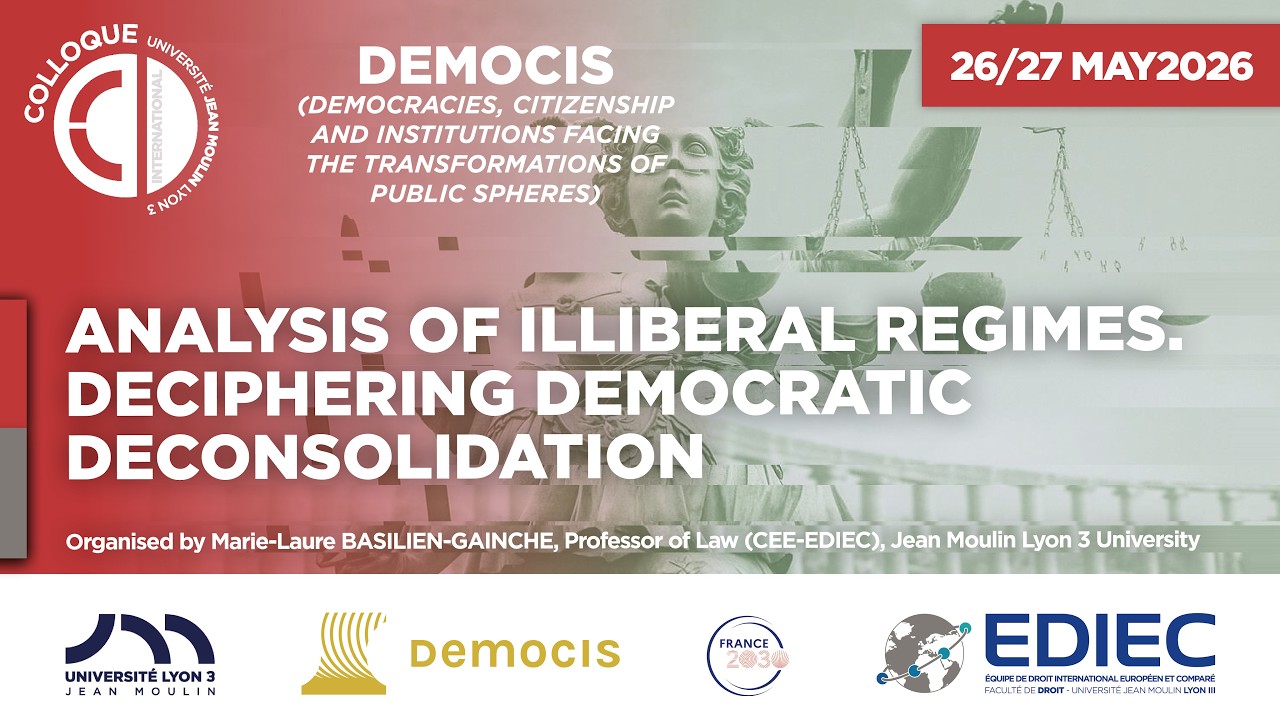
The Illiberal Continuum : Discourses Delegitimising Human Rights
Keywords
Summary
161 words
Critical Evaluation
Value of the Information & Strength of the Argument
The talk provides a valuable conceptual analysis of illiberalism, offering a clear framework to understand its various manifestations. The argument is well-structured, moving from definition to critique of existing concepts, to identification of ideological variants, and finally to a proposal for a deflationary sovereignty. The speaker engages with major political theorists (Strauss, Schmitt, Lefort, Rawls, Habermas, Arendt) and provides a nuanced critique of populism, distinguishing it from oligarchy. The argument is persuasive in its coherence and depth, though it remains at a theoretical level without empirical evidence.
Scientific Rigor, Source Quality, Title Accuracy
The speaker demonstrates scholarly rigor by referencing key thinkers and debates in political philosophy. He explicitly cites Jan-Werner Müller’s definition of illiberalism, engages with Leo Strauss’s critique of Carl Schmitt, and draws on Claude Lefort’s theory of democratic sovereignty. The title accurately reflects the content, which focuses on the continuum of illiberal discourses that delegitimize human rights. The talk is well-organized and the argument is logically developed, though it is an opinion piece rather than a peer-reviewed study.
180 words
Title / Content Match
The title accurately reflects the content, which focuses on the continuum of illiberal discourses that delegitimize human rights.
Quality & Reliability
8/10
The speaker is a professor of philosophy with deep expertise in political theory. The argument is well-structured, references key thinkers (Strauss, Schmitt, Lefort, Rawls, Habermas, Arendt) and provides a nuanced conceptual analysis. However, it is an opinion piece without empirical data or peer review.
Key Moments
Markers derived by PSI from the transcript: the creator did not define chapters.
- Introduction and thanks; speaker outlines his approach as a political philosopher.
- Distinguishes three discursive registers of illiberalism: theoretical, media-effective, and sub-argumentative (memes).
- Defines illiberalism as a continuum of gradual deviation from liberal norms, citing Jan-Werner Müller.
- Argues that illiberalism attacks the shared core of liberalism and democracy: equal fundamental rights.
- Critiques the concepts of 'illiberal democracy' and 'populism', suggesting alternatives like 'electoral authoritarianism'.
- Discusses the historical alignment of liberalism and democracy, referencing Tocqueville and Arendt.
- Introduces the role of sovereignty in illiberal discourse, referencing Carl Schmitt and Leo Strauss.
- Presents the tripartite division of ideologies (conservatism, liberalism, socialism) and their illiberal versions.
- Identifies three contemporary illiberal ideologies: reactionary nationalism, libertarianism, and Leninist revival.
- Proposes a deflationary concept of sovereignty, citing Claude Lefort's idea of the empty place of power.
- Concludes that liberal rights require a social foundation, linking to socialist policy.
Cited Sources
- Jan-Werner Müller, 'Illiberalism' (definition) — Cited for the definition of illiberalism as a continuum of gradual deviation from liberal norms.
- Carl Schmitt, 'The Concept of the Political' — Referenced in the discussion of sovereignty and the critique of liberalism.
- Leo Strauss, critical review of Schmitt's 'The Concept of the Political' — Mentioned in the context of early uses of the term 'illiberal'.
- Claude Lefort, 'The Political Forms of Modern Society' — Referenced for the idea that democratic sovereignty leaves the place of power empty.
- John Rawls, 'A Theory of Justice' — Referenced for the concept of the social basis of self-respect.
- Hannah Arendt, 'The Origins of Totalitarianism' — Referenced for the idea of the right to have rights.
- Jürgen Habermas, 'Between Facts and Norms' — Referenced for the co-originality of human rights and popular sovereignty.
Concurring Sources
- Jan-Werner Müller, 'What Is Populism?' — Müller's work on populism and illiberalism aligns with the speaker's critique of the term 'populism'.
- Steven Levitsky and Daniel Ziblatt, 'How Democracies Die' — Their analysis of democratic erosion through legal means supports the speaker's argument about illiberal regimes.
Dissenting Sources
- Fareed Zakaria, 'The Rise of Illiberal Democracy' — Zakaria's concept of 'illiberal democracy' is explicitly critiqued by the speaker as conceptually flawed.
Contribution & Novelties
The talk offers a fresh conceptual framework for understanding illiberalism as a continuum that attacks the shared core of liberalism and democracy. It critiques common terms like ‘populism’ and ‘illiberal democracy’ and proposes more precise alternatives. The analysis of sovereignty as an imaginary and the proposal for a deflationary concept is a novel contribution. The talk also highlights the social foundation of liberal rights, linking to socialist policy.
Pour aller plus loin :
- Illiberalism — Provides an overview of the concept and its usage.
- Populism — Discusses the term’s ambiguity and historical examples.
- Sovereignty — Explores the concept and its various interpretations.
- Claude Lefort — Background on the philosopher whose ideas on democratic sovereignty are central to the talk.
- Carl Schmitt — Context for the discussion of sovereignty and the political.
131 words
Radar Profile
The radar profile shows high scores in quality of information, technical level, and reliability, reflecting the speaker's expertise and the depth of the argument. The quantity of information is moderate, as the talk is a focused theoretical exposition rather than a comprehensive survey.