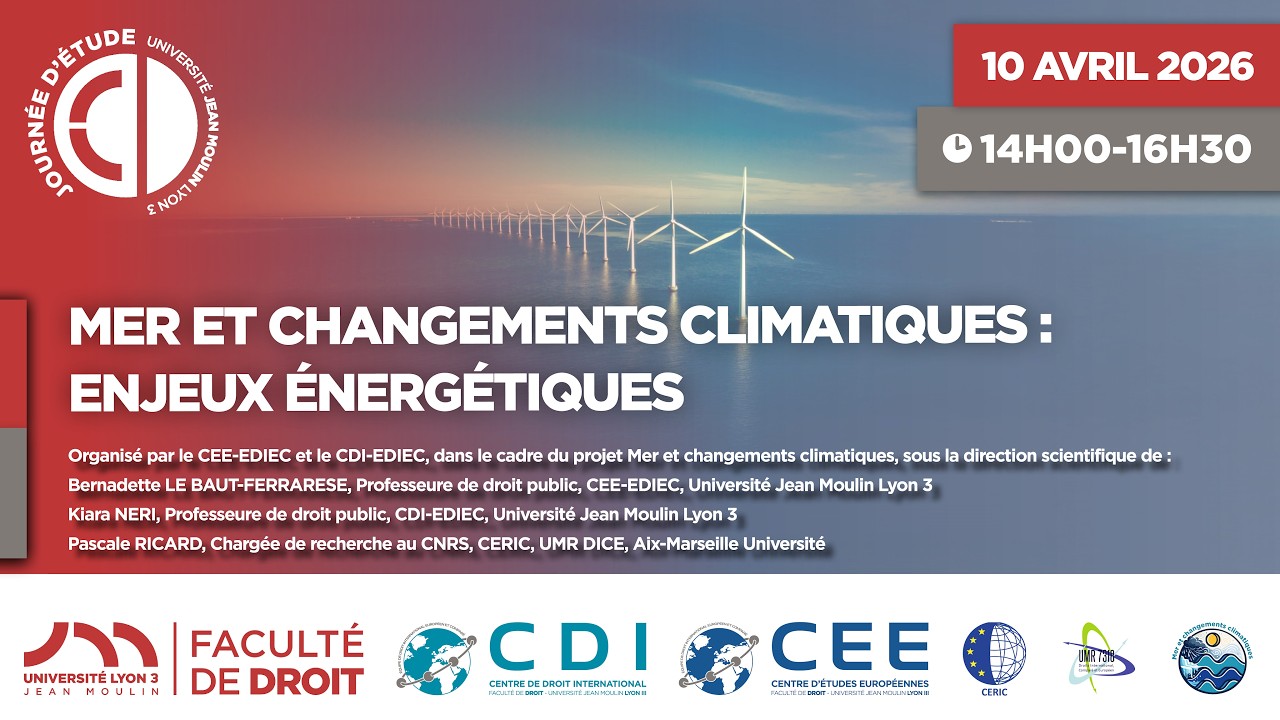
MCC : Enjeux énergétiques | La place des énergies marines dans les COP climat (…)
Keywords
Summary
188 words
Critical Evaluation
Value of the Information & Strength of the Argument
The presentation provides a valuable overview of the legal and policy landscape regarding marine renewable energies in international climate governance. It synthesizes information from COP decisions and NDCs, offering concrete examples from various countries. The argumentation is structured and logical, progressing from the general legal framework to specific COP outcomes and then to national contributions. However, the analysis is somewhat descriptive rather than critical, and the speaker’s personal opinions are occasionally presented without strong supporting evidence. The discussion of the legal status of NDCs is insightful, but the potential implications could be explored more deeply.
Scientific Rigor, Source Quality, Title Accuracy
The presentation demonstrates a reasonable level of scientific rigor, relying on official documents such as COP decisions, the Paris Agreement, and NDCs, as well as academic works like the thesis of Séverine Michalac and an article by Hugio. The sources are relevant and cited appropriately, though not all are explicitly referenced in the video. The title accurately reflects the content, focusing on the place of marine energies in COP climate conferences and national contributions. The presentation is well-structured and the speaker’s arguments are generally coherent, though some legal interpretations could be more nuanced.
203 words
Title / Content Match
The title accurately reflects the content, which focuses on the role of marine energies in COP climate conferences and national contributions.
Quality & Reliability
6/10
The presentation is based on official documents (COP decisions, Paris Agreement, national contributions) and academic references, but the speaker is a master's student and the content is partly a personal analysis. The legal interpretation is generally sound but lacks depth in some areas.
Key Moments
Markers derived by PSI from the transcript: the creator did not define chapters.
- Introduction and thanks
- Context: IPCC report on ocean warming
- Legal framework: UNCLOS and EU directive
- Overview of marine energy technologies
- France's role and projects
- Analysis of COP decisions (COP21-COP28)
- COP27 ocean initiatives
- NDCs: EU and Canada examples
- NDCs: Australia and fossil fuel producers
- Legal status of NDCs and conclusion
Cited Sources
- Paris Agreement — Referenced as the main international climate agreement, particularly articles 2, 3, 4.2, 4.8, 4.9, and 13.
- UNCLOS (United Nations Convention on the Law of the Sea) — Article 56 on sovereign rights in the EEZ is cited as the legal basis for exploiting marine resources.
- EU Directive 2009/28/EC on renewable energy — Defines marine renewable energy and includes it in the scope of renewable sources.
- IPCC Sixth Assessment Report — Cited for data on ocean warming and human influence.
- Thèse de Séverine Michalac sur les énergies marines renouvelables — Mentioned as a reference for legal specificities of marine energies.
- Article de Hugio sur les contributions déterminées au niveau national — Cited for the legal status of NDCs as unilateral state acts.
Concurring Sources
- IRENA: Ocean energy overview — Provides data on the potential and development of marine energy, supporting the presentation's claims.
- IEA: Offshore Wind Outlook 2019 — Highlights the growth of offshore wind, a key marine energy technology.
Dissenting Sources
- Some experts argue that marine energy is not cost-effective compared to other renewables — The presentation does not address the economic challenges of marine energy, which some studies highlight.
Contribution & Novelties
This presentation offers a focused analysis of the often-overlooked role of marine renewable energies in international climate law, synthesizing COP decisions and NDCs. It highlights the gap between the potential of marine energies and their minimal presence in climate governance, and discusses the legal implications of NDCs as unilateral acts. The speaker suggests that the ICJ advisory opinion could be leveraged to hold states accountable for insufficient action on marine energy.
Pour aller plus loin :
- Paris Agreement — The central legal framework for international climate action.
- UNCLOS — The legal basis for ocean governance and resource exploitation.
- IPCC Special Report on the Ocean and Cryosphere — Provides scientific evidence on ocean-climate interactions.
- IRENA reports on ocean energy — Offers data and analysis on marine energy potential.
- ICJ Advisory Opinion on Climate Change — The opinion referenced in the presentation, which may clarify state obligations.
145 words
Radar Profile
The radar profile shows a balanced but moderate performance across all dimensions. The quantity of information is relatively high, but the quality and technical depth are moderate, reflecting the presentation's descriptive nature. The reliability is moderate, as the speaker is a student and relies on secondary sources. The overall score is average, indicating a useful but not exceptional contribution.
💬 No comments were provided for analysis.