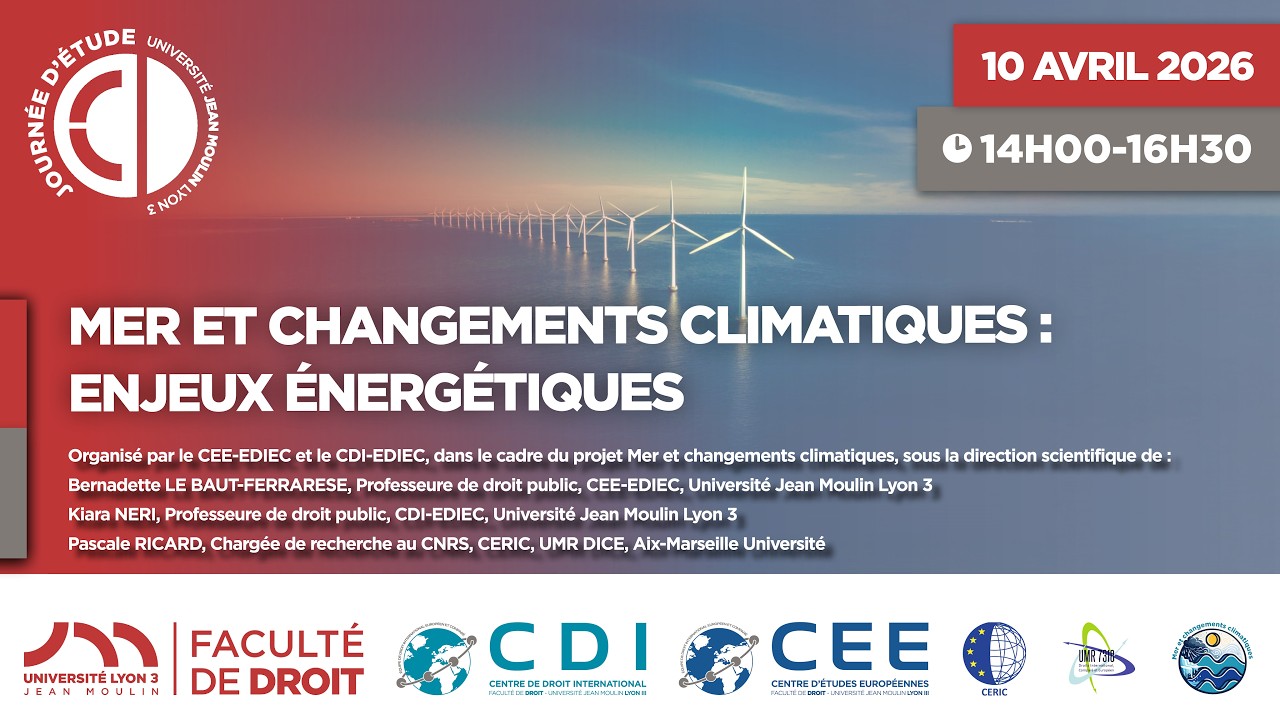
MCC : Enjeux énergétiques | Production d’énergie renouvelable en mer et catégorisation juridique
Keywords
Summary
191 words
Critical Evaluation
Value of the Information & Strength of the Argument
The lecture provides a valuable analysis of the legal complexities surrounding marine renewable energy, offering a clear conceptual framework for understanding how law categorizes and regulates this emerging field. The argumentation is well-structured, moving from general principles of legal categorization to specific examples and case law. The speaker effectively demonstrates the tensions between different categorization criteria (source-based vs. spatial) and illustrates these with concrete legal texts and judicial decisions. However, the argumentation is primarily descriptive and analytical, without proposing a normative solution or engaging with counterarguments in depth. The value lies in its systematic exploration of a niche but important legal question, which is relevant for scholars and practitioners in energy law and law of the sea.
Scientific Rigor, Source Quality, Title Accuracy
The lecture demonstrates scientific rigor through its reliance on primary legal sources, including EU directives (RED I and RED II), French codes (Code de l’énergie, Code des assurances), and case law from the Conseil d’État. The speaker cites specific articles and decrees, and references academic works and institutional reports. However, the presentation does not include a formal bibliography, and some references are mentioned only in passing. The title accurately reflects the content, as the lecture focuses on the legal categorization of marine renewable energy production. The content is consistent with the title, and the speaker’s expertise is evident. The lecture is part of an academic conference, which adds to its credibility.
243 words
Title / Content Match
The title accurately reflects the content: the lecture focuses on the legal categorization of marine renewable energy production, as part of a broader conference on energy challenges.
Quality & Reliability
8/10
The presentation is grounded in legal doctrine and positive law, with references to EU directives, French codes, and case law. The speaker is a professor of public law, and the content is part of an academic conference. However, the talk is an expert opinion rather than a peer-reviewed study, and some references are cited without full bibliographic details.
Key Moments
Markers derived by PSI from the transcript: the creator did not define chapters.
- Introduction by Kiara Neri, presentation of the speaker and topic.
- Bernadette Le Baut-Ferrarese begins her talk, explaining the importance of legal categorization.
- Discussion of the definition of renewable energy in EU directives and French law.
- Introduction of the two approaches to categorizing marine renewable energy: 'marine energy' vs. 'renewable energy at sea'.
- Analysis of the limitations of the 'marine energy' category, including exclusion of offshore wind.
- Examination of the spatial criterion and its use in legal texts.
- Discussion of the unification of legal regimes, focusing on litigation centralization and authorization procedures.
- Examples of case law from the Conseil d'État regarding jurisdiction over marine renewable energy disputes.
- Conclusion summarizing the findings and acknowledging the fragmented nature of the legal framework.
Cited Sources
- Directive (EU) 2018/2001 on the promotion of the use of energy from renewable sources (RED II) — Cited as the EU directive that defines renewable energy and includes a list of sources, including marine energy.
- Code de l'énergie (French Energy Code) — Cited as the French legal text that transposes the EU definition of renewable energy.
- Convention on the Law of the Sea (UNCLOS) — Mentioned as the international framework governing maritime spaces and activities.
- Conseil d'État decisions on marine renewable energy — Referenced in the lecture as examples of case law on jurisdiction over marine renewable energy disputes.
Concurring Sources
- Directive (EU) 2018/2001 (RED II) — Supports the definition and categorization of renewable energy sources, including marine energy.
- United Nations Convention on the Law of the Sea — Provides the legal framework for maritime spaces, which is relevant to the spatial categorization of marine renewable energy.
Dissenting Sources
- Potential conflicting interpretations of 'marine energy' in legal texts — The lecture highlights inconsistencies in legal texts, such as the exclusion of offshore wind from the 'marine energy' category in some definitions, which may conflict with other legal instruments.
Contribution & Novelties
The lecture offers a novel contribution by systematically analyzing the legal categorization of marine renewable energy, highlighting the tensions between source-based and spatial criteria. It provides a comprehensive overview of the current legal framework and identifies gaps and inconsistencies. The speaker’s expertise in energy law adds depth to the analysis.
Pour aller plus loin :
- Directive (EU) 2018/2001 (RED II) — The primary EU legal instrument defining renewable energy and its categories.
- United Nations Convention on the Law of the Sea — The foundational treaty for the law of the sea, relevant to the spatial categorization of marine activities.
- French Energy Code (Code de l’énergie) — The national legal framework for energy, including renewable energy definitions and regimes.
118 words
Radar Profile
The radar profile shows high scores in quality of information and reliability, reflecting the speaker's expertise and use of legal sources. The quantity of information is moderate, as the lecture is focused and not exhaustive. The technical level is high, indicating a specialized audience. Overall, the profile suggests a well-founded and rigorous presentation.
💬 No comments were provided for analysis.