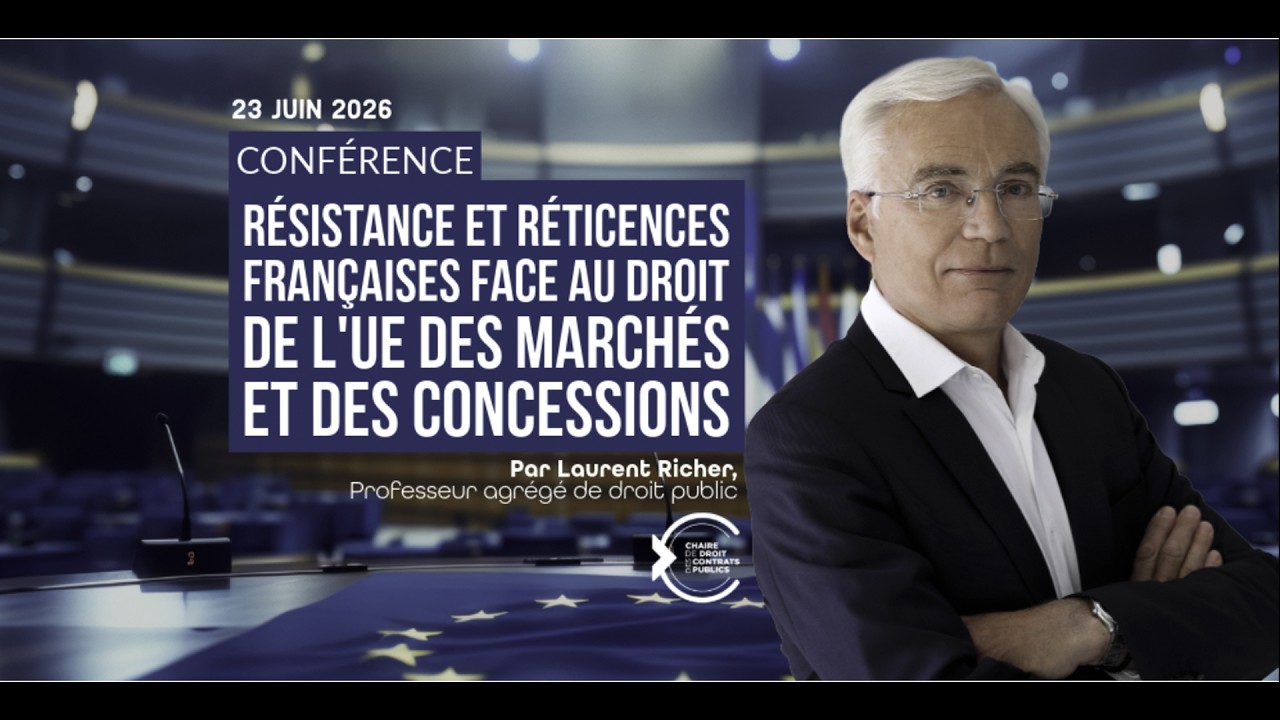
Résistance et réticences françaises face au droit de l'UE des marchés et concessions
Keywords
Summary
193 words
Critical Evaluation
Value of the Information & Strength of the Argument
The lecture provides valuable insights into the complex relationship between French law and EU procurement directives, drawing on the speaker’s personal experience and legal expertise. Richer presents a balanced argument, acknowledging France’s general compliance while highlighting specific instances of resistance and their justifications. He supports his points with concrete examples, such as the insurance sector’s practical difficulties and the evolution of legal services. The argumentation is well-structured, moving from resistance to adoption to resistance to application, and concludes with a nuanced reflection on the legitimacy of certain resistances. The value lies in its insider perspective and the identification of ongoing tensions that may inform future reforms.
Scientific Rigor, Source Quality, Title Accuracy
The lecture demonstrates scientific rigor through the citation of specific legal cases, directives, and dates, reflecting the speaker’s deep knowledge. However, as an oral presentation, it lacks formal citations and references. The title accurately reflects the content, focusing on French resistance and reluctance. The description provided by the channel includes a link to the event page, which serves as a source. The lecture is an expert opinion, not a peer-reviewed study, but its authority is high given the speaker’s credentials. The adequacy between title and content is strong, with the lecture directly addressing the theme.
216 words
Title / Content Match
The title accurately reflects the content, which focuses on French resistance and reluctance towards EU public procurement law.
Quality & Reliability
8/10
The speaker is a distinguished professor emeritus of public law with extensive experience in public procurement law. The lecture is based on personal involvement and legal expertise, citing specific cases and legal developments. However, it is an opinion-based lecture without formal citations or peer review.
Key Moments
Markers derived by PSI from the transcript: the creator did not define chapters.
- Introduction by François Lichère and Pablo, welcoming Laurent Richer.
- Richer begins his lecture, outlining the topic and France's general compliance with EU directives.
- Discussion of resistance to adoption, focusing on insurance contracts and the arguments against applying procurement rules.
- Analysis of legal services sector, including the Conseil d'État's rulings and the impact of the 2014 directive.
- Examination of development concessions and the Telaustria ruling, leading to French attempts to avoid transparency.
- Discussion of resistance to application, including the self-cleaning case and the CJEU ruling.
- Richer reflects on whether resistance is sometimes justified, citing practical difficulties in insurance and legal services.
- Conclusion and opening for questions from the audience.
Cited Sources
- Event page: Résistance et réticences françaises face au droit de l'UE des marchés et concessions — Official page of the conference providing details and context.
Concurring Sources
- Event page — Confirms the event details and the speaker's credentials.
Contribution & Novelties
The lecture offers a unique insider perspective on the historical and practical aspects of French resistance to EU procurement law, drawing on the speaker’s personal involvement. It highlights specific sectors where resistance was arguably justified and suggests potential areas for reform in future directives.
Pour aller plus loin :
- Directive 2014/24/EU on public procurement — Key legal text governing public procurement in the EU.
- Telaustria case (C-324/98) — Landmark CJEU ruling on transparency obligations for concessions.
- Conseil d’État decisions — French administrative court rulings relevant to public procurement and EU law.
91 words
Radar Profile
The radar profile shows high scores in information quantity, quality, technical level, and reliability, indicating a well-rounded and authoritative lecture. The speaker's expertise and the detailed case analysis contribute to a strong overall assessment.