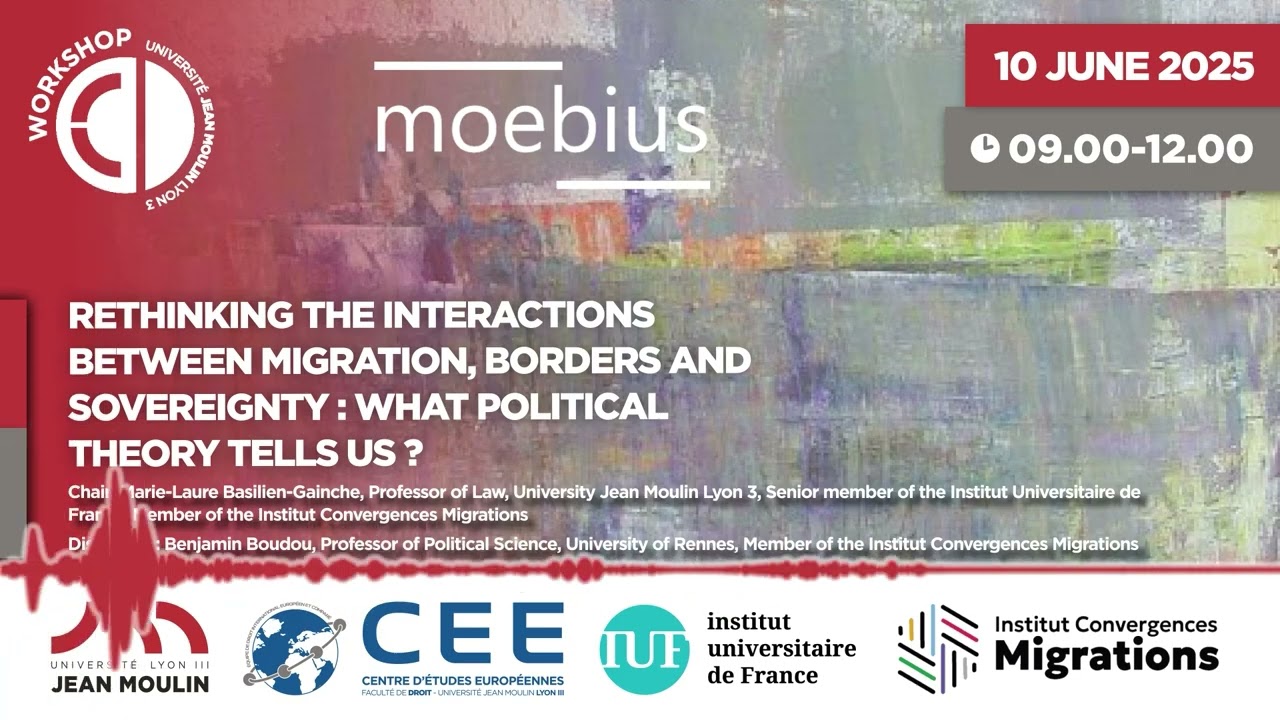
Rethinking the Interactions between Migration, Borders and Sovereignty
Keywords
Summary
142 words
Critical Evaluation
Value of the Information & Strength of the Argument
The value of the information is high, as it provides a nuanced theoretical analysis of migration and sovereignty, drawing on contemporary political theory and legal perspectives. The argumentation is solid, with each presenter offering a structured and well-reasoned case. For instance, Jules Lepoutre’s presentation on citizenship exclusion is particularly compelling, using comparative case studies to illustrate different models of exclusion. The discussions are grounded in established theoretical frameworks, such as the boundary problem and democratic theory, and they effectively challenge conventional assumptions about state sovereignty and migration. The panel successfully bridges normative and empirical approaches, offering insights that are both academically rigorous and practically relevant.
Scientific Rigor, Source Quality, Title Accuracy
The scientific rigor is evident in the academic credentials of the speakers and the structured format of the workshop. The sources referenced are primarily theoretical and legal, with mentions of scholars like Rousseau, Jellinek, and Montesquieu, as well as references to EU legal frameworks. The quality of sources is high, though the video itself does not provide direct citations or a bibliography. The title accurately reflects the content, which is a focused exploration of the interactions between migration, borders, and sovereignty. The adéquation between title and content is strong, as the presentations directly address these themes. No comments were provided for analysis.
222 words
Title / Content Match
The title accurately reflects the content, which explores the theoretical interactions between migration, borders, and sovereignty through multiple scholarly perspectives.
Quality & Reliability
8/10
The video features academic presentations by established scholars in political theory and law, with a structured panel format. The arguments are well-reasoned and grounded in theoretical frameworks, though the content is primarily opinion and analysis rather than empirical research. The lack of formal citations in the video itself is compensated by the academic context and the detailed description.
Key Moments
Markers derived by PSI from the transcript: the creator did not define chapters.
- Introduction by Marie-Laure Basilien-Gainche, outlining the workshop's purpose and the MOEBIUS project.
- Jules Lepoutre begins his presentation on citizenship exclusion, introducing the concept of two borders: territorial and membership.
- Lepoutre discusses the case of Monaco as an aristocratic model of citizenship, highlighting low naturalization rates and jus sanguinis.
- Lepoutre analyzes Austria as an ethnocultural model, with restrictive naturalization and expansive citizenship for ethnic Germans abroad.
- Lepoutre examines Estonia as a strategic model, focusing on the concept of regional minority majorities and the exclusion of Russian-speaking populations.
- Discussion and Q&A session begins, with questions from the audience.
- Denis Duez presents on filtering, sorting, and excluding at the EU's external borders, discussing the reconfiguration of European sovereignties.
- Duez elaborates on the new screening procedures and the concept of 'fiction of non-entrée'.
- Further presentations and discussions continue, with a focus on the ethical implications of border control.
Cited Sources
- MOEBIUS Project — The workshop is part of the MOEBIUS project, which explores sovereignty and migration in Europe.
Concurring Sources
- MOEBIUS Project — The project's website provides additional context and resources related to the workshop.
Contribution & Novelties
The workshop provides a novel interdisciplinary perspective on migration and sovereignty, integrating political theory, law, and empirical case studies. It challenges traditional views by highlighting the ethical and normative dimensions of border control and citizenship exclusion. The presentations offer fresh insights into how states justify exclusionary practices and the implications for democratic theory.
Pour aller plus loin :
- Boundary Problem in Political Theory — Relevant to the discussion of the boundary problem and citizenship.
- Jus Sanguinis — Key concept in understanding citizenship acquisition by descent.
- Sovereignty — Central to the workshop’s theme.
- Migration Ethics — Stanford Encyclopedia of Philosophy entry on immigration ethics, relevant to the normative discussions.
108 words
Radar Profile
The radar profile shows high scores in quantity and quality of information, with a slightly lower but still strong technical level. The overall reliability is high, reflecting the academic rigor of the presentations. The profile suggests a well-balanced and informative workshop.