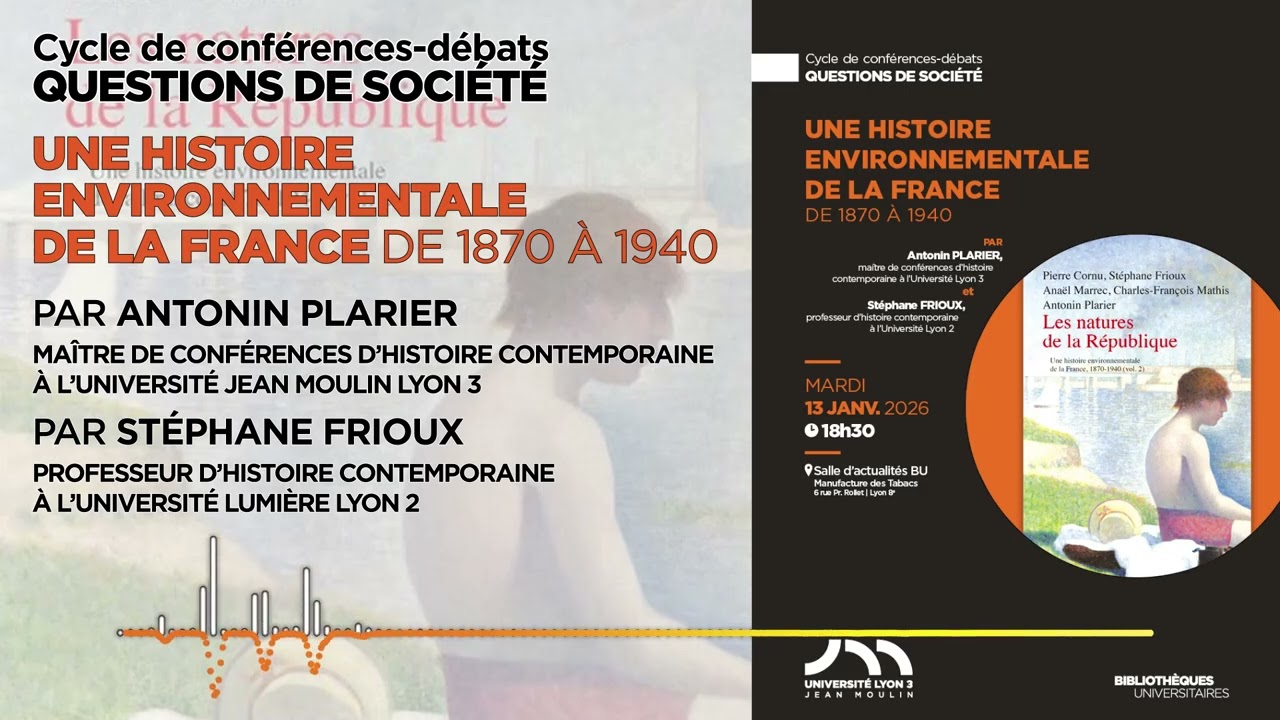
BU | Conférence : Une histoire environnementale de la France, 1870 à 1940 - A. Plarier et S. Frioux.
Keywords
Summary
131 words
Critical Evaluation
Value of the Information & Strength of the Argument
The value of the information is high, as it provides a synthesis of recent research in environmental history, a field that has grown significantly. The speakers present concrete examples, such as the artesian well in the Sahara and the demographic impact of colonial conquest, to illustrate their arguments. The argumentation is solid, based on their own research and the collective work of the book. They acknowledge historiographical debates and the limitations of sources, which strengthens their credibility. The discussion of the gap between environmental projects and their outcomes is particularly insightful, showing a nuanced understanding of colonial environmental history.
108 words
Title / Content Match
The title accurately reflects the content: a conference on the environmental history of France from 1870 to 1940, presented by the two authors.
Quality & Reliability
8/10
The conference is delivered by two academic historians (maître de conférences and professor) specializing in contemporary history, presenting their collective work. The content is based on recent historiographical research and primary sources, but it is a presentation rather than a peer-reviewed article, and some claims (e.g., demographic estimates) are debated.
Key Moments
Markers derived by PSI from the transcript: the creator did not define chapters.
- Introduction by Lionel Mignot, presentation of the speakers and the book.
- Stéphane Frioux contextualizes the emergence of environmental history in France.
- Antonin Plarier explains the reasons for the book: historiographical actuality, teaching needs, and ecological urgency.
- Discussion of the colonial empire and its environmental impact, starting with the artesian well anecdote.
- The environmental shock of colonial conquest, including demographic decline and famine in Algeria.
- Land appropriation and the 'ruée vers la terre' in colonies, with examples from AEF and Algeria.
- The gap between environmental projects and their outcomes, illustrated by the Sahara lake project.
- Transition to the metropolitan France, urbanization, and hygiene issues.
- Discussion of pollution and regulation in cities.
- Conclusion and invitation for questions.
Cited Sources
- Conférences-débats Questions de société - Bibliothèques Universitaires Lyon 3 — Page describing the conference series, mentioned in the video description.
Concurring Sources
- EHNE - Encyclopédie d'histoire numérique de l'Europe — Mentioned by Stéphane Frioux as a resource with many environmental history articles.
Contribution & Novelties
The conference provides a synthesis of recent research in environmental history, offering a new perspective on the Third Republic by integrating environmental concerns. It highlights the importance of colonial history and the connections between metropolitan and colonial environments. The speakers emphasize the gap between environmental projects and their outcomes, and the need to consider the environmental impact of modernization.
Pour aller plus loin :
- Environmental history — Provides an overview of the field.
- Third French Republic — Contextualizes the period.
- French colonial empire — Relevant to the colonial aspects discussed.
90 words
Radar Profile
The radar profile shows high scores in information quantity, quality, technical level, and reliability, indicating a well-informed and credible presentation. The balance across dimensions suggests a comprehensive and rigorous talk.