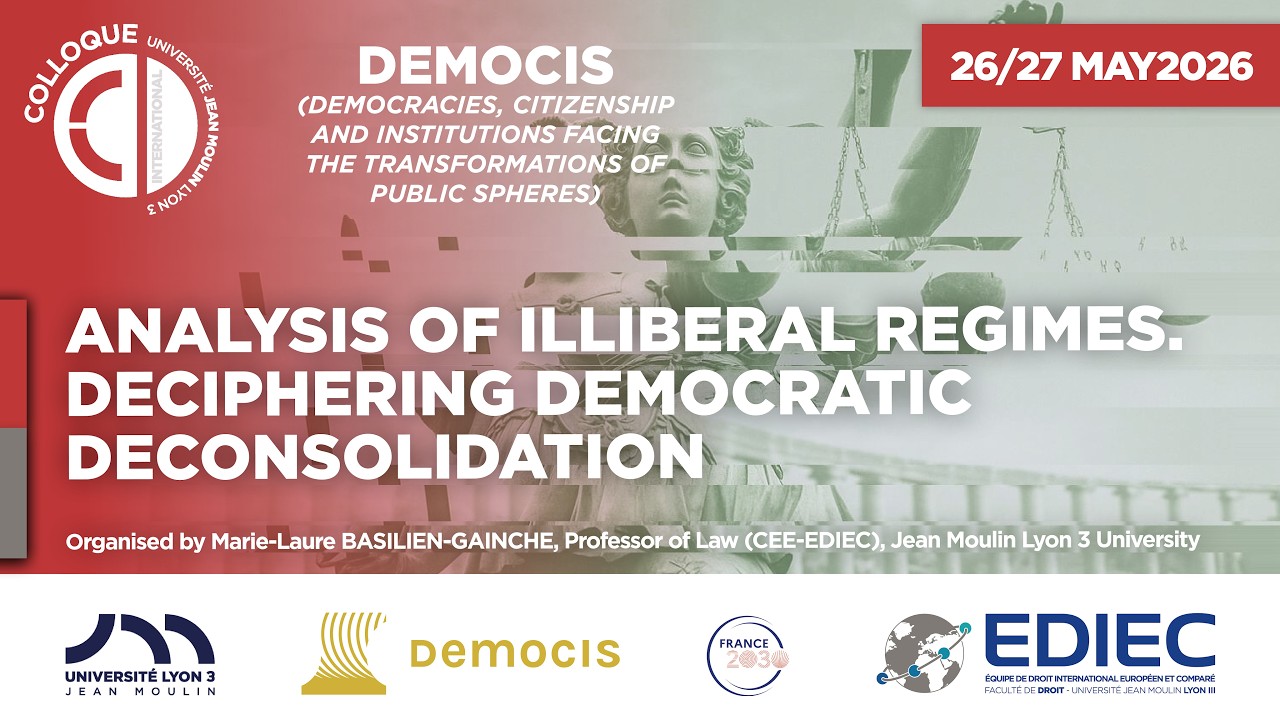
Restoring the Rule of Law Post Backsliding in a European Context
Keywords
Summary
199 words
Critical Evaluation
Value of the Information & Strength of the Argument
The presentation offers valuable insights into the legal tools available for restoring the rule of law, particularly through the case law of the European Court of Justice and the European Court of Human Rights. The speaker’s argumentation is solid, grounded in specific examples and recent judgments. He effectively uses the shield/sword/torch metaphor to structure the discussion, making complex legal concepts accessible. He also provides a critical analysis of the Venice Commission’s approach, contrasting it with the more assertive stance of the European courts. The argument is nuanced, acknowledging the limitations of legal solutions and the need for political will.
Scientific Rigor, Source Quality, Title Accuracy
The presentation demonstrates high scientific rigor, with references to specific court cases, institutional reports (e.g., World Justice Project), and the Venice Commission’s checklist. The speaker is a recognized expert, and his arguments are well-supported. The title accurately reflects the content, focusing on the European context and the restoration of the rule of law. The presentation is part of an academic conference, adding to its credibility. No comments were provided for analysis.
185 words
Title / Content Match
The title accurately reflects the content: the speaker focuses on legal mechanisms for restoring the rule of law in post-backsliding European countries.
Quality & Reliability
8/10
Presentation by a recognized academic expert (Professor of Law at University College Dublin) with extensive references to European court case law and institutional reports. The argumentation is structured and nuanced, though it reflects the author's own interpretive stance.
Key Moments
Markers derived by PSI from the transcript: the creator did not define chapters.
- Introduction: the panel on solutions to reverse illiberal regimes.
- Presentation of the three metaphors: shield, sword, torch.
- Definition of rule of law backsliding and focus on judicial independence.
- Discussion of the global rule of law recession and Hungary's case.
- Impact of backsliding on the case law of European courts.
- Critique of the Venice Commission's checklist and examples of recent ECHR rulings.
- Conclusion: legal tools are necessary but not sufficient for restoration.
Cited Sources
- World Justice Project Rule of Law Index — Referenced as the source for the global rule of law recession.
- Venice Commission Rule of Law Checklist — Mentioned as the source of the checklist criticized by the speaker.
- European Court of Human Rights — Referenced for its judgments and interim measures in Polish cases.
- Court of Justice of the European Union — Referenced for its case law on rule of law and judicial independence.
Concurring Sources
- World Justice Project Rule of Law Index — Supports the claim of a global rule of law recession.
- Venice Commission Rule of Law Checklist — Provides the official checklist that the speaker critiques.
Dissenting Sources
- Venice Commission Rule of Law Checklist — The speaker argues that the checklist's approach is overly cautious and does not fully align with the case law of European courts.
Contribution & Novelties
The presentation offers a novel framework (shield, sword, torch) for using European court case law in post-backsliding contexts, and provides a critical assessment of the Venice Commission’s approach. It highlights recent developments in the case law that offer concrete guidance for restoration efforts.
Pour aller plus loin :
- Rule of Law Checklist — The Venice Commission’s checklist, which the speaker critiques.
- World Justice Project Rule of Law Index — Data on global rule of law trends.
- European Court of Human Rights - Pilot Judgments — Explanation of the pilot judgment procedure used in the Polish case.
96 words
Radar Profile
The radar profile shows high scores in information quantity, quality, and reliability, with a slightly lower technical level, indicating a well-substantiated expert presentation that is accessible to a broad academic audience.