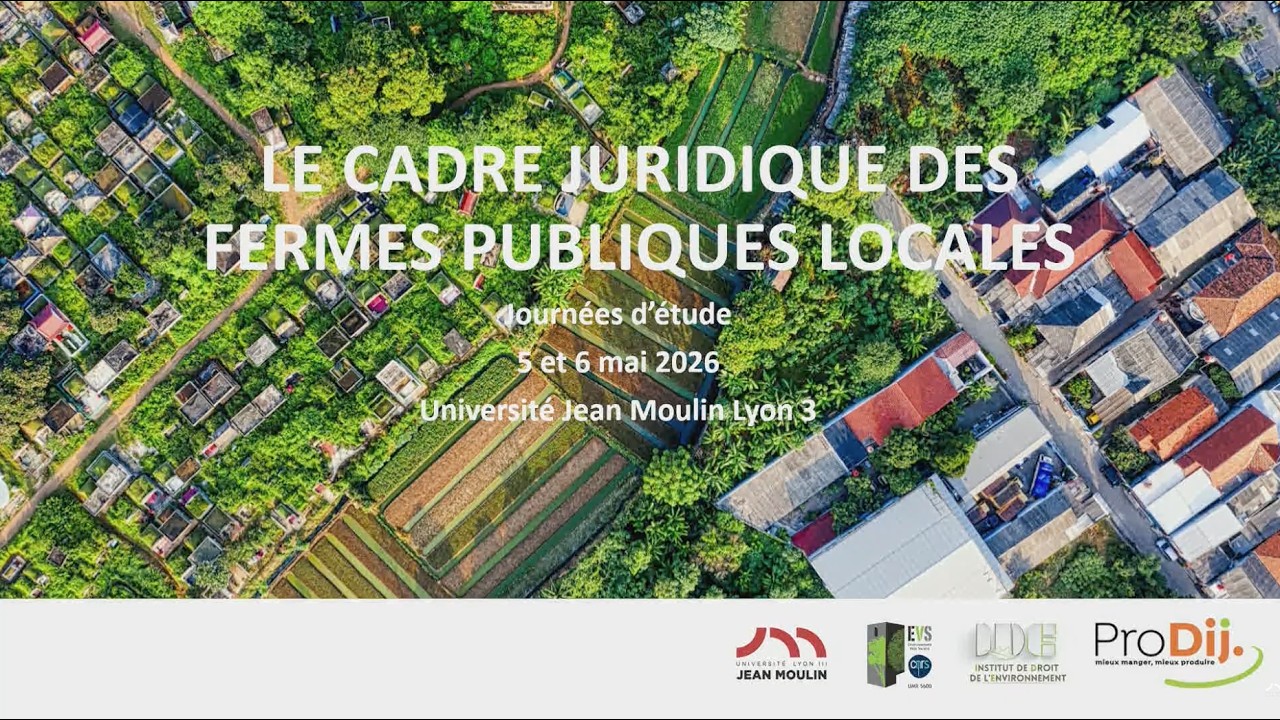
09 - Les biens affectés à une ferme publique locale, un fonds administratif agricole ?
Keywords
Summary
169 words
Critical Evaluation
Value of the Information & Strength of the Argument
The lecture provides a valuable and nuanced analysis of the legal framework applicable to local public farms. The speaker demonstrates a deep understanding of public property law and its application to a novel context. He carefully distinguishes between different legal situations (public vs. private property, direct management vs. delegation) and highlights the practical consequences of each. The argumentation is solid, based on legal doctrine and case law (e.g., the ‘arrêt Aprei’ and the ‘arrêt Vallée du Bail’ are mentioned). The speaker also introduces an original theoretical perspective with the concept of ‘fonds administratif’, which adds depth to the discussion. However, the presentation is somewhat exploratory and does not provide definitive answers, which is acknowledged by the speaker.
Scientific Rigor, Source Quality, Title Accuracy
The lecture is rigorous in its legal reasoning and demonstrates a strong command of the subject. The speaker references his own doctoral thesis and mentions relevant legal provisions (e.g., Article L.2111-1 of the General Code of Public Property) and case law. The title is accurate and reflects the content well. The presentation is well-structured, moving from practical legal questions to a more theoretical reflection. The speaker also connects the topic to broader issues of ecological transition and social metabolism, which enriches the discussion. However, the lecture is an opinion piece rather than a systematic review, and the sources are not formally cited.
234 words
Title / Content Match
The title accurately reflects the content: the lecture examines whether the assets of a local public farm can be considered an 'administrative fund' (fonds administratif), a doctrinal concept.
Quality & Reliability
7/10
The speaker is a law professor (maître de conférences) with a doctoral thesis on public property law. The presentation is well-structured, references legal concepts and case law, and is delivered in an academic setting. However, it is an opinion/expert lecture without formal citations or peer review, and some parts are exploratory.
Key Moments
Markers derived by PSI from the transcript: the creator did not define chapters.
- Introduction by the session chair and presentation of the speaker.
- The speaker introduces his research background and the concept of 'social metabolism'.
- Discussion of the legal categories for the assets of a local public farm: public vs. private property.
- Explanation of the implications of public domain: inalienability and unsaisissability.
- Analysis of the possibility of the farm being classified as a public service and the consequences for the assets.
- Introduction of the concept of 'fonds administratif' and its application to local public farms.
- Comparison with the legal notion of 'fonds agricole' and discussion of the potential benefits and limitations.
- Conclusion and final remarks.
Cited Sources
- Thèse de doctorat : Les personnes publiques propriétaires — The speaker refers to his own doctoral thesis defended at Lyon 3 in 2014, which develops the concept of 'fonds administratif'.
- Code général de la propriété des personnes publiques (CGPPP) — The speaker references Article L.2111-1 of the CGPPP, which defines the criteria for public domain classification.
- Arrêt Aprei (CE, 2007) — The speaker mentions the case law on the importance of the activity's role in the public service for qualification as a public service.
- Arrêt Vallée du Bail (CE) — The speaker refers to this case to illustrate the concept of 'biens de retour' in concessions.
Concurring Sources
- Code général de la propriété des personnes publiques — The legal framework for public property, which the speaker relies on for the classification of assets.
Contribution & Novelties
The lecture offers an original perspective by applying the doctrinal concept of ‘fonds administratif’ to local public farms, which is a novel approach. It also connects the legal analysis to broader issues of ecological transition and social metabolism, highlighting the potential role of public farms in sustainable food systems. The speaker’s emphasis on the need for a coherent legal framework for these farms is a valuable contribution.
Pour aller plus loin :
- Droit de la domanialité publique — Provides an overview of the French legal framework for public domain.
- Fonds agricole — Explains the legal concept of agricultural fund in French law.
- Service public — Discusses the notion of public service in French administrative law.
- Écologie sociale — Introduces the concept of social ecology, which the speaker uses to frame his analysis.
132 words
Radar Profile
The radar profile shows high scores in technical level and information quality, reflecting the speaker's expertise and the depth of the legal analysis. The quantity of information is moderate, as the lecture is relatively short and focuses on specific aspects. The overall reliability is good, but the lack of formal citations and the exploratory nature of some parts slightly reduce the score.