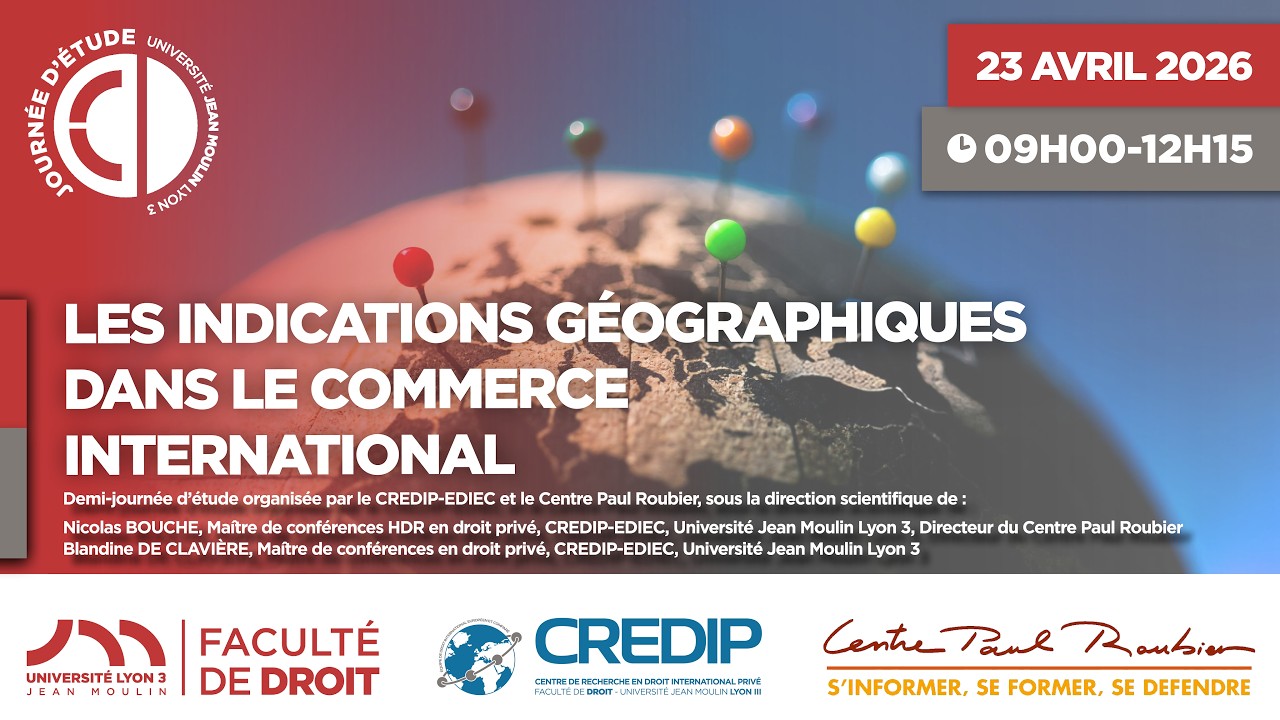
La protection des indications géographiques européennes en Chine
Keywords
Summary
139 words
Critical Evaluation
Value of the Information & Strength of the Argument
The presentation provides valuable insights into the Chinese legal framework for geographical indications, offering specific statistics and case law. The argumentation is solid, based on legal provisions and judicial decisions. The speakers demonstrate a deep understanding of the subject, and the use of examples like Champagne and Cognac illustrates the practical application of the law. The discussion is well-structured, moving from general principles to specific cases, and concludes with trends and future directions.
Scientific Rigor, Source Quality, Title Accuracy
The presentation is rigorous, relying on legal texts, international agreements, and court cases. The speakers are academics from a prestigious university, lending credibility. The title accurately reflects the content. No external sources are cited, but the presentation is based on the speakers’ expertise and official legal documents. The Q&A session adds depth, addressing nuances such as genericide. Overall, the scientific rigor is high, though the lack of formal citations may be a minor limitation.
162 words
Title / Content Match
The title accurately reflects the content, which focuses on the protection of European geographical indications in China, covering both the legal framework and practical cases.
Quality & Reliability
8/10
The presentation is given by academics from Tsinghua University, a top Chinese university, and is part of an academic conference. It provides a detailed overview of the Chinese legal framework for geographical indications, including specific cases and statistics. The information appears reliable and well-structured, though it is based on the speakers' expertise and not peer-reviewed publications.
Key Moments
Markers derived by PSI from the transcript: the creator did not define chapters.
- Introduction to the presentation and the speakers' backgrounds.
- Overview of the two systems for GI protection in China: trademark and GI product.
- Historical evolution of GI protection in China, including key regulations and international treaties.
- Recognition of foreign GIs in China, including the Champagne case and bilateral agreements with the EU.
- Detailed comparison of the two systems and their respective protection mechanisms.
- Case studies on confusion and dilution in trademark law, including the Seven Star Sparkling Shampagne case.
- Case study on legitimate use and the requirements for using a GI.
- Case study on administrative penalties and the Scottish Whiskey case.
- Case study on dilution protection via anti-unfair competition law, the Ford Cognac case.
- Conclusion and Q&A session.
Contribution & Novelties
This presentation offers a comprehensive and up-to-date overview of the protection of European geographical indications in China, based on the speakers’ academic expertise. It provides specific case law and statistics that are not widely available in English, making it a valuable resource for legal scholars and practitioners. The discussion of the dual system and its evolution, as well as the innovative use of anti-unfair competition law, highlights recent developments in Chinese IP law.
Pour aller plus loin :
- Geographical indication - Wikipedia — Provides a general overview of GIs and their international protection.
- EU-China Agreement on Geographical Indications — Official EU page on the agreement, detailing its scope and implementation.
- Trademark Law of the People’s Republic of China — Full text of the Chinese Trademark Law, relevant to the trademark system for GIs.
133 words
Radar Profile
The radar profile shows high scores in information quantity, quality, and reliability, with a slightly lower technical level. This indicates a well-balanced presentation that is both informative and credible, though it may require some legal background to fully appreciate.