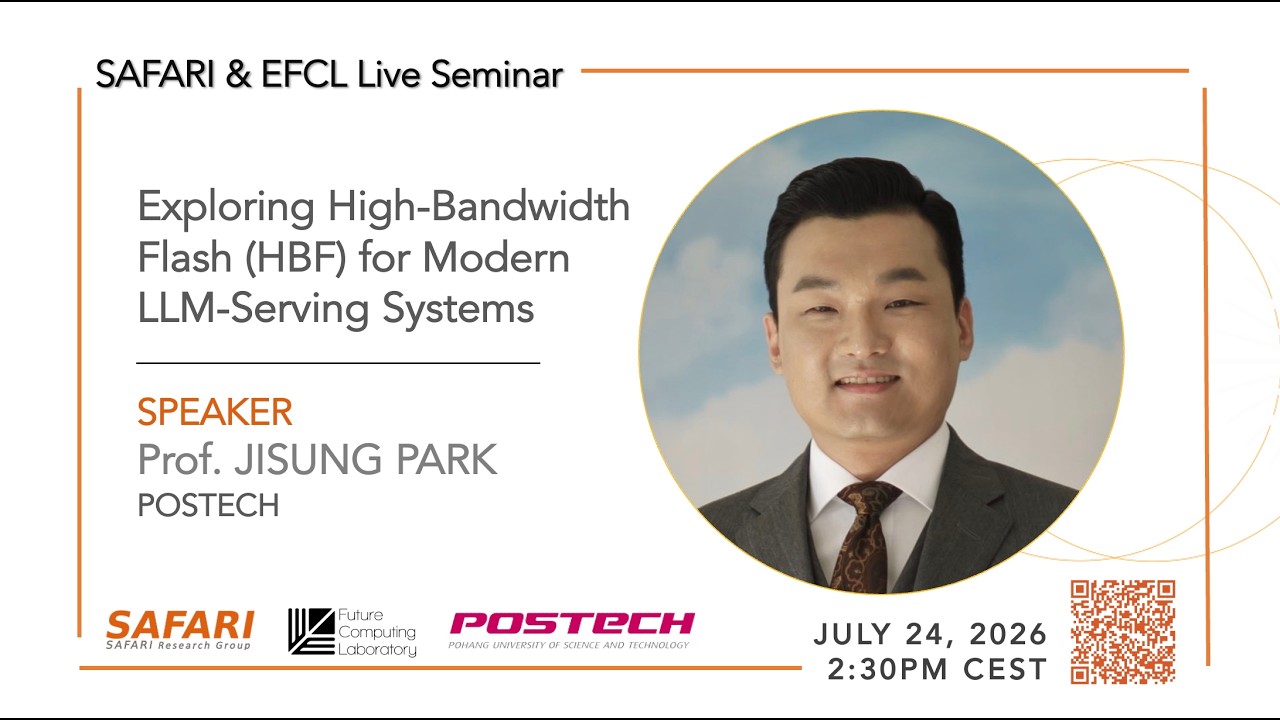
Exploring High-Bandwidth Flash (HBF) for Modern LLM-Serving Systems
Keywords
Summary
140 words
Critical Evaluation
Value of the Information & Strength of the Argument
The talk provides valuable insights into an emerging memory technology and its application to LLM serving. The argumentation is solid, based on systematic simulation and comparison with state-of-the-art HBM systems. The speaker clearly explains the methodology, assumptions, and results, and addresses potential limitations such as the optimistic performance projections. The work is original and contributes to understanding the feasibility and benefits of HBF, which is crucial for guiding future hardware and system design.
Scientific Rigor, Source Quality, Title Accuracy
The talk demonstrates high scientific rigor, with a clear methodology and reliance on established simulation tools. The sources cited include the speaker’s own publications and industry projections from SanDisk, which are relevant and credible. The title accurately reflects the content, and the presentation is well-structured. The talk is based on a paper accepted for publication, indicating peer review. The speaker also acknowledges assumptions and future work, enhancing credibility.
156 words
Title / Content Match
The title accurately reflects the content, focusing on exploring HBF for LLM-serving systems.
Quality & Reliability
8/10
The talk presents original research with a systematic methodology, including simulation-based analysis and comparisons with industry projections. The speaker is an established researcher in memory systems, and the work is accepted for publication at a top venue (ITP). However, the results rely on assumptions and simulations, and the technology is still emerging, so absolute certainty is limited.
Key Moments
Markers derived by PSI from the transcript: the creator did not define chapters.
- Introduction and speaker biography
- Motivation: memory capacity wall in LLM serving
- Introduction to High-Bandwidth Flash (HBF) and its potential
- Methodology: simulation setup and assumptions
- Evaluation of HBF-based systems vs HBM baseline
- Key observations and takeaways
- Technical challenges: write performance and endurance
- Hybrid HBM+HBF configurations and their benefits
- Conclusion and future work
Cited Sources
- Jisung Park's homepage — Speaker's personal website with research information
- Talk slides (PDF) — Slides used in the presentation
- Talk slides (PPTX) — Slides used in the presentation
- Paper (PDF) — Research paper on HBF for LLM serving
- SAFARI Live Seminar page — Seminar details and registration
- SAFARI seminar series — List of past and upcoming seminars
Concurring Sources
- SanDisk's HBF proposal — Industry proposal for HBF technology (mentioned in talk)
Contribution & Novelties
The talk provides a systematic analysis of HBF for LLM serving, offering insights into its potential benefits and challenges. It highlights that HBF can significantly reduce GPU count and improve throughput, but emphasizes the need for HBM-comparable read bandwidth and endurance enhancements. The work also suggests that a hybrid HBM+HBF approach may be more practical. This contributes to guiding future research and development in memory systems for AI.
Pour aller plus loin :
- High Bandwidth Memory (HBM) — Background on HBM technology.
- NAND flash memory — Overview of NAND flash characteristics.
- LLM inference optimization — Related work on efficient LLM serving.
101 words
Radar Profile
The radar profile shows high scores across all dimensions, indicating a well-rounded and reliable presentation. The talk excels in information quantity and quality, with strong technical depth and credibility. The overall high scores reflect the speaker's expertise and the rigorous methodology.
💬 Sur les 0 commentaires analysés, aucune tendance n'est disponible.