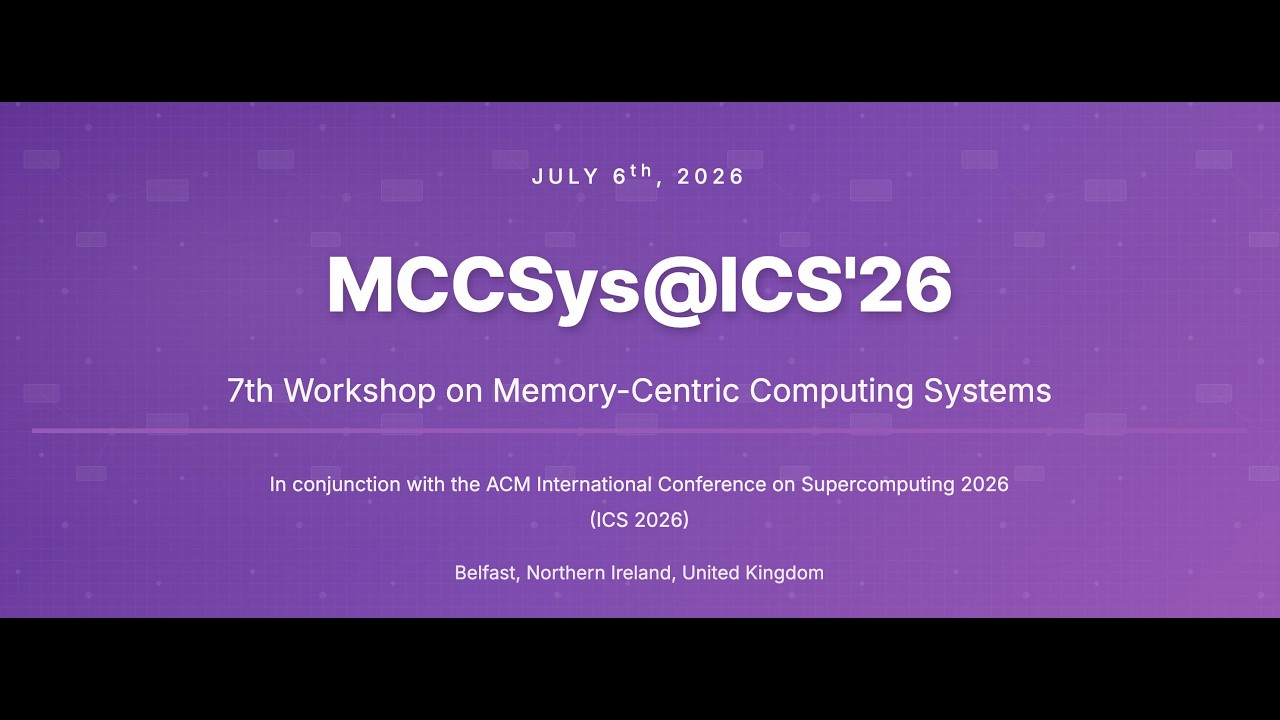
MCCSys-7: 7th Workshop on Memory-Centric Computing Systems, held with ICS 2026 - 6 July 2026
Keywords
Summary
173 words
Critical Evaluation
Value of the Information & Strength of the Argument
The video provides high-value information by presenting a coherent and well-motivated argument for memory-centric computing. It systematically builds the case from the fundamental data movement bottleneck to specific PIM techniques, supported by quantitative examples and references to seminal papers. The argumentation is solid, as it draws on established research and demonstrates practical implementations. The talk is not merely a survey but also explains the underlying mechanisms, such as charge sharing and majority logic, making it valuable for understanding the principles. The presentation is clear and logical, with a strong emphasis on real-world impact.
Scientific Rigor, Source Quality, Title Accuracy
The scientific rigor is high, as the talk references numerous peer-reviewed papers and open-source frameworks, many of which are listed in the video description. The sources are credible and directly relevant to the topic. The title accurately reflects the content, which is a workshop on memory-centric computing systems. The presentation is well-structured and technically accurate, with appropriate caveats about the limitations of current approaches. The inclusion of recommended readings and lecture playlists further enhances the resource value. Overall, the video demonstrates a strong commitment to scientific accuracy and educational quality.
198 words
Title / Content Match
The title accurately reflects the content, which is a full-day workshop on memory-centric computing systems.
Quality & Reliability
8/10
The video is a workshop tutorial by leading researchers in the field, providing a rigorous overview of processing-in-memory technology. It references multiple peer-reviewed papers and open-source frameworks, and the content is technically accurate and well-structured. Minor limitations include the lack of formal citations within the talk itself and the reliance on the presenter's expertise.
Key Moments
Markers derived by PSI from the transcript: the creator did not define chapters.
- Introduction and logistics by Ismail Yuksel
- Motivation: data movement bottleneck and energy costs
- Background on DRAM organization and operations
- RowClone: in-DRAM data copy
- Ambit: majority-based boolean operations
- SIMDRAM: end-to-end processing framework
- MIMDRAM: fine-grained PIM and compiler support
- PyRAM: exploiting commodity DRAM for PIM
Cited Sources
- A Modern Primer on Processing in Memory — Recommended reading providing a comprehensive overview of PIM.
- Processing Data Where It Makes Sense: Enabling In-Memory Computation — Invited paper discussing the rationale for in-memory computation.
- Processing-in-Memory: A Workload-Driven Perspective — Perspective on PIM from a workload-driven viewpoint.
- Benchmarking a New Paradigm: An Experimental Analysis of a Real Processing-in-Memory Architecture — Analysis of real PIM hardware (UPMEM).
- Benchmarking Memory-Centric Computing Systems: Analysis of Real Processing-in-Memory Hardware — Benchmarking of memory-centric systems.
- SIMDRAM: An End-to-End Framework for Bit-Serial SIMD Computing in DRAM — Paper on SIMDRAM framework.
- DAMOV: A New Methodology and Benchmark Suite for Evaluating Data Movement Bottlenecks — Benchmark suite for data movement.
- Intelligent Architectures for Intelligent Computing Systems — Invited paper on intelligent architectures.
- RowHammer: A Retrospective — Retrospective on RowHammer vulnerability.
Concurring Sources
- A Modern Primer on Processing in Memory — Provides a comprehensive overview consistent with the talk.
- Processing Data Where It Makes Sense: Enabling In-Memory Computation — Supports the motivation for in-memory computation.
- Benchmarking a New Paradigm: An Experimental Analysis of a Real Processing-in-Memory Architecture — Provides experimental evidence for PIM benefits.
External References
Contribution & Novelties
The video provides a comprehensive and up-to-date overview of processing-in-memory technology, with a focus on processing using DRAM. It synthesizes a large body of research and presents it in an accessible yet technically rigorous manner. The talk highlights recent advances such as MIMDRAM and PyRAM, which are not widely covered in introductory materials. It also emphasizes the practical aspects of implementing PIM on real hardware, including open-source frameworks. The inclusion of a workshop format with multiple speakers adds diversity of perspectives.
Pour aller plus loin :
- Processing-in-Memory (PIM) - Wikipedia — General overview of PIM concepts.
- UPMEM - Processing-in-Memory — Commercial PIM technology.
- SAFARI Research Group — Research group led by Onur Mutlu, with many PIM publications.
- RowHammer - Wikipedia — Related DRAM reliability issue.
- SIMDRAM GitHub — Open-source framework for PIM.
132 words
Radar Profile
The radar profile shows high scores across all dimensions, indicating a well-rounded and reliable educational resource. The quantity of information is particularly high, reflecting the workshop's comprehensive coverage. The technical level is appropriate for an advanced audience, and the overall reliability is strong due to the credible sources and expert presentation.