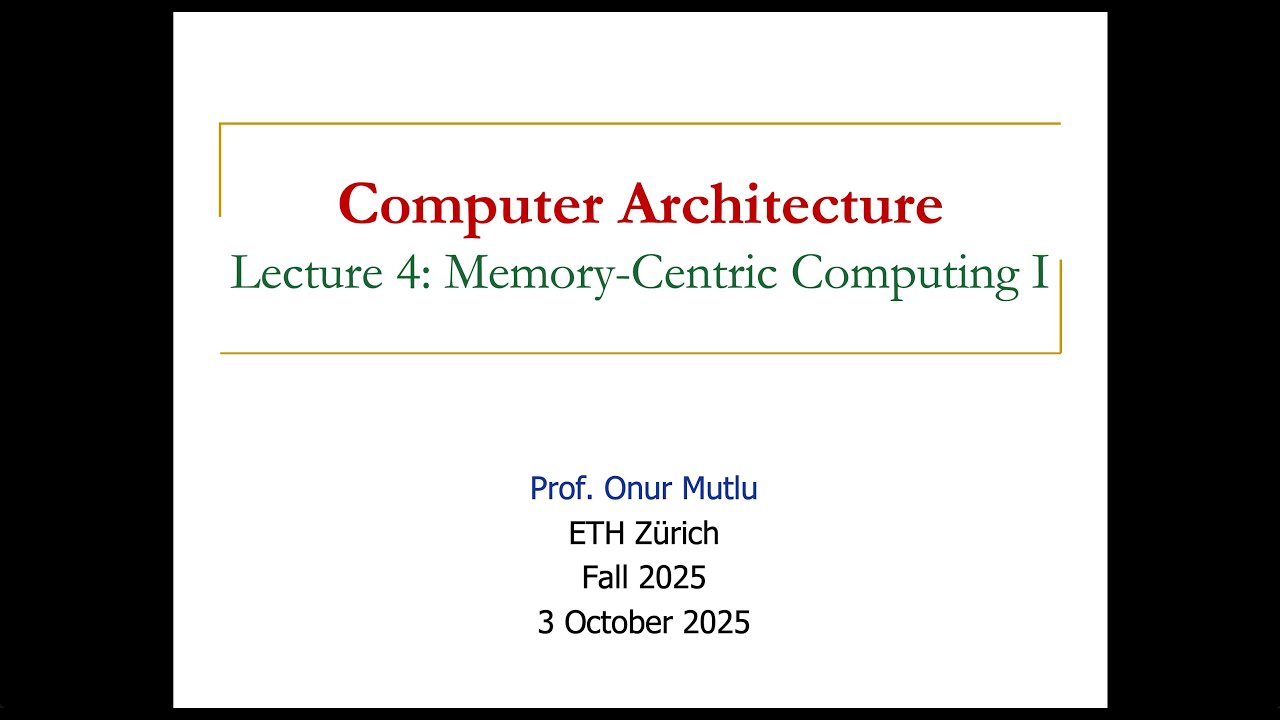
Computer Architecture - Lecture 4: Memory-Centric Computing I (Fall 2025)
Keywords
Summary
180 words
Critical Evaluation
Value of the Information & Strength of the Argument
The lecture provides a comprehensive and well-structured overview of memory-centric computing, with a clear distinction between processing using memory and processing near memory. The argumentation is solid, supported by references to seminal papers and industry developments. The lecturer effectively motivates the need for PIM by highlighting the data movement bottleneck and energy inefficiencies, and he presents a compelling case for why this paradigm is gaining traction. The discussion of historical context and current prototypes adds depth and credibility. However, the lecture is primarily an overview and does not delve into detailed technical implementations or quantitative comparisons, which limits its value for those seeking in-depth technical knowledge.
Scientific Rigor, Source Quality, Title Accuracy
The lecture demonstrates high scientific rigor, with references to peer-reviewed papers and industry prototypes. The sources cited are credible and directly relevant to the topic. The title accurately reflects the content, which is focused on memory-centric computing. The lecture is well-structured and the arguments are logically presented. The inclusion of real-world examples and industry developments enhances the credibility of the content. However, as a lecture, it may not cover all perspectives or potential criticisms of PIM, but it provides a solid foundation for further study.
206 words
Title / Content Match
The title accurately reflects the content, which focuses on memory-centric computing, specifically processing in memory.
Quality & Reliability
9/10
Lecture by a leading academic in computer architecture, with detailed slides and references to peer-reviewed papers and industry prototypes. Content is technical and well-structured, but as a lecture it presents the instructor's perspective and may not cover all counterarguments.
Key Moments
Markers derived by PSI from the transcript: the creator did not define chapters.
- Introduction and motivation for memory-centric computing
- Historical context: early proposals for processing in memory in the 1960s
- Taxonomy of processing in memory: processing using memory vs. processing near memory
- Detailed explanation of processing using memory with DRAM examples
- Discussion of processing near memory and its advantages
- Real-world prototypes and industry efforts in PIM
- Applications of PIM, including genome analysis
- Challenges and future directions in memory-centric computing
Cited Sources
- A Modern Primer on Processing in Memory — Recommended reading for the lecture, providing an overview of PIM.
- Memory-Centric Computing: Solving Computing's Memory Problem — Recommended reading discussing the memory problem and PIM solutions.
- Memory-Centric Computing: Recent Advances in Processing-in-DRAM — Recommended reading on recent advances in processing-in-DRAM.
- Intelligent Architectures for Intelligent Computing Systems — Recommended reading on intelligent architectures.
- RowHammer: A Retrospective — Recommended reading on RowHammer, a DRAM reliability issue.
- Fundamentally Understanding and Solving RowHammer — Recommended reading on understanding and solving RowHammer.
- Accelerating Genome Analysis via Algorithm-Architecture Co-Design — Recommended reading on genome analysis acceleration.
- From Molecules to Genomic Variations: Accelerating Genome Analysis via Intelligent Algorithms and Architectures — Recommended reading on genome analysis acceleration.
Concurring Sources
- A Modern Primer on Processing in Memory — Provides a comprehensive overview of PIM, consistent with the lecture's content.
- Memory-Centric Computing: Solving Computing's Memory Problem — Discusses the memory problem and PIM solutions, aligning with the lecture's motivation.
- Memory-Centric Computing: Recent Advances in Processing-in-DRAM — Focuses on recent advances in processing-in-DRAM, matching the lecture's emphasis.
External References
Contribution & Novelties
This lecture provides a comprehensive and up-to-date overview of memory-centric computing, clearly distinguishing between processing using memory and processing near memory. It offers a taxonomy that helps categorize different PIM approaches and highlights real-world industry prototypes, making the topic tangible. The lecture also connects PIM to broader challenges like energy efficiency and sustainability, and discusses applications such as genome analysis. It serves as an excellent starting point for researchers and students interested in this emerging field.
Pour aller plus loin :
- Processing-in-memory (Wikipedia) — Provides a general overview of PIM concepts and history.
- DRAM (Wikipedia) — Background on DRAM technology, which is central to the lecture.
- RowHammer (Wikipedia) — Discusses the RowHammer issue and its relation to PIM.
- Onur Mutlu’s publications — A list of relevant papers by the lecturer.
130 words
Radar Profile
The radar profile shows high scores across all dimensions, indicating a well-rounded and reliable lecture. The high technical level and information quality make it suitable for advanced audiences, while the strong reliability and quantity of information ensure its value as a reference.