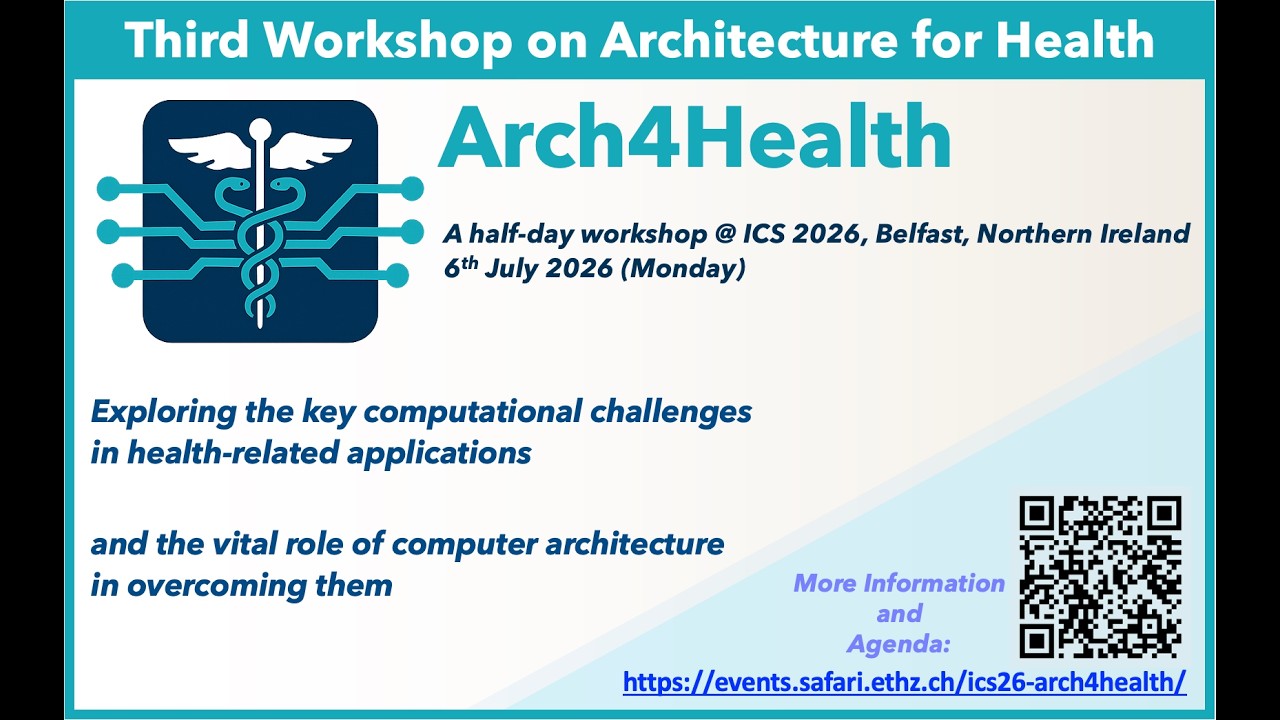
Arch4Health: 3rd Workshop on Architecture for Health (held with ICS 2026) -- 6 July 2026
Keywords
Summary
203 words
Critical Evaluation
Value of the Information & Strength of the Argument
The video provides valuable insights into the intersection of computer architecture and healthcare, highlighting real-world challenges and innovative solutions. The arguments are well-supported by concrete examples, such as the SLOW5 file format achieving significant speedups, and the FLORIA base caller enabling GPU flexibility. The speakers demonstrate a strong understanding of both the biological and computational aspects, making a compelling case for hardware-software co-design in genomics. The discussion of FPGA acceleration and its integration difficulties is particularly valuable, offering a realistic perspective on the hurdles in deploying accelerators in clinical settings.
Scientific Rigor, Source Quality, Title Accuracy
The scientific rigor is high, with speakers referencing published papers and ongoing research projects. The sources cited in the description include reputable academic publications and institutional links, such as those from ETH Zurich and the SAFARI research group. The title accurately reflects the content, as it is indeed a workshop on architecture for health. The video is a raw recording, so production quality is not polished, but this does not detract from the scientific value. The comments are not provided, so no analysis of public reception is possible.
193 words
Title / Content Match
The title accurately describes the content: a workshop on computer architecture for health applications, held with ICS 2026.
Quality & Reliability
8/10
The video is a full-day workshop recording featuring multiple expert speakers from academia and industry, presenting peer-reviewed research and practical applications. The content is technical and detailed, with references to published papers and ongoing projects. The production quality is raw (live stream), but the scientific content is high-quality and reliable.
Key Moments
Markers derived by PSI from the transcript: the creator did not define chapters.
- Workshop introduction and overview by Nika Mansouri Ghiasi
- Introduction to DNA sequencing and its applications
- Overview of nanopore sequencing technology and challenges
- Discussion of SLOW5 file format and its performance benefits
- Presentation of FLORIA base caller for AMD GPUs
- FPGA acceleration of sequence alignment and integration challenges
- GPU-based acceleration and clinical deployment examples
Cited Sources
- Arch4Health Workshop Website — Official workshop page with agenda and details.
- Benchmarking Memory-Centric Computing Systems: Analysis of Real Processing-in-Memory Hardware — Referenced as recommended reading on processing-in-memory.
- DAMOV: A New Methodology and Benchmark Suite for Evaluating Data Movement Bottlenecks — Referenced as recommended reading on data movement.
- A Modern Primer on Processing in Memory — Referenced as recommended reading on processing-in-memory.
- PrIM-UPMEM-Tutorial-Analysis-Benchmarking — Referenced as recommended reading on processing-in-memory benchmarking.
- Processing Data Where It Makes Sense: Enabling In-Memory Computation — Referenced as recommended reading on in-memory computation.
- RowHammer: A Retrospective — Referenced as recommended reading on hardware security.
- SIMDRAM: An End-to-End Framework for Bit-Serial SIMD Computing in DRAM — Referenced as recommended reading on processing-in-memory.
- Intelligent Architectures for Intelligent Computing Systems — Referenced as recommended reading on intelligent architectures.
- Processing-in-Memory: A Workload-Driven Perspective — Referenced as recommended reading on processing-in-memory.
Concurring Sources
- SLOW5: A new file format for nanopore sequencing — The speaker's project on SLOW5, which is open-source and available on GitHub.
- FLORIA: Open-source base caller — The speaker's project on FLORIA, which is open-source and available on GitHub.
Contribution & Novelties
This workshop recording provides a unique overview of the current state and future directions in computer architecture for health applications, particularly focusing on genomics. It highlights innovative solutions like SLOW5 and FLORIA, and discusses the challenges of hardware acceleration in real-world pipelines. The content is valuable for researchers and practitioners seeking to understand the intersection of these fields.
Pour aller plus loin :
- Nanopore sequencing — Provides background on the technology discussed.
- FPGA — Relevant to the hardware acceleration approaches mentioned.
- Processing-in-memory — A key concept in the workshop’s context.
90 words
Radar Profile
The radar profile shows high scores in quantity and technical level, reflecting the dense and specialized content. Quality and reliability are also high, though slightly lower due to the raw production and lack of peer-reviewed verification in the video itself. The overall balance indicates a technically rich but not perfectly polished presentation.