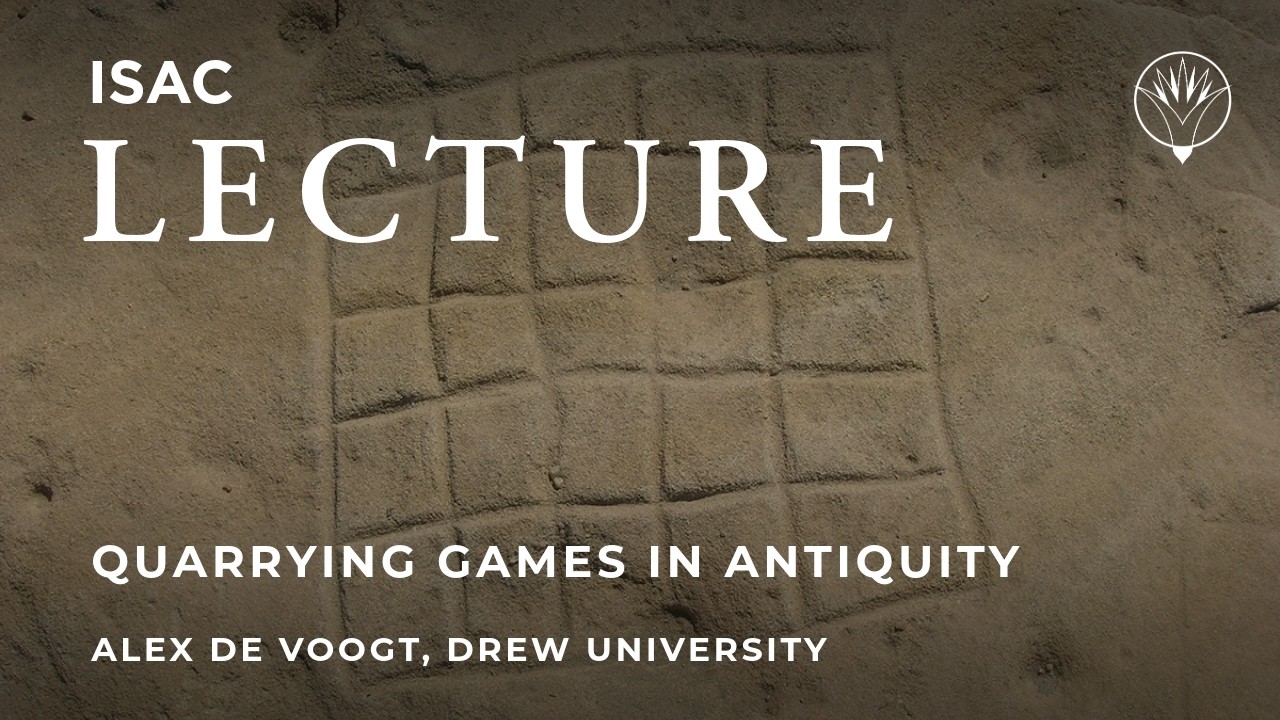
Quarrying Games in Antiquity | Alex de Voogt, Professor, Psychology Department at Drew University
Keywords
Summary
177 words
Critical Evaluation
Value of the Information & Strength of the Argument
The lecture provides substantial value by synthesizing decades of research on ancient board games and introducing a novel focus on graffiti games as a primary source. De Voogt’s argumentation is solid, grounded in specific archaeological examples and comparative analysis. He effectively demonstrates how the study of graffiti games can reveal patterns of cultural transmission and site usage. The reasoning is clear, and he acknowledges limitations, such as the absence of rules for ancient games, which strengthens the credibility of his claims.
Scientific Rigor, Source Quality, Title Accuracy
The lecture demonstrates high scientific rigor, with the speaker citing his own extensive publications and collaborations. He references specific archaeological sites and artifacts, and his methodology for identifying and dating graffiti games is systematic. The title accurately reflects the content, focusing on the archaeological study of games. The lecture is part of an academic series, and the speaker’s expertise is well-established. No comments were provided for analysis.
163 words
Title / Content Match
The title accurately reflects the content, focusing on the study of ancient board games through archaeological evidence, particularly graffiti and quarry contexts.
Quality & Reliability
9/10
Lecture by a recognized expert in board game archaeology, based on extensive fieldwork and published research. The content is well-structured, with clear methodological explanations and references to specific sites and artifacts. The speaker's authority and the institutional setting (ISAC) enhance reliability.
Key Moments
Markers derived by PSI from the transcript: the creator did not define chapters.
- Introduction to ancient Egyptian board games: Senet, Mehen, and the Game of Twenty Squares.
- Discussion on the distribution of the Game of Twenty Squares across regions and its transmission through conquest.
- Transition to Roman board games: Duodecim Scripta, Latrunculi, and Five Lines.
- Introduction to late antiquity games like Tab and Seega, still played today.
- Case study of Sai Island: identifying game boards in archaeological context.
- Explanation of graffiti games and their importance as archaeological evidence.
- Examples of graffiti games from various sites and their dating.
- Conclusion: potential of graffiti games to rewrite the history of board games.
Cited Sources
- Board Game Studies Journal — Co-founded and co-edited by Alex de Voogt; relevant to the academic study of board games.
- Digital Ludem Project — Mentioned as a collaborative project modeling the evolution of traditional games.
Concurring Sources
- Board Game Studies Journal — Academic journal co-founded by the speaker, supporting the scholarly context.
Contribution & Novelties
The lecture offers a fresh perspective by highlighting graffiti game boards as a significant and often overlooked archaeological source. It demonstrates how these informal carvings can provide insights into the daily lives and activities of ancient peoples, complementing traditional finds. The speaker’s comparative approach across different cultures and time periods adds depth to the understanding of game transmission.
Pour aller plus loin :
104 words
Radar Profile
The radar profile shows high scores in information quantity, quality, and reliability, with a slightly lower technical level, reflecting the lecture's accessibility to a general audience while maintaining scholarly depth.