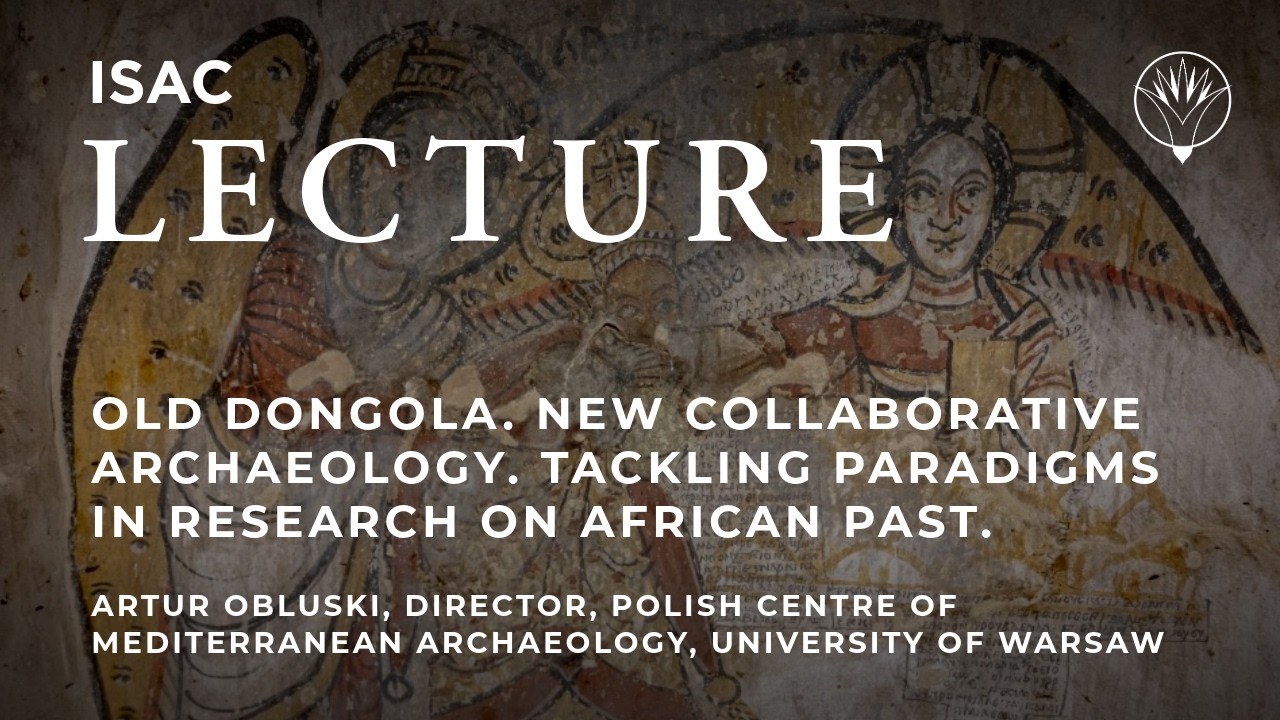
Old Dongola. New collaborative archaeology. Tackling paradigms in research on African past.
Keywords
Summary
147 words
Critical Evaluation
Value of the Information & Strength of the Argument
The lecture provides substantial value by presenting original archaeological discoveries and a novel interpretive framework. The argumentation is solid, grounded in detailed analysis of inscriptions, iconography, and historical sources. Obluski effectively connects the material evidence to broader debates about cultural agency and center-periphery dynamics. The community archaeology model is presented as a pioneering approach, with clear ethical and practical implications. The speaker’s expertise and the institutional backing enhance the credibility of the arguments.
Scientific Rigor, Source Quality, Title Accuracy
The scientific rigor is high: the speaker references specific archaeological contexts, radiocarbon dating, and epigraphic analysis. He cites historical sources such as Arab chronicles and liturgical texts. The title accurately reflects the content, covering both the new discoveries and the collaborative methodology. The lecture is well-structured and supported by visual evidence. No comments were provided, so no analysis of public reception is included.
151 words
Title / Content Match
The title accurately reflects the content: the lecture covers new archaeological findings at Old Dongola and the collaborative community archaeology approach.
Quality & Reliability
9/10
Lecture by a leading archaeologist, director of the Polish Centre of Mediterranean Archaeology, presenting recent discoveries and a community archaeology model. The content is based on original research, with references to specific archaeological findings, inscriptions, and historical sources. The speaker's credentials and the institutional context (University of Chicago) support high reliability. Minor caveats: some interpretations are tentative, and the lecture format may not include full peer review.
Key Moments
Markers derived by PSI from the transcript: the creator did not define chapters.
- Introduction to Nubia and its kingdoms.
- Overview of Old Dongola and its urban layout.
- Discovery of the large church and identification as the cathedral.
- Excavation of room U292 and its wall paintings.
- Analysis of inscriptions and liturgical texts.
- Interpretation of the Mary Dongolitis painting.
- Community archaeology model and collaborative approach.
Cited Sources
- Archaeology Magazine — Mentioned as selecting the discovery as a top 10 archaeological discovery.
- Polish Centre of Mediterranean Archaeology — Institution directed by the speaker.
Concurring Sources
- Polish Centre of Mediterranean Archaeology — Institution conducting the excavations.
Contribution & Novelties
The lecture presents original findings from recent excavations at Old Dongola, including a unique iconographic type of the Virgin Mary and previously unknown liturgical inscriptions. It also introduces a community archaeology model that challenges traditional practices. The speaker’s interpretations offer new perspectives on medieval Nubian Christianity and cultural agency.
Pour aller plus loin :
- Nubian studies — Overview of the academic field.
- Makuria — Historical context of the kingdom.
- Community archaeology — Theoretical framework for collaborative practice.
77 words
Radar Profile
The radar profile shows high scores across all dimensions, indicating a well-rounded and reliable lecture. The strongest aspects are the quantity and quality of information, while the technical level is also high, reflecting the specialist audience. The overall reliability is excellent, supported by the speaker's expertise and institutional backing.