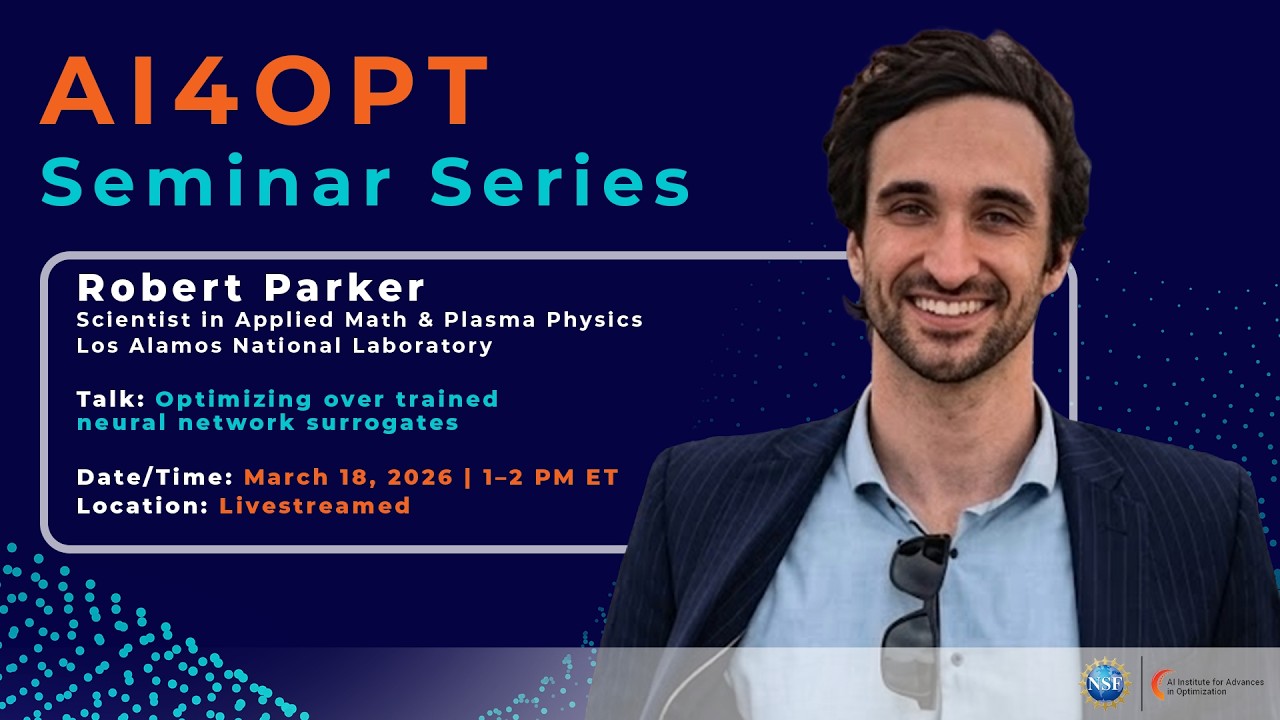
AI4OPT Seminar: Optimizing over trained neural network surrogates
Keywords
Summary
154 words
Critical Evaluation
Value of the Information & Strength of the Argument
The talk provides valuable insights into the practical challenges of optimizing over neural network surrogates, highlighting the importance of formulation choice and computational bottlenecks. The argumentation is solid, supported by examples and a clear motivation for using local optimization over global methods. The speaker acknowledges limitations and engages with audience questions, strengthening the credibility of the presentation.
Scientific Rigor, Source Quality, Title Accuracy
The speaker references his own work and the MathOptAI.jl package, but does not cite specific external sources in the talk. The title accurately reflects the content. The presentation is rigorous in its technical depth, though it is a seminar rather than a peer-reviewed publication.
116 words
Title / Content Match
The title accurately reflects the content, which focuses on optimization problems involving trained neural network surrogates and introduces a software package to address them.
Quality & Reliability
8/10
The speaker is a scientist at Los Alamos National Laboratory with a PhD in Chemical Engineering, and the talk presents a software package (MathOptAI.jl) with technical details and practical examples. The content is expert-level and appears reliable, though it is a seminar presentation rather than peer-reviewed publication.
Key Moments
Markers derived by PSI from the transcript: the creator did not define chapters.
- Introduction and motivation for optimizing over neural network surrogates
- Discussion of why machine learning surrogates are used in decision-making
- Comparison of local nonlinear optimization vs global discrete optimization
- Introduction of MathOptAI.jl and its features
- Explanation of full space vs reduced space formulations and their bottlenecks
- Techniques to overcome bottlenecks: GPU-based differentiation and linear algebra exploitation
- Application to adversarial input generation for AC power flow model
- Q&A and discussion on implementation details
Cited Sources
- MathOptAI.jl — Software package introduced in the talk for embedding machine learning models into optimization problems.
- AI4OPT Seminars — List of past seminars, including this one.
Concurring Sources
- MathOptAI.jl — The package is the main contribution and is consistent with the talk's claims.
External References
Contribution & Novelties
The talk presents MathOptAI.jl, a novel software package that facilitates embedding machine learning models into optimization problems, addressing computational bottlenecks through formulation choices and algorithmic exploitation of neural network structure. It demonstrates practical application to adversarial input generation for a graph neural network model of AC power flow.
Pour aller plus loin :
- Neural network verification — Relevant to the verification aspect mentioned.
- Interior-point method — Core optimization method discussed.
- Graph neural network — The type of model used in the example.
82 words
Radar Profile
The radar profile shows high scores in technical level and information quality, indicating a specialized and informative presentation. The slightly lower score in information quantity reflects the focused scope of the talk.