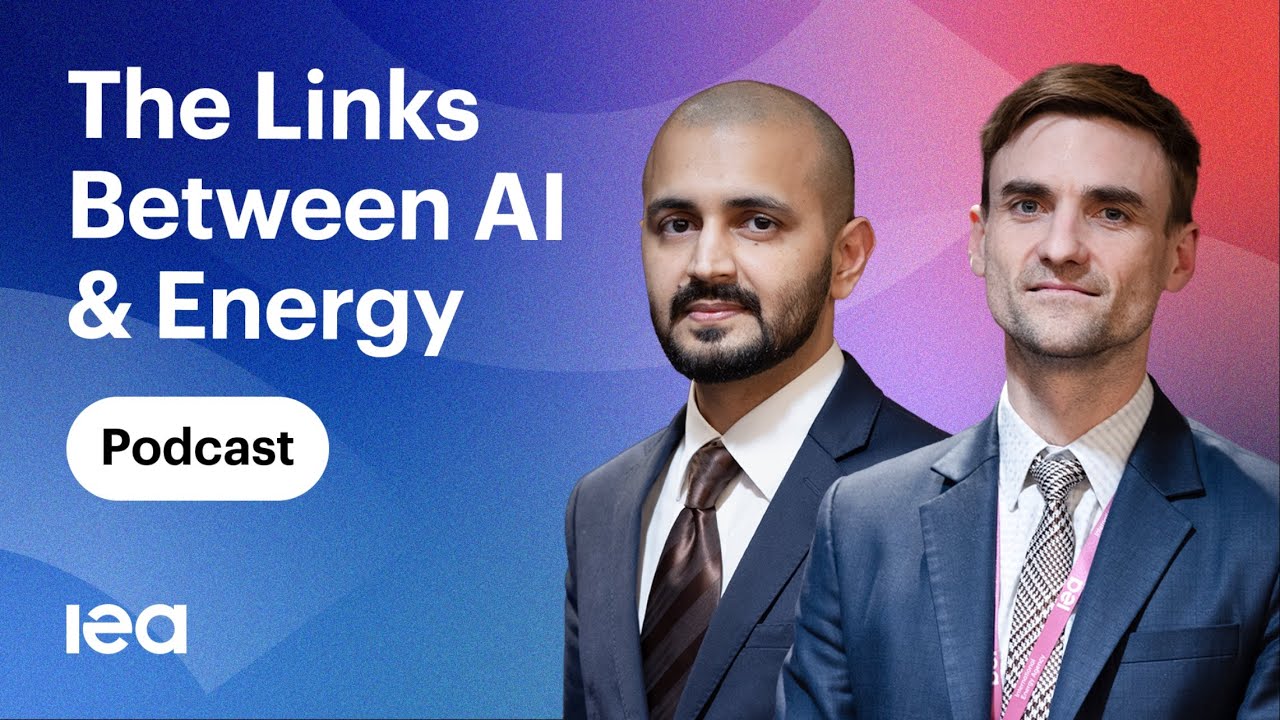
Podcast episode: The relationship between energy and AI is evolving rapidly
Keywords
Summary
195 words
Critical Evaluation
Value of the Information & Strength of the Argument
The podcast provides valuable insights into the current state and future projections of AI’s energy demand, backed by IEA research. The argumentation is solid, with experts presenting data on investment, efficiency improvements, and bottlenecks. They acknowledge uncertainties and potential alternative scenarios, enhancing credibility. The discussion is well-structured, covering investment, efficiency, bottlenecks, innovations, and future outlook. However, some claims lack detailed citations, and the format is conversational rather than a formal presentation of evidence.
Scientific Rigor, Source Quality, Title Accuracy
The content is scientifically rigorous, drawing on IEA’s institutional research and expertise. The speakers are lead authors of the referenced report, adding authority. The title accurately reflects the content. No external sources are cited in the description, but the podcast references the IEA’s own report. The discussion is balanced and acknowledges limitations, such as uncertainties in efficiency improvements and future scenarios.
149 words
Title / Content Match
The title accurately reflects the content, which focuses on the evolving relationship between energy and AI, as discussed by IEA experts.
Quality & Reliability
8/10
The podcast features lead authors of an IEA report, providing expert analysis based on institutional research. The discussion is balanced, acknowledges uncertainties, and references specific data points. However, it is an opinion/discussion format rather than a peer-reviewed study, and some claims lack detailed sourcing.
Key Moments
Markers derived by PSI from the transcript: the creator did not define chapters.
- Introduction to the podcast and the topic of energy and AI.
- Discussion on massive investments in AI infrastructure, exceeding $700 billion in 2026.
- Explanation of energy consumption per AI query and efficiency improvements.
- Overview of data center electricity consumption and growth rates.
- Discussion of bottlenecks including gas turbines, transformers, and grid connections.
- New bottlenecks: high-bandwidth memory shortage and helium supply disruptions.
- Innovations in the energy sector: renewables and nuclear power purchase agreements.
- AI's potential to reduce energy consumption and barriers to adoption.
- Analysis of data centers' impact on electricity prices.
- Reflections on missed trends: on-site power generation and physical AI.
- Future outlook to 2030 and uncertainties.
Cited Sources
- IEA report on Energy and AI (2025) — Referenced as the landmark report from April 2025.
- IEA report on Energy and AI (2026) — The new report discussed in the podcast.
Concurring Sources
- IEA World Energy Outlook 2025 — Provides broader energy demand projections consistent with the podcast's data.
Contribution & Novelties
The podcast provides an updated analysis of the energy-AI nexus, highlighting rapid changes in investment, efficiency, and bottlenecks. It offers new insights into on-site power generation and physical AI, and projects future scenarios. The discussion emphasizes the potential for AI to offset its own energy demand through efficiency gains.
Pour aller plus loin :
- IEA Energy and AI report — The original 2025 report providing baseline data.
- Small modular reactors — Context on nuclear technology mentioned in the podcast.
- Agentic AI — Explanation of autonomous AI agents, a key driver of future energy demand.
94 words
Radar Profile
The radar profile shows high scores in information quantity, quality, and reliability, with a moderate technical level. This indicates a well-informed discussion suitable for a general audience, with strong institutional backing.
💬 No comments were provided for analysis.