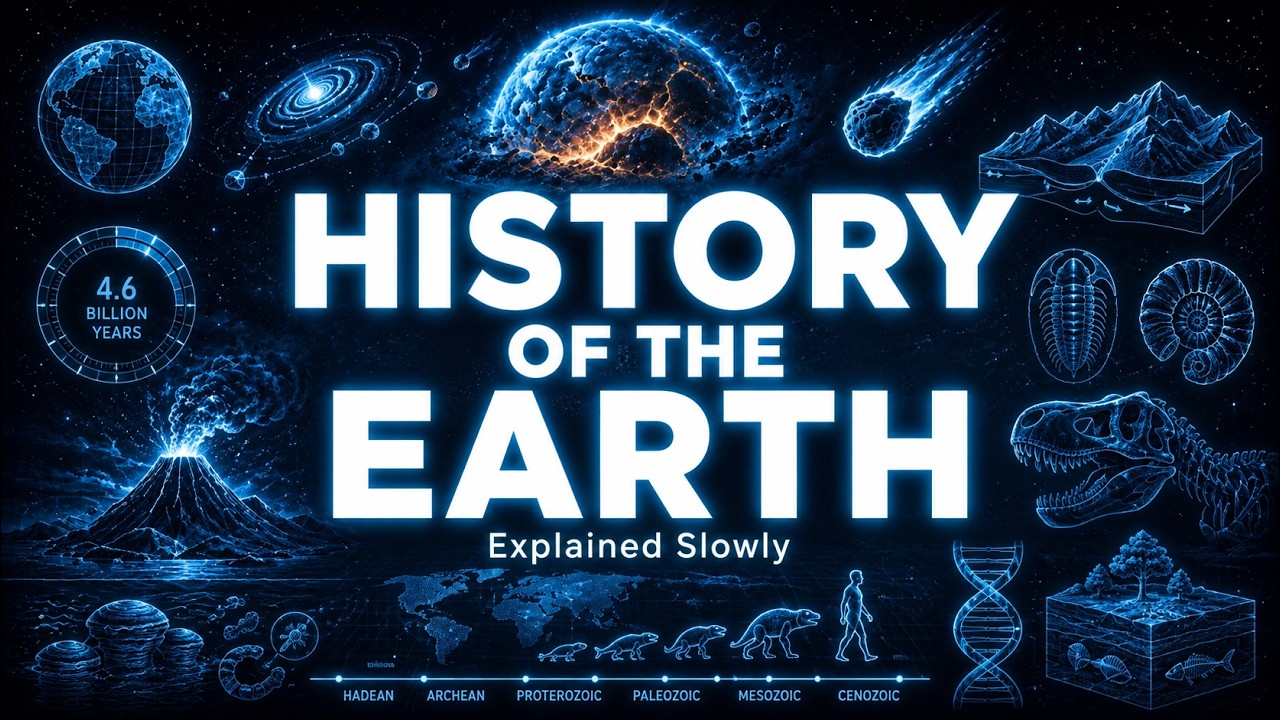
The Entire History Of The Earth Explained Slowly (For Sleep)
Keywords
Summary
150 words
Critical Evaluation
The video offers a comprehensive and scientifically sound overview of Earth’s history, making it a valuable resource for those seeking a relaxing yet informative experience. The content is well-structured, progressing logically from the solar system’s formation to the emergence of humans. The narration is accurate and reflects current scientific understanding, with appropriate mentions of key theories and evidence. The inclusion of sources like NASA and USGS in the description enhances credibility. However, the video is not without limitations. The slow pace and soothing tone, while intentional for sleep, may reduce the density of information per minute, making it less efficient for those seeking a quick overview. Additionally, some topics are simplified, which is expected for a general audience but may leave experts wanting more depth. The video does not address any controversies or alternative hypotheses in detail, such as the ongoing debates about the exact mechanism of the Moon’s formation. Overall, the video succeeds in its goal of providing a calming yet educational journey through Earth’s history, and the scientific rigor is commendable for the format.
176 words
Title / Content Match
The title accurately reflects the content, which is a slow, comprehensive narration of Earth's history designed for relaxation and sleep.
Quality & Reliability
8/10
The video presents a scientifically accurate overview of Earth's history, relying on established theories and citing reputable sources such as NASA, USGS, and the Natural History Museum. The content is well-researched and aligns with current scientific consensus, though it simplifies complex topics for a general audience.
Key Moments
Markers derived by PSI from the transcript: the creator did not define chapters.
- Introduction: the concept of lying on a moving planet and the scale of Earth's history.
- The age of the Earth and how we know it (radiometric dating).
- Formation of the solar system from a collapsing cloud of gas and dust.
- Planetesimal formation and the meter-size barrier, streaming instability.
- Giant impacts and the formation of the Moon (Theia impact).
- Earth's differentiation into core, mantle, and crust; formation of the magnetic field.
- Importance of the magnetic field in protecting the atmosphere, comparison with Mars.
- Cooling of Earth, formation of oceans, and the first signs of life.
- Oxygenation of the atmosphere and the Great Oxidation Event.
- Snowball Earth and the Cambrian explosion.
Cited Sources
- NASA – Facts About Earth — Referenced for general facts about Earth's formation and characteristics.
- USGS – Geologic Time — Referenced for the geologic time scale and Earth's age.
- Natural History Museum – The Origin of Life on Earth — Referenced for the origin of life on Earth.
- Smithsonian – Introduction to Human Evolution — Referenced for human evolution.
Concurring Sources
- NASA – Facts About Earth — Supports the video's claims about Earth's formation and characteristics.
- USGS – Geologic Time — Supports the geologic time scale and Earth's age.
- Natural History Museum – The Origin of Life on Earth — Supports the discussion on the origin of life.
- Smithsonian – Introduction to Human Evolution — Supports the section on human evolution.
External References
Contribution & Novelties
The video provides a unique blend of scientific accuracy and relaxation, making complex Earth history accessible in a soothing format. It emphasizes the interconnectedness of geological and biological events, from planetary formation to human evolution.
Pour aller plus loin :
- Giant Impact Hypothesis — Detailed explanation of the leading theory for the Moon’s formation.
- Streaming Instability — Mechanism for planetesimal formation discussed in the video.
- Great Oxidation Event — Key event in Earth’s oxygenation history.
- Snowball Earth — Hypothesis of global glaciation events.
- Cambrian Explosion — Rapid diversification of life forms.
91 words
Radar Profile
The radar profile shows high scores in quantity and quality of information, with a slightly lower technical level, indicating a well-balanced, accessible overview. The reliability is strong, reflecting the use of reputable sources.