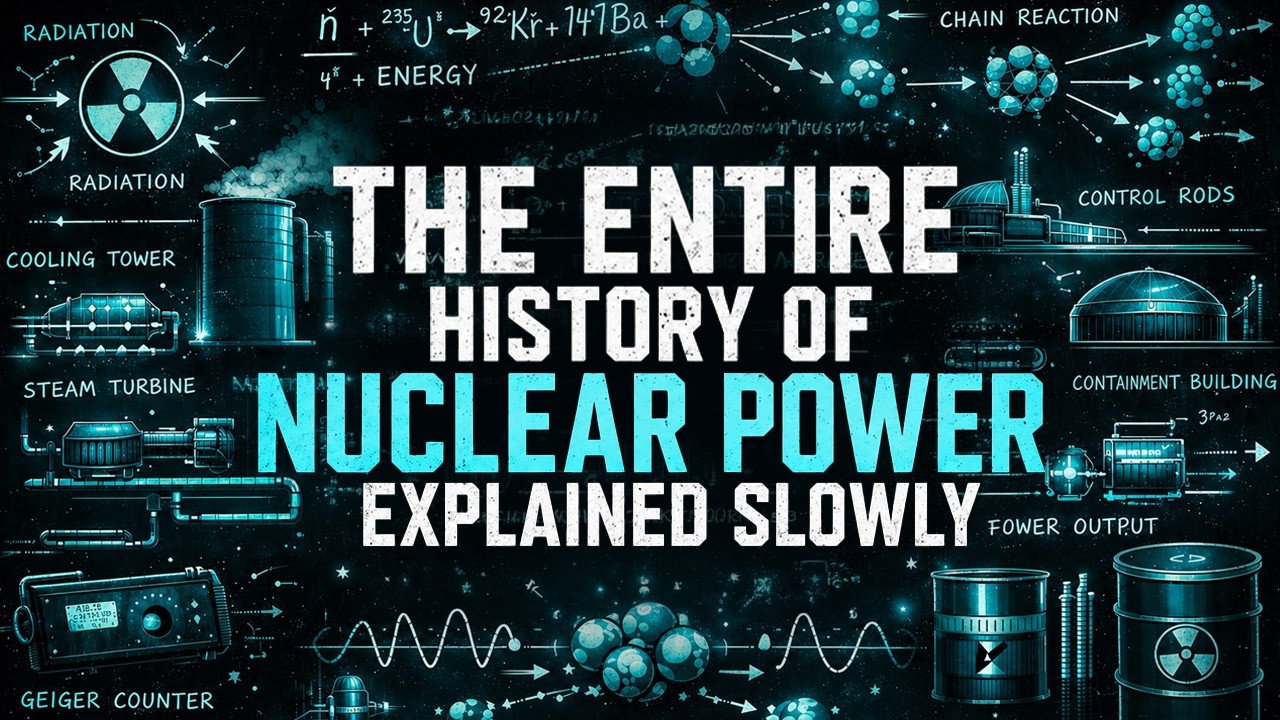
The Entire History Of Nuclear Power Explained Slowly (For Sleep)
Keywords
Summary
169 words
Critical Evaluation
The video excels in providing a comprehensive and historically accurate overview of nuclear power. The narrative is well-structured, progressing logically from early atomic theories to modern applications and challenges. The scientific content is presented with clarity, making complex topics accessible without oversimplifying. The inclusion of key figures like Marie Curie, Ernest Rutherford, and Lise Meitner adds human interest and highlights the collaborative nature of scientific discovery. The video also addresses the ethical and safety concerns associated with nuclear power, including the major accidents, which adds depth and balance. However, the video’s primary purpose as a sleep aid means that the pacing is deliberately slow, which may not suit viewers seeking a more concise or fast-paced explanation. Additionally, while the historical facts are accurate, the video does not delve deeply into the technical details of reactor design or the physics of nuclear fission, which might be a limitation for more scientifically inclined viewers. The lack of visual aids, such as diagrams or animations, could also hinder understanding for some. Overall, the video is a valuable educational resource that successfully combines scientific accuracy with a relaxing presentation style.
186 words
Title / Content Match
The title accurately reflects the content: a comprehensive, slow-paced history of nuclear power designed for sleep or background listening.
Quality & Reliability
8/10
The video provides a historically accurate and well-structured overview of nuclear power, from early atomic theory to modern reactors and accidents. It relies on established scientific facts and historical events, with no apparent misinformation. The narration is calm and accessible, maintaining scientific rigor while simplifying complex concepts.
Key Moments
Markers derived by PSI from the transcript: the creator did not define chapters.
- Introduction: the significance of nuclear power and the plan for the video.
- Ancient Greek atomic theory and Democritus' concept of atomos.
- John Dalton's atomic theory and the 19th-century view of atoms as solid spheres.
- Röntgen's discovery of X-rays and its impact on science.
- Becquerel's discovery of radioactivity and the mystery of uranium rays.
- Marie Curie's research on radioactivity and the discovery of polonium and radium.
- Ernest Rutherford's experiments revealing the atomic nucleus.
- The discovery of nuclear fission by Hahn and Meitner.
- The Manhattan Project and the development of the first nuclear weapons.
- Post-war expansion of nuclear power for electricity generation.
- Major accidents: Three Mile Island, Chernobyl, and Fukushima.
- Modern nuclear technology and the future of nuclear power.
Cited Sources
- No external sources cited in video or description — The video does not mention specific sources, and the description contains no links.
Concurring Sources
- IAEA - Nuclear Power Reactors in the World — Provides current statistics on the number of nuclear reactors worldwide, supporting the video's opening statement.
Contribution & Novelties
The video provides a comprehensive and accessible historical narrative of nuclear power, emphasizing the human stories behind scientific discoveries. It synthesizes well-known historical events into a coherent and engaging story, making it suitable for a general audience. The slow pacing and calm narration are innovative for educational content, targeting relaxation and sleep.
Pour aller plus loin :
- Nuclear fission — Provides detailed scientific background on the process of nuclear fission.
- Lise Meitner — Explores the life and contributions of the physicist who co-discovered nuclear fission.
- Chernobyl disaster — Offers comprehensive information on the 1986 nuclear accident and its aftermath.
99 words
Radar Profile
The radar profile shows high scores in quantity and quality of information, with moderate technical depth and high reliability. This indicates a well-researched and informative video that is accessible to a broad audience, though it may not satisfy viewers seeking advanced technical details.