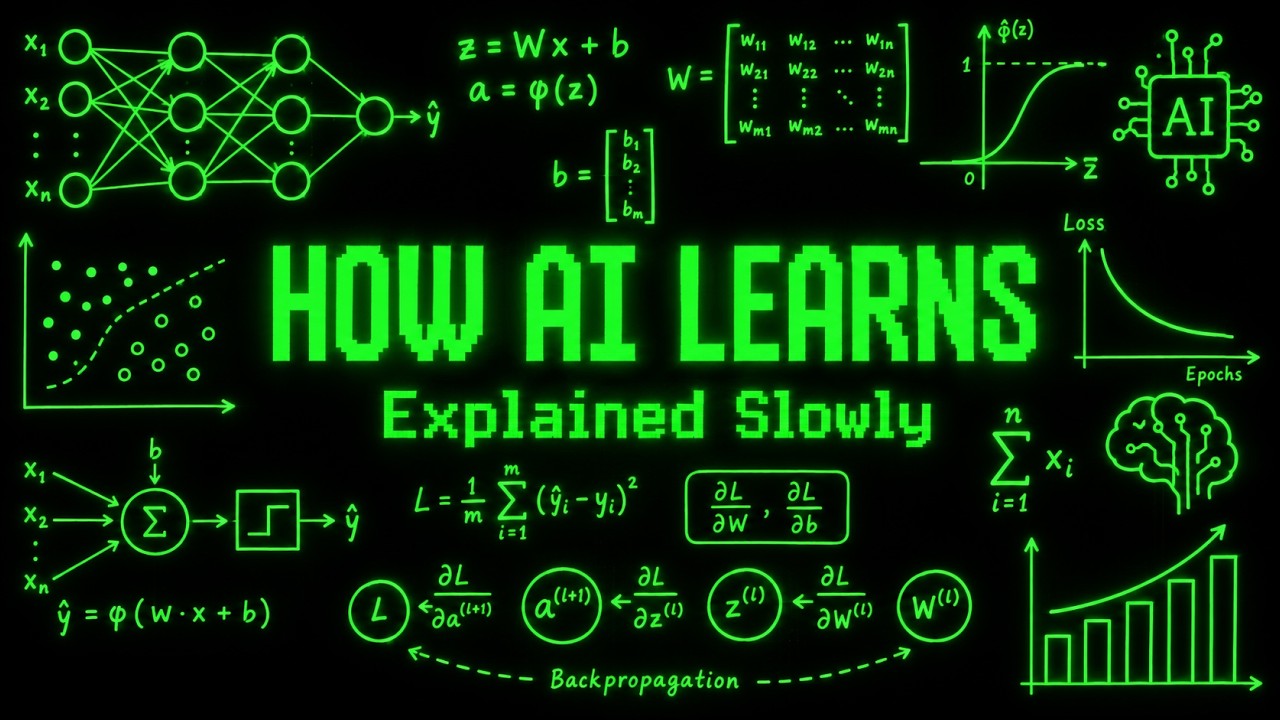
Every Confusing Thing About Neural Networks Explained Slowly (For Sleep)
Keywords
Summary
166 words
Critical Evaluation
Value of the Information & Strength of the Argument
The video provides substantial value by weaving together historical context and technical explanation, making it both educational and engaging. It clearly explains the core concepts of neural networks—weights, activation functions, gradient descent, and backpropagation—using analogies like tuning a guitar to illustrate the chain rule. The argumentation is solid, tracing the evolution of ideas and acknowledging the contributions of multiple researchers, which adds credibility. The narrative is well-structured, building from simple models to complex architectures, and it effectively conveys why neural networks are both powerful and still not fully understood.
Scientific Rigor, Source Quality, Title Accuracy
The video demonstrates strong scientific rigor by referencing seminal papers and key historical figures. It accurately describes the contributions of McCulloch, Pitts, Rosenblatt, Minsky, Papert, Linnainmaa, Werbos, Rumelhart, Hinton, and Williams. The sources cited in the description—Nature papers on backpropagation and deep learning, the NeurIPS ‘Attention Is All You Need’ paper, and the GPT-3 arXiv paper—are authoritative and directly relevant. The title accurately reflects the content, which is a slow, detailed, and calming explanation of neural networks. The video does not overstate claims and appropriately notes the limitations and unresolved questions in the field.
198 words
Title / Content Match
The title accurately reflects the content: a slow, detailed, and calming explanation of neural network concepts, suitable for sleep or relaxation.
Quality & Reliability
8/10
The video provides a historically accurate and technically sound overview of neural networks, from McCulloch-Pitts to Transformers, with clear explanations of key concepts like backpropagation and gradient descent. It cites seminal papers (Nature, NeurIPS, arXiv) and avoids overstatement, though it simplifies some details for accessibility.
Key Moments
Markers derived by PSI from the transcript: the creator did not define chapters.
- Introduction to neurons and the brain's 86 billion neurons.
- Santiago Ramón y Cajal's discovery of neurons and synapses.
- McCulloch-Pitts model (1943) and universal computation.
- Frank Rosenblatt's perceptron and its learning rule.
- Minsky and Papert's 'Perceptrons' book and the XOR problem.
- Seppo Linnainmaa's automatic differentiation and backpropagation.
- Rumelhart, Hinton, and Williams' 1986 Nature paper on backpropagation.
- Deep learning resurgence with AlexNet and ResNet.
- Transformers and the 'Attention Is All You Need' paper.
- Large language models like GPT-3 and their capabilities.
Cited Sources
- Learning representations by back-propagating errors — Seminal 1986 paper by Rumelhart, Hinton, and Williams on backpropagation.
- Deep Learning — 2015 Nature review article by LeCun, Bengio, and Hinton on deep learning.
- Attention Is All You Need — 2017 NeurIPS paper introducing the Transformer architecture.
- Language Models are Few-Shot Learners — 2020 arXiv paper describing GPT-3.
- Cosmo Explains Podcast — Podcast version of the video content.
Concurring Sources
- Learning representations by back-propagating errors — The video's explanation of backpropagation aligns with this seminal paper.
- Deep Learning — The video's overview of deep learning history and concepts is consistent with this review.
- Attention Is All You Need — The video's description of Transformers and attention matches the original paper.
Contribution & Novelties
The video’s original contribution lies in its accessible, narrative-driven synthesis of neural network history and concepts, designed for relaxation and sleep. It effectively connects biological inspiration to modern AI, making complex ideas approachable without sacrificing accuracy. The ‘slow’ format is a unique pedagogical approach.
Pour aller plus loin :
- Gradient descent — Core optimization algorithm for training neural networks.
- Backpropagation — Detailed explanation of the algorithm and its history.
- Transformer (machine learning model) — Architecture behind modern LLMs.
- AlexNet — The CNN that won ImageNet 2012 and sparked the deep learning boom.
- ResNet — Introduced skip connections to train very deep networks.
102 words
Radar Profile
The radar profile shows high scores in information quantity and technical level, with slightly lower scores in quality and reliability, reflecting the video's comprehensive yet accessible approach. The balance suggests a well-rounded educational resource.