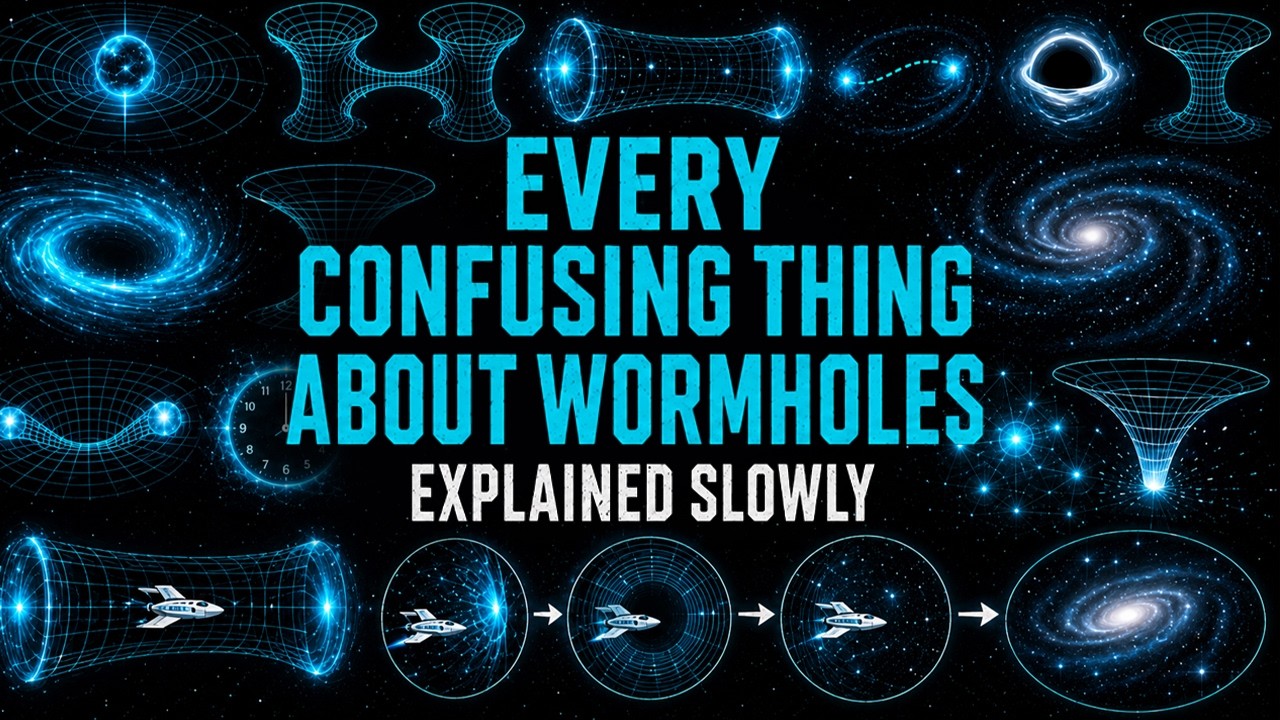
Every Confusing Thing About Wormholes Explained Slowly (For Sleep)
Keywords
Summary
164 words
Critical Evaluation
The video provides a comprehensive and scientifically accurate overview of wormholes, tracing the concept from its origins in general relativity to modern theoretical physics. The historical narrative is well-researched and presented with clarity, making complex ideas accessible without oversimplifying. The explanation of the equivalence principle and the curvature of spacetime is particularly effective, laying a solid foundation for understanding wormholes. The discussion of Schwarzschild’s solution and the nature of black holes is accurate, and the video correctly notes that the Einstein-Rosen bridge is unstable and cannot be traversed. The introduction of exotic matter as a requirement for stable wormholes is properly contextualized, and the video does not overstate the feasibility of time travel, acknowledging the paradoxes involved. The video’s strength lies in its ability to convey the mathematical and conceptual foundations of wormholes without resorting to sensationalism. However, it does not delve into the mathematical details, which may leave some viewers wanting more depth. Additionally, while the video mentions the work of Einstein, Rosen, Schwarzschild, and Wheeler, it does not cite specific papers or sources, which could be a limitation for those seeking to verify the information. Overall, the video is a reliable and engaging introduction to a complex topic, suitable for a general audience interested in astrophysics and theoretical physics.
211 words
Title / Content Match
The title accurately reflects the content: a slow, sleep-friendly explanation of wormholes and related concepts.
Quality & Reliability
8/10
The video provides a historically accurate and scientifically sound overview of wormholes, based on established physics (general relativity) and the work of Einstein, Rosen, Schwarzschild, and Wheeler. It correctly explains concepts like the equivalence principle, Schwarzschild radius, and the instability of Einstein-Rosen bridges. The presentation is clear and accessible, with no major scientific errors. However, it is a popularization and does not delve into the mathematical details, and it does not cite specific sources in the video itself.
Key Moments
Markers derived by PSI from the transcript: the creator did not define chapters.
- Introduction to wormholes and the idea that space can curve.
- Explanation of Einstein's equivalence principle and general relativity.
- Karl Schwarzschild's exact solution and the prediction of black holes.
- Einstein and Rosen's 1935 paper and the Einstein-Rosen bridge.
- John Wheeler coins the term 'wormhole' and introduces quantum foam.
- Discussion of exotic matter and the stability of wormholes.
- Time travel possibilities and paradoxes associated with wormholes.
- Conclusion: wormholes remain theoretical and unconfirmed.
Contribution & Novelties
The video offers a unique sleep-friendly format that combines historical narrative with scientific explanation, making complex physics accessible and relaxing. It provides a clear chronological account of the development of wormhole theory, from Einstein’s equations to modern speculations.
Pour aller plus loin :
- Einstein-Rosen bridge — Wikipedia article on wormholes, covering the Einstein-Rosen bridge and related concepts.
- General relativity — Overview of general relativity, including the field equations and their solutions.
- Exotic matter — Explanation of exotic matter and its role in stabilizing wormholes.
84 words
Radar Profile
The radar profile shows high scores in quantity and quality of information, with a moderate technical level. This indicates a well-balanced educational video that is both informative and accessible, though it does not delve into advanced mathematical details.