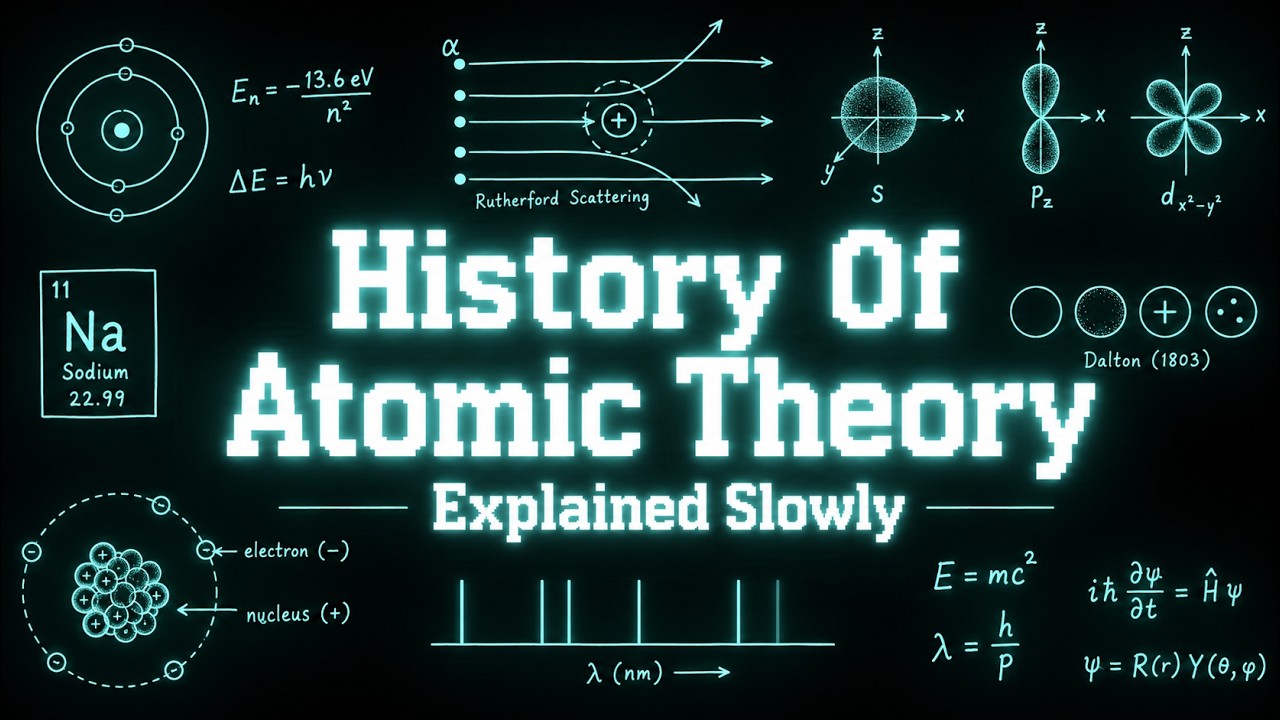
The Entire History Of Atomic Theory Explained Slowly (For Sleep)
Keywords
Summary
214 words
Critical Evaluation
The video offers a thorough and engaging narrative of atomic theory, spanning over two millennia of intellectual history. Its primary strength lies in its historical accuracy and the clear connections it draws between philosophical speculation, experimental discovery, and theoretical synthesis. The presentation correctly identifies the contributions of key figures such as Democritus, Dalton, Thomson, Rutherford, Bohr, and others, and it places their work in the broader context of scientific progress. The inclusion of the rediscovery of Lucretius’s poem and the role of chemistry in transforming atomism from philosophy to science adds depth and demonstrates a nuanced understanding of the history of science.
The scientific content is generally sound, with accurate descriptions of atomic structure, quantum mechanics, and the Standard Model. The video avoids oversimplification that could lead to misconceptions, and it appropriately notes where early theories were later refined or replaced. For example, it explains that Dalton’s solid, indivisible atoms were later found to have internal structure, and it clarifies that Bohr’s model was a stepping stone to more advanced quantum theories. The use of analogies, such as the dust motes in a sunbeam, helps make abstract concepts accessible without sacrificing accuracy.
The sources cited in the description are reputable and directly relevant, including OpenStax for educational material, Nobel Prize for Bohr’s biography, the U.S. Department of Energy for the Manhattan Project, and CERN for the Standard Model. These lend credibility to the content and provide viewers with avenues for further exploration. However, the video does not explicitly cite sources within the narration, which might make it harder for viewers to verify specific claims in real time.
The pacing is intentionally slow, which suits its stated purpose of aiding sleep or relaxation. This does not detract from the informational value, but it may not appeal to viewers seeking a more dynamic presentation. The title accurately reflects the content, and the video delivers on its promise of a comprehensive history.
Overall, the video is a reliable and informative resource for anyone interested in the history of atomic theory. It balances historical context with scientific explanation, and its use of authoritative sources enhances its credibility. Minor simplifications are acceptable given the target audience, and the content is free of significant errors. The video earns a high score for its quality and reliability.
380 words
Title / Content Match
The title accurately reflects the content: a comprehensive, slow-paced history of atomic theory designed for relaxation or sleep.
Quality & Reliability
8/10
The video provides a historically accurate and scientifically sound overview of atomic theory, from ancient Greek philosophy to the Standard Model. It correctly attributes key discoveries and includes references to reputable sources such as OpenStax, Nobel Prize, DOE, and CERN. The content is well-structured and avoids major errors, though it simplifies some complex topics for a general audience.
Key Moments
Markers derived by PSI from the transcript: the creator did not define chapters.
- Introduction: the ubiquity of atoms and the philosophical question of indivisibility.
- Democritus and Leucippus: the first atomic theory in ancient Greece.
- Aristotle's rejection of atoms and the dominance of the four elements.
- Lucretius's poem and the rediscovery of atomism in the Renaissance.
- Robert Boyle and the shift towards experimental chemistry.
- John Dalton's atomic theory and the laws of chemical combination.
- Discovery of the electron by J.J. Thomson and the plum pudding model.
- Rutherford's gold foil experiment and the nuclear model of the atom.
- Niels Bohr's quantum model and the quantization of electron orbits.
- Development of quantum mechanics and the discovery of the neutron.
- Nuclear fission, the Manhattan Project, and the atomic bomb.
- Particle physics: quarks, the Standard Model, and the Higgs boson.
- Conclusion: the ongoing quest for deeper layers of matter.
Cited Sources
- OpenStax – Evolution of Atomic Theory — Referenced as a resource for the historical development of atomic theory.
- Nobel Prize – Niels Bohr and Atomic Structure — Referenced for Bohr's contributions to atomic structure.
- U.S. Department of Energy – Manhattan Project History — Referenced for the history of the Manhattan Project.
- CERN – The Standard Model — Referenced for the Standard Model of particle physics.
- Spotify – Cosmo Explains Podcast — Promotional link for the podcast version of the content.
Concurring Sources
- OpenStax – Evolution of Atomic Theory — Supports the historical account of atomic theory from Democritus to modern chemistry.
- Nobel Prize – Niels Bohr and Atomic Structure — Confirms Bohr's role in developing the quantum model of the atom.
- CERN – The Standard Model — Aligns with the video's description of the Standard Model and fundamental particles.
Dissenting Sources
- No discordant sources found — The video's content is consistent with established scientific consensus and the cited sources.
Contribution & Novelties
The video provides a comprehensive and accessible historical narrative of atomic theory, connecting ancient philosophical ideas to modern particle physics. Its main contribution is the synthesis of a vast timeline into a coherent story, emphasizing the evolution of scientific thought and the interplay between theory and experiment. It also highlights the human side of science, with biographical details about key figures like Dalton and Bohr.
Pour aller plus loin :
- Atomic theory - Wikipedia — A broad overview of the development of atomic theory.
- Democritus - Stanford Encyclopedia of Philosophy — Detailed philosophical analysis of Democritus’s atomism.
- Quantum mechanics - Wikipedia — Introduction to the quantum framework that replaced Bohr’s model.
- Standard Model - CERN — Official CERN page on the Standard Model, as cited in the video.
128 words
Radar Profile
The radar profile shows high scores in quantity and quality of information, reflecting the video's comprehensive and accurate coverage. The technical level is moderate, suitable for a general audience, while reliability is strong due to the use of authoritative sources. This indicates a well-balanced educational resource.