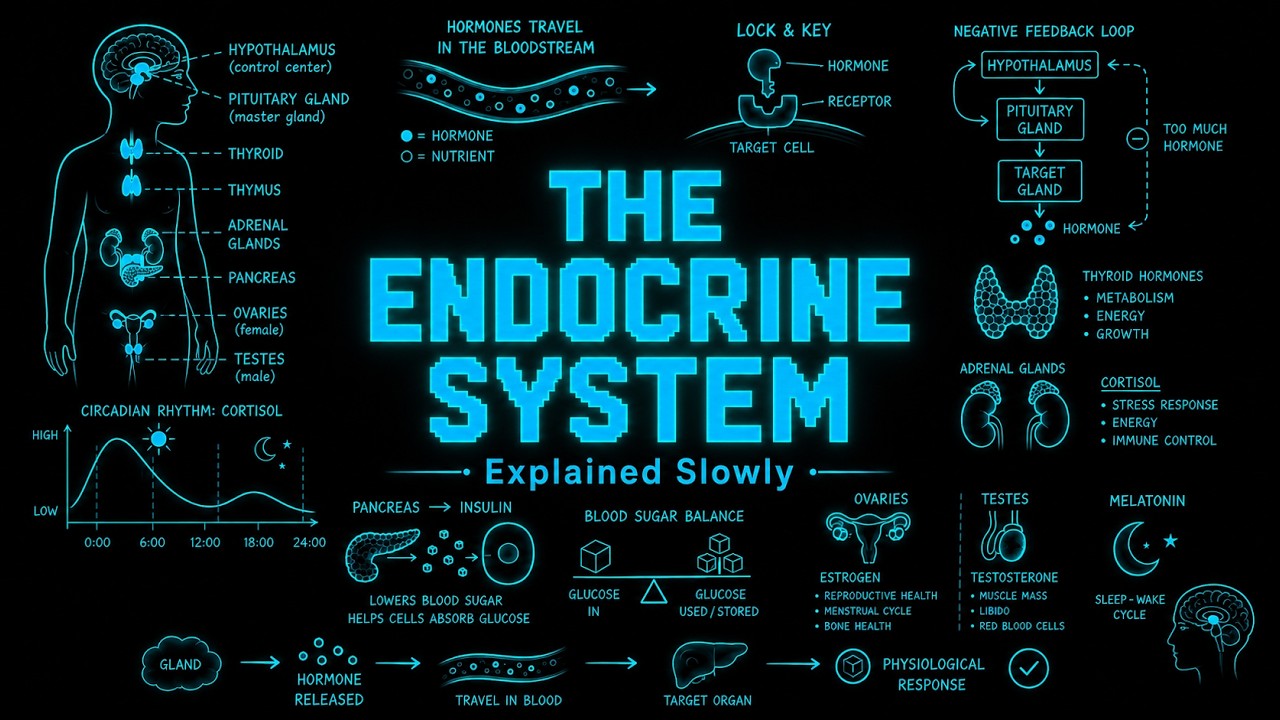
Every Confusing Thing About The Endocrine System Explained Slowly (For Sleep)
Keywords
Summary
176 words
Critical Evaluation
Value of the Information & Strength of the Argument
The video provides substantial educational value by weaving historical narratives with physiological mechanisms, making complex topics accessible. The argumentation is solid, using clear analogies (radio broadcast, lock-and-key) and logical progression from discovery to function. It effectively explains the ‘why’ behind the ‘what’, such as why the pancreas is difficult to extract insulin from. The historical accounts are detailed and engaging, adding depth to the scientific explanations. The video’s structure, building from simple concepts to more complex ones, supports comprehension, especially in a sleep context.
Scientific Rigor, Source Quality, Title Accuracy
The scientific content is rigorous, with accurate descriptions of historical experiments and physiological processes. The video cites authoritative sources in its description, including the National Institute of Diabetes and Digestive and Kidney Diseases (NIDDK), MedlinePlus, and Nobel Prize lectures, which are appropriate for the topics covered. The title accurately reflects the content and purpose of the video. The video’s approach is scientifically sound, with no evident misinformation or misleading claims.
169 words
Title / Content Match
The title accurately reflects the content: a slow, comprehensive, and relaxing explanation of the endocrine system, explicitly designed for sleep.
Quality & Reliability
8/10
The video provides a scientifically accurate and well-structured overview of the endocrine system, covering historical discoveries (Addison, Bernard, Bayliss & Starling, Banting & Best) and core physiological concepts (hormones, receptors, feedback loops). It cites reputable sources (NIDDK, MedlinePlus, Nobel Prize) in the description. Minor simplifications are typical of a sleep-focused science communication video, but no significant errors were identified.
Key Moments
Markers derived by PSI from the transcript: the creator did not define chapters.
- Introduction to the endocrine system as a chemical communication network.
- Historical context: ancient Greek humors and Galen's description of the thyroid.
- Thomas Addison's discovery linking adrenal gland destruction to disease.
- Claude Bernard's concept of the internal environment and internal secretions.
- Bayliss and Starling's experiment discovering secretin and coining 'hormone'.
- The discovery of insulin: from Langerhans' islets to Banting and Best's extraction.
- The first successful insulin injection in Leonard Thompson and the impact on diabetes treatment.
- Explanation of hormone-receptor interaction using the lock-and-key analogy.
- Introduction to the pituitary gland as the master gland controlling growth and other functions.
- Discussion of cortisol, stress response, and circadian rhythms.
- Modern endocrinology: GLP-1 and the broader role of hormones in metabolism and appetite.
Cited Sources
- Endocrine Diseases - NIDDK — General resource on endocrine diseases mentioned in the video description.
- Endocrine Diseases - MedlinePlus — General resource on endocrine diseases mentioned in the video description.
- Nobel Prize - Frederick Banting: Diabetes and Insulin — Referenced in the description for the insulin discovery story.
- Nobel Prize - Molecular Mechanisms Controlling the Circadian Rhythm — Referenced in the description for the circadian rhythm section.
- Cosmo Explains on Spotify — Streaming platform for the video content, mentioned in the description.
Concurring Sources
- Endocrine Diseases - NIDDK — Confirms the general functions and disorders of the endocrine system.
- Endocrine Diseases - MedlinePlus — Provides reliable health information on endocrine diseases, supporting the video's content.
- Nobel Prize - Frederick Banting: Diabetes and Insulin — Primary source for the insulin discovery story, aligning with the video's narrative.
- Nobel Prize - Molecular Mechanisms Controlling the Circadian Rhythm — Supports the video's explanation of circadian rhythms and their molecular basis.
Contribution & Novelties
The video’s original contribution lies in its format: a slow, narrative-driven, and historically contextualized explanation of the endocrine system designed for sleep. It effectively connects the dots between historical discoveries and modern understanding, making the subject approachable without oversimplifying. The focus on the ‘why’ and ‘how’ of hormone function, rather than just listing facts, provides a deeper understanding.
Pour aller plus loin :
- Endocrine System - Wikipedia — Comprehensive overview of the endocrine system, its glands, and hormones.
- Insulin - Wikipedia — Detailed article on insulin, its discovery, and its role in diabetes.
- Circadian Rhythm - Wikipedia — Explains the biological clock and its molecular mechanisms, relevant to the video’s discussion of sleep and hormones.
- GLP-1 - Wikipedia — Information on GLP-1, a modern hormone target mentioned in the video.
- Pituitary Gland - Wikipedia — Details on the ‘master gland’ and its hormones.
143 words
Radar Profile
The radar profile shows high scores in information quantity and quality, reflecting the video's comprehensive and accurate content. The technical level is moderate, appropriate for a general audience, while reliability is high due to the use of authoritative sources. This indicates a well-balanced educational resource.