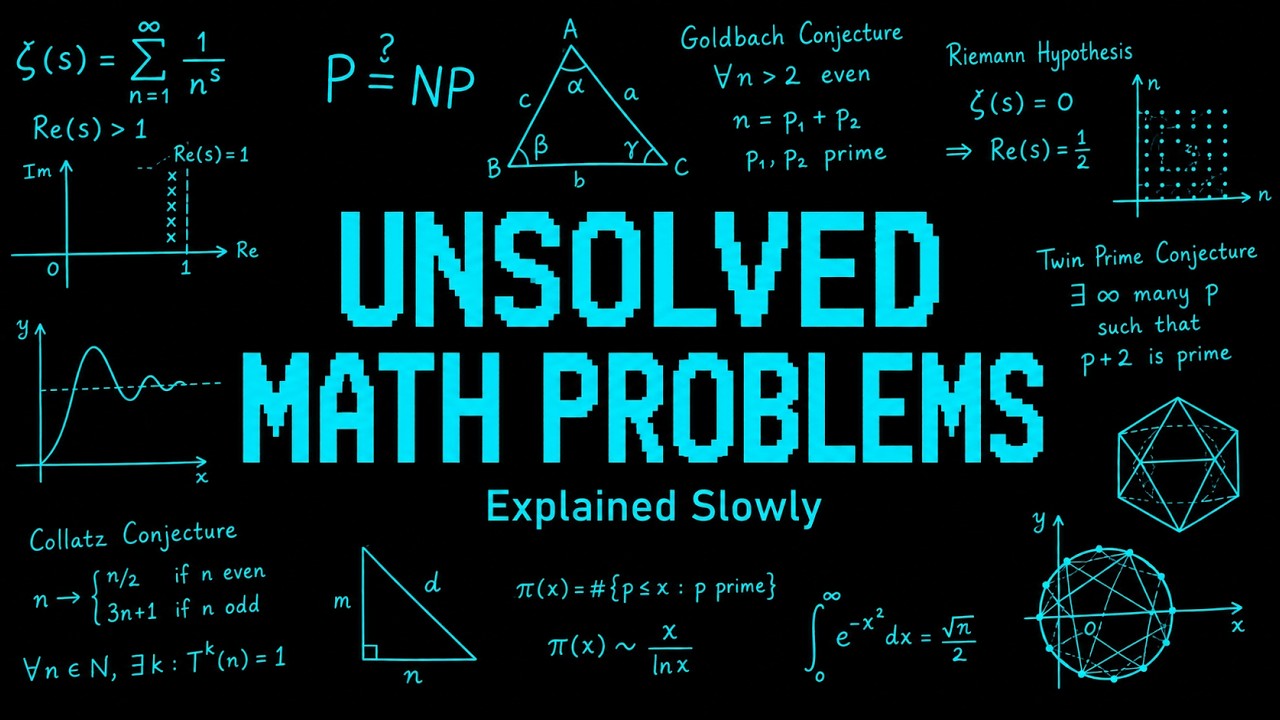
Every Unsolved Math Problem In History Explained Slowly (For Sleep)
Keywords
Summary
138 words
Critical Evaluation
The video offers a commendable overview of several major unsolved problems in mathematics, presented in a calm and accessible manner suitable for a general audience. The historical context is generally accurate, and the explanations are clear, making complex ideas understandable without oversimplifying to the point of error. The inclusion of recent developments, such as Yitang Zhang’s breakthrough on bounded gaps between primes and the Polymath project’s reduction to 246, adds credibility and shows that the content is up-to-date. The video also correctly emphasizes the distinction between empirical evidence and rigorous proof, a fundamental aspect of mathematical methodology.
However, the scientific depth is limited by the format and target audience. Some topics are treated superficially, and the video does not delve into the technical details or the mathematical machinery behind the problems. For instance, the Riemann Hypothesis is introduced with its connection to the zeta function, but the explanation of why it matters and the implications of its proof are not fully explored. Similarly, the Navier-Stokes existence and smoothness problem is mentioned but not explained in any depth, which might leave viewers with only a vague understanding.
The sources cited are reputable, including the Clay Mathematics Institute and Stanford Encyclopedia of Philosophy, which bolsters the reliability of the information. However, the video does not always clearly distinguish between established facts and conjectures, though it generally does so. The presentation is engaging and well-structured, with a logical flow from historical foundations to modern problems.
The title accurately reflects the content, and the slow-paced narration is effective for its intended purpose of relaxation and sleep. The video does not contain any obvious errors or misleading claims, but it also does not provide a comprehensive or rigorous treatment of the subject. For viewers seeking a gentle introduction to these fascinating problems, it serves as an excellent starting point, but those looking for a deeper understanding would need to consult more specialized resources.
318 words
Title / Content Match
The title accurately reflects the content: the video covers a wide range of unsolved math problems in a slow, explanatory style intended for sleep.
Quality & Reliability
7/10
The video provides a broad overview of several famous unsolved problems in mathematics, with generally accurate historical context and explanations. It cites reputable sources such as the Clay Mathematics Institute and Stanford Encyclopedia of Philosophy. However, it lacks depth on some topics and does not discuss recent developments or controversies in detail. The presentation is clear and accessible, but the scientific rigor is moderate due to the simplified nature.
Key Moments
Markers derived by PSI from the transcript: the creator did not define chapters.
- Introduction to unsolved math problems and the nature of mathematical proof.
- Discussion of ancient Babylonian mathematics and their practical approach.
- Pythagoras and the discovery of irrational numbers, leading to the first crisis in mathematics.
- Euclid's proof of infinitely many primes and the fundamental theorem of arithmetic.
- Introduction to twin primes and the twin prime conjecture.
- Yitang Zhang's breakthrough and the Polymath project reducing the gap to 246.
- Leonhard Euler and the connection between infinite sums and primes.
- Introduction to the Riemann Hypothesis and the zeta function.
- Goldbach's conjecture and its history.
- The Collatz conjecture and its deceptively simple formulation.
- P vs NP problem and its implications for computer science.
- Navier-Stokes equations and the challenge of proving existence and smoothness.
- Gödel's incompleteness theorems and the limits of mathematical proof.
- The Poincaré conjecture and its solution by Grigori Perelman.
- Ramanujan's contributions and the mystery of his formulas.
- Reflections on the nature of unsolved problems and the future of mathematics.
Cited Sources
- Clay Mathematics Institute – Millennium Prize Problems — Official source for the Millennium Prize Problems, including the Riemann Hypothesis, P vs NP, and Navier-Stokes.
- American Mathematical Society – Prime Numbers, Twin Primes and Goldbach’s Conjecture — Article discussing prime numbers, twin primes, and Goldbach's conjecture.
- Stanford Encyclopedia of Philosophy – Gödel’s Incompleteness Theorems — Detailed philosophical and mathematical overview of Gödel's incompleteness theorems.
- Wolfram MathWorld – Collatz Problem — Reference for the Collatz conjecture, including its statement and known results.
Concurring Sources
- Clay Mathematics Institute – Millennium Prize Problems — The video's descriptions of the Millennium Prize Problems align with the official statements.
- Stanford Encyclopedia of Philosophy – Gödel’s Incompleteness Theorems — The video's explanation of Gödel's theorems is consistent with the philosophical and mathematical details.
Dissenting Sources
- No discordant sources found — The video does not contradict any major established mathematical knowledge.
External References
Contribution & Novelties
The video provides a comprehensive and accessible overview of several major unsolved problems in mathematics, connecting them through historical narrative and emphasizing the importance of proof. It highlights recent progress, such as Zhang’s work on prime gaps, and presents the material in a calm, sleep-friendly format.
Pour aller plus loin :
- Riemann Hypothesis — Detailed explanation of the hypothesis and its significance.
- Twin Prime Conjecture — Overview of the conjecture and recent progress.
- Goldbach’s Conjecture — History and current status.
- Collatz Conjecture — Explanation and computational evidence.
- P vs NP Problem — Introduction to one of the most important problems in computer science.
- Navier–Stokes Existence and Smoothness — Millennium Prize problem description.
- Gödel’s Incompleteness Theorems — Overview of the theorems and their implications.
- Poincaré Conjecture — History and Perelman’s proof.
130 words
Radar Profile
The radar profile shows high scores in quantity of information and fiabilité, indicating a comprehensive and reliable overview. The quality of information and technical level are moderate, reflecting the accessible but not deeply technical nature of the content.
💬 No comments were provided for analysis.