Every Confusing Thing About How Sleep Actually Works Explained Slowly (For Sleep)
Keywords
Summary
161 words
Critical Evaluation
The video excels in making complex sleep science accessible and engaging. It weaves a compelling narrative, starting with historical misconceptions and progressing through pivotal discoveries, which helps contextualize current understanding. The scientific accuracy is high: the descriptions of EEG waves (alpha, beta, delta), sleep stages, and REM sleep align with established knowledge. The evolutionary perspective on sleep’s universality is well-presented, though it could be strengthened by mentioning specific species and their sleep patterns, which it does briefly. The explanation of the sleep cycle is clear, but it omits details on the neural mechanisms (e.g., the role of the hypothalamus, brainstem, and neurotransmitters like orexin). The video also touches on circadian rhythms but does not explain the molecular clock (e.g., CLOCK and BMAL1 genes). The lack of citations to recent research is a minor weakness; it relies on historical figures and general facts, which are reliable but not cutting-edge. The production quality is high, with a soothing narration and visuals that support comprehension. The title accurately reflects the content, and the slow pace is intentional, catering to an audience seeking relaxation or sleep aid. Overall, the video is a valuable educational resource for laypeople, but it does not offer novel insights for those already familiar with sleep science. The absence of a discussion on sleep disorders (e.g., insomnia, sleep apnea) is a missed opportunity, as it could enhance practical relevance. The video’s strength lies in its clarity and narrative flow, making it an excellent introduction to the topic.
247 words
Title / Content Match
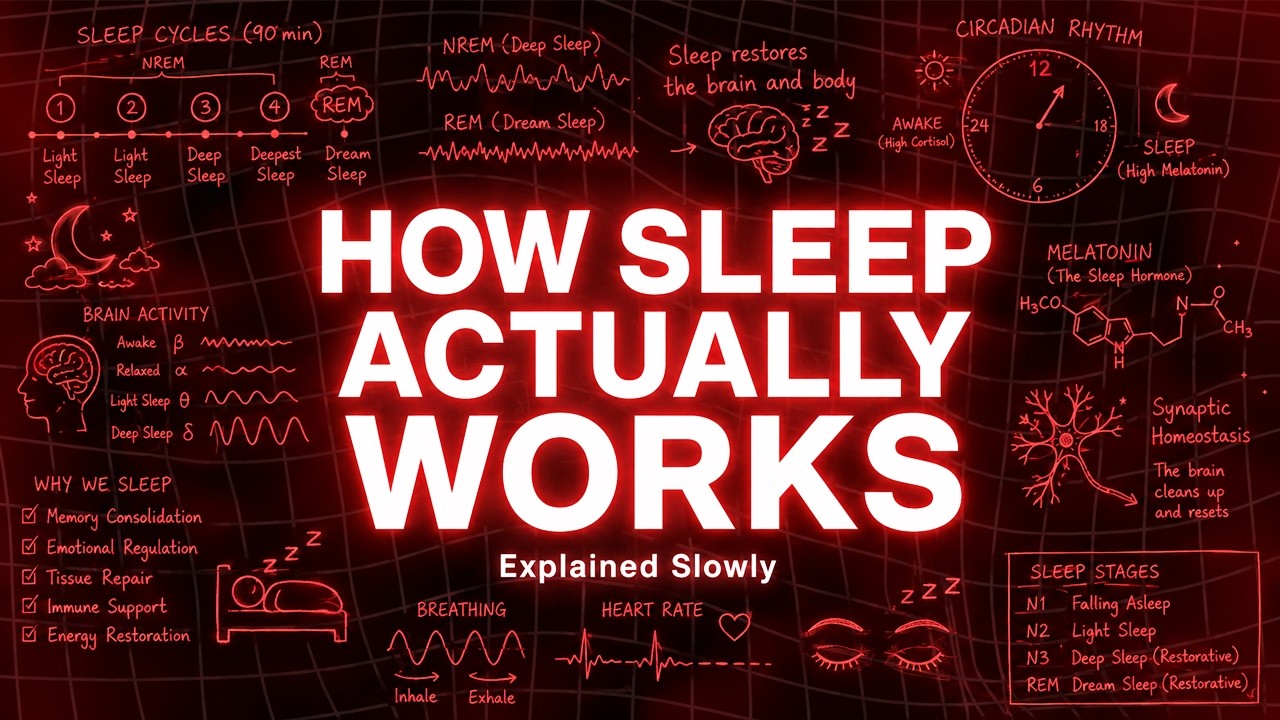
The title accurately reflects the content: a slow, detailed explanation of sleep mechanisms, including cycles, REM, deep sleep, and brain activity.
Quality & Reliability
8/10
The video provides a historically grounded and scientifically accurate overview of sleep research, citing key figures (Aristotle, Hans Berger, Alfred Loomis, Eugene Aserinsky, Nathaniel Kleitman) and landmark studies. It avoids major errors, though it simplifies some mechanisms and does not cite specific recent studies. The presentation is clear and engaging, with a calm tone suitable for a general audience.
Key Moments
Markers derived by PSI from the transcript: the creator did not define chapters.
- Introduction: the mystery of sleep and its evolutionary paradox.
- Aristotle's theory of sleep as digestive vapors.
- Hans Berger's invention of the EEG and discovery of brain waves.
- Alfred Loomis identifies distinct sleep stages using EEG.
- Eugene Aserinsky discovers REM sleep and its link to dreaming.
- Explanation of the sleep cycle: alternating non-REM and REM phases.
- Discussion on how sleep architecture changes across the night.
- Overview of sleep functions: memory, repair, and emotional regulation.
Cited Sources
- On Sleep and Sleeplessness (Aristotle) — Mentioned as the first scientific text on sleep in the Western tradition.
- Hans Berger's EEG recordings (1929) — Described as the first successful recording of human brain electrical activity.
- Loomis's sleep stages (1937) — Identified distinct stages of sleep using EEG.
- Aserinsky and Kleitman's REM discovery (1953) — Discovery of rapid eye movement sleep and its association with dreaming.
Concurring Sources
- Sleep: A Comprehensive Overview — The National Institute of Neurological Disorders and Stroke provides a reliable overview of sleep, corroborating the video's explanations of sleep stages and functions.
Contribution & Novelties
The video provides a clear historical narrative of sleep research, making it accessible to a general audience. It synthesizes key discoveries into a coherent story, emphasizing the evolutionary importance of sleep. While it does not present new scientific findings, it effectively communicates established knowledge in an engaging format.
Pour aller plus loin :
- Sleep cycle on Wikipedia — Provides a detailed overview of sleep stages and cycles.
- Circadian rhythm on Wikipedia — Explains the biological clock and its molecular mechanisms.
- Hans Berger on Wikipedia — Biography of the inventor of EEG.
- REM sleep on Wikipedia — Detailed information on REM sleep characteristics and functions.
104 words
Radar Profile
The radar profile shows high scores in quantity and quality of information, with a moderate technical level. This indicates a well-balanced educational video that is informative yet accessible, with strong reliability.