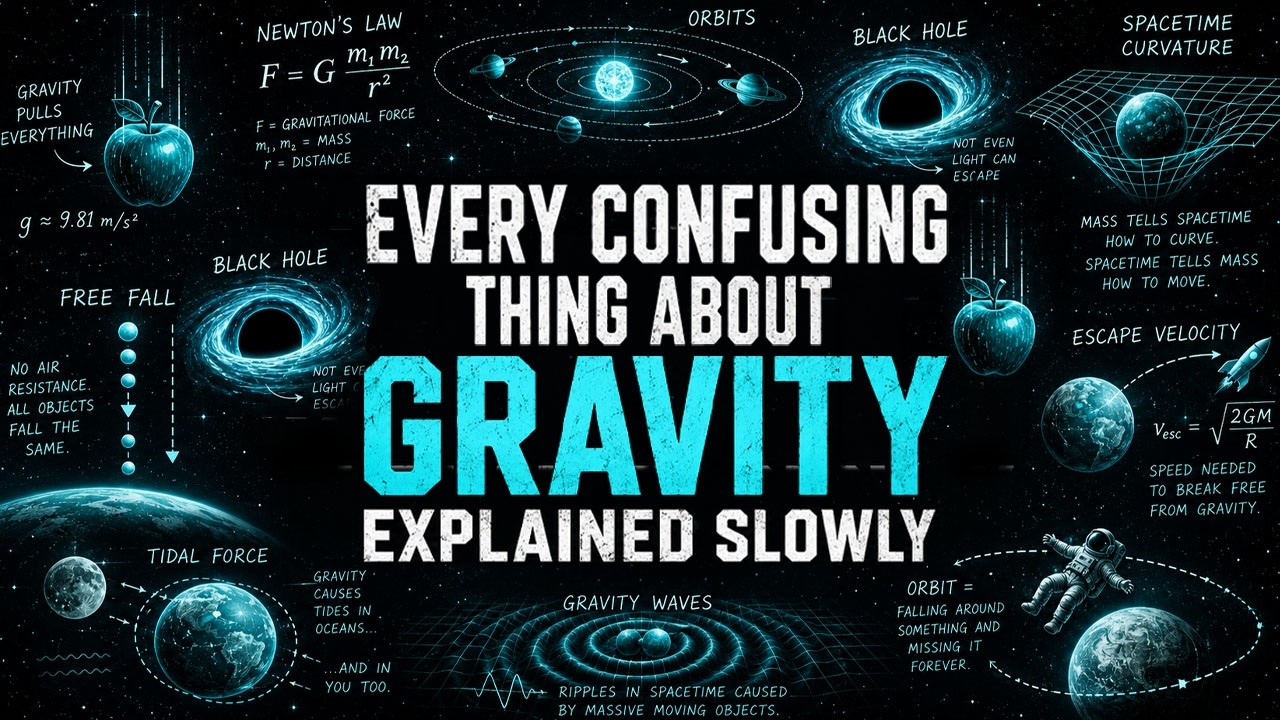
Every Confusing Thing About Gravity Explained Slowly (For Sleep)
Keywords
Summary
104 words
Critical Evaluation
The video offers a solid, historically grounded introduction to gravity, focusing on the classical understanding from Aristotle to Newton. The scientific content is accurate: Galileo’s inclined plane experiments correctly demonstrate constant acceleration and the independence of mass, and Newton’s law of universal gravitation is explained with the inverse-square relationship. The explanation of orbits as ‘falling and missing’ is particularly effective and intuitive. The historical narratives, while sometimes embellished, are presented with appropriate skepticism (e.g., the Galileo tower story is noted as likely legendary). The video’s strength lies in its clarity and pacing, making complex ideas accessible without oversimplifying. However, it has limitations: it does not address modern physics, such as general relativity, which is a significant omission given the title’s promise to cover ’every confusing thing about gravity.’ Additionally, no sources are cited within the video, and the only link in the description is to a Spotify show, which is not a scientific reference. The sponsorship segment is brief and does not detract from the content. The title is well-matched to the content, though the scope is narrower than implied. Overall, the video is a reliable and engaging educational resource for beginners, but it lacks depth and citations for a more rigorous audience.
203 words
Title / Content Match
The title accurately reflects the content: a slow, sleep-focused explanation of confusing aspects of gravity.
Quality & Reliability
7/10
The video provides an accurate historical and conceptual overview of gravity, from Aristotle to Newton, with correct scientific explanations. It includes some historical anecdotes that are presented with appropriate caveats (e.g., Galileo's tower experiment). However, it lacks citations to primary sources and does not delve into modern physics (e.g., general relativity) in depth.
Key Moments
Markers derived by PSI from the transcript: the creator did not define chapters.
- Introduction: gravity as a constant force acting on us.
- Aristotle's theory of natural places and heavy objects falling faster.
- Galileo's inclined plane experiments and discovery of constant acceleration.
- Galileo's concept of inertia and the natural state of motion.
- Newton's apple story and the idea of orbits as falling and missing.
- Newton's law of universal gravitation and inverse-square law.
- Prediction of Neptune using Newton's law.
Cited Sources
- Cosmo Explains on Spotify — The video description links to the show's Spotify page, which may contain related content.
Concurring Sources
- Newton's law of universal gravitation — Provides a detailed explanation of the law, consistent with the video's description.
- Galileo's inclined plane experiments — Confirms the historical accuracy of Galileo's methods and findings.
Dissenting Sources
Contribution & Novelties
The video provides a clear, accessible explanation of classical gravity, emphasizing historical context and intuitive analogies. It is particularly effective in explaining orbits as continuous falling and the equivalence of gravitational and inertial mass. For a more comprehensive understanding, viewers can explore general relativity, which extends Newton’s framework to extreme conditions.
Pour aller plus loin :
- General relativity — The modern theory of gravity, essential for understanding black holes and cosmology.
- Equivalence principle — The foundation of general relativity, explaining why all objects fall at the same rate.
- Inverse-square law — The mathematical form of Newton’s law, applicable to many physical phenomena.
102 words
Radar Profile
The radar profile shows strong scores in quality of information and reliability, reflecting accurate scientific content. The quantity of information is moderate, and the technical level is low, consistent with a sleep-oriented, introductory video. The overall balance indicates a reliable but not deeply technical resource.
💬 No comments were provided for analysis.