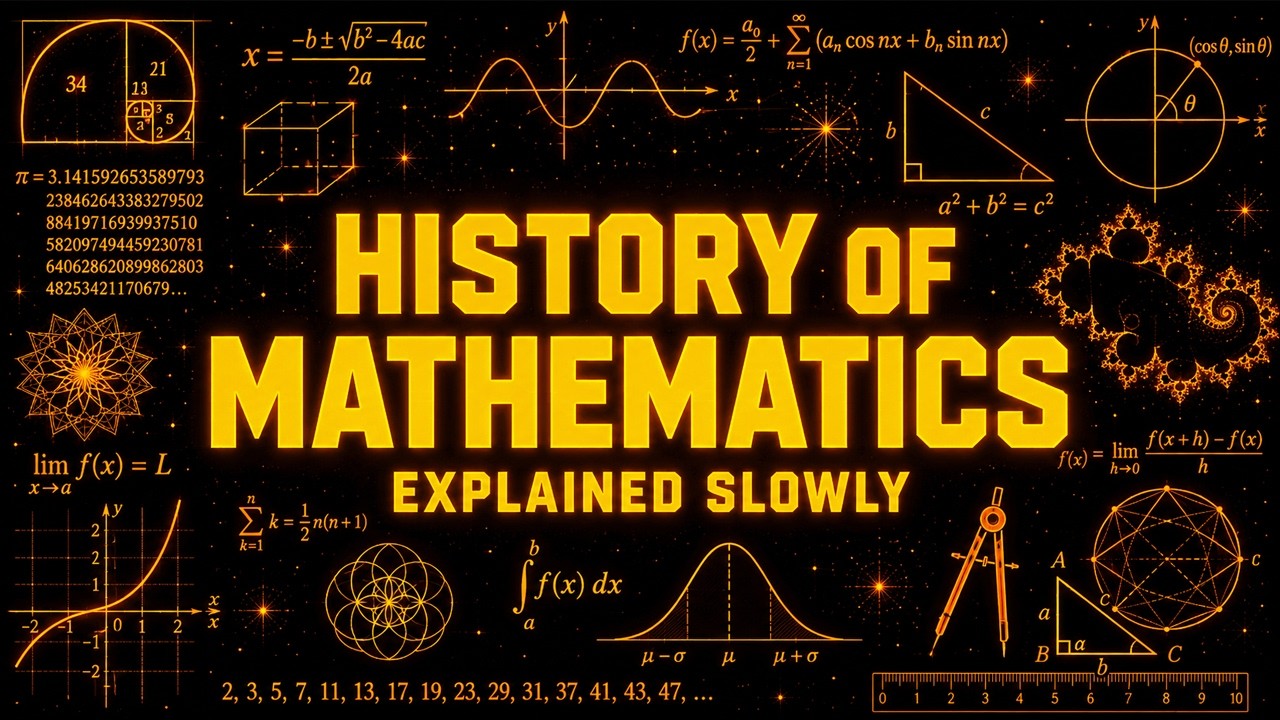
The Entire History Of Mathematics Explained Slowly (For Sleep)
Keywords
Summary
154 words
Critical Evaluation
The video offers a comprehensive and engaging overview of the history of mathematics, spanning from prehistoric artifacts to modern developments. Its strength lies in its accessible narrative and the clear connections it draws between mathematical concepts and their practical origins, such as the need for land measurement in Egypt or accounting in Mesopotamia. The pacing is deliberately slow, which suits its stated purpose as a sleep aid, but this also means that complex ideas are often simplified, potentially glossing over nuances. For instance, the treatment of Pythagoras leans heavily on legend, and the video acknowledges the uncertainty but does not delve into the historical debates. The discussion of the Ishango bone is appropriately cautious, noting the ambiguity of its interpretation. The video’s scientific rigor is moderate: it presents established historical narratives without deep critical analysis, and it does not provide citations or references to primary sources. However, the information is generally accurate and well-aligned with mainstream historical accounts. The production quality is high, with a calm narration and soothing visuals, effectively fulfilling its purpose as a relaxing educational documentary. The title accurately reflects the content, and the video delivers on its promise of a slow, comprehensive history. Overall, it is a valuable resource for those seeking a gentle introduction to the subject, though it may not satisfy viewers looking for a more rigorous academic treatment.
225 words
Title / Content Match
The title accurately reflects the content: a slow, comprehensive history of mathematics designed for relaxation and sleep.
Quality & Reliability
7/10
The video provides a broad historical overview of mathematics, covering well-known artifacts and figures. It is generally accurate but simplifies complex historical nuances and relies on traditional narratives. The content is well-structured and accessible, but lacks in-depth critical analysis and citations to primary sources.
Key Moments
Markers derived by PSI from the transcript: the creator did not define chapters.
- Introduction: The concept of numbers and the Ishango bone.
- Early counting and one-to-one correspondence.
- Mesopotamian mathematics: base-60 and Plimpton 322.
- Egyptian mathematics: Rhind Papyrus and practical geometry.
- Pythagoras and the Greek shift to proof-based mathematics.
- Hellenistic mathematics: Euclid and Archimedes.
- Islamic Golden Age: algebra and algorithms.
- Renaissance and the development of calculus.
- Modern mathematics: set theory and computability.
- Computers and the future of mathematics.
Cited Sources
- Ishango bone — Mentioned as an early mathematical artifact.
- Plimpton 322 — Babylonian clay tablet with Pythagorean triples.
- Rhind Mathematical Papyrus — Egyptian mathematical text.
Concurring Sources
- Ishango bone — The video's description of the Ishango bone aligns with mainstream archaeological interpretations.
- Plimpton 322 — The video's account of Plimpton 322 as a list of Pythagorean triples is consistent with scholarly consensus.
- Rhind Mathematical Papyrus — The video's description of the Rhind Papyrus as a practical mathematical text matches historical understanding.
Dissenting Sources
Contribution & Novelties
The video provides a comprehensive and accessible overview of the history of mathematics, emphasizing the practical origins of mathematical concepts and the human stories behind them. It is particularly effective in connecting ancient practices to modern applications, making the subject relatable. The slow, calming presentation style is innovative for the genre, catering to a niche audience seeking educational content for relaxation or sleep.
Pour aller plus loin :
- History of mathematics — A comprehensive overview of the subject.
- Babylonian mathematics — Detailed information on the mathematical achievements of ancient Babylon.
- Pythagorean theorem — The theorem associated with Pythagoras, with historical context.
101 words
Radar Profile
The radar profile shows high scores in quantity of information and quality of information, reflecting the video's comprehensive coverage and accurate presentation. The level of technical detail is moderate, suitable for a general audience, and the overall reliability is solid, though not without simplifications.
💬 Sur les 0 commentaires analysés, aucune tendance n'est disponible.