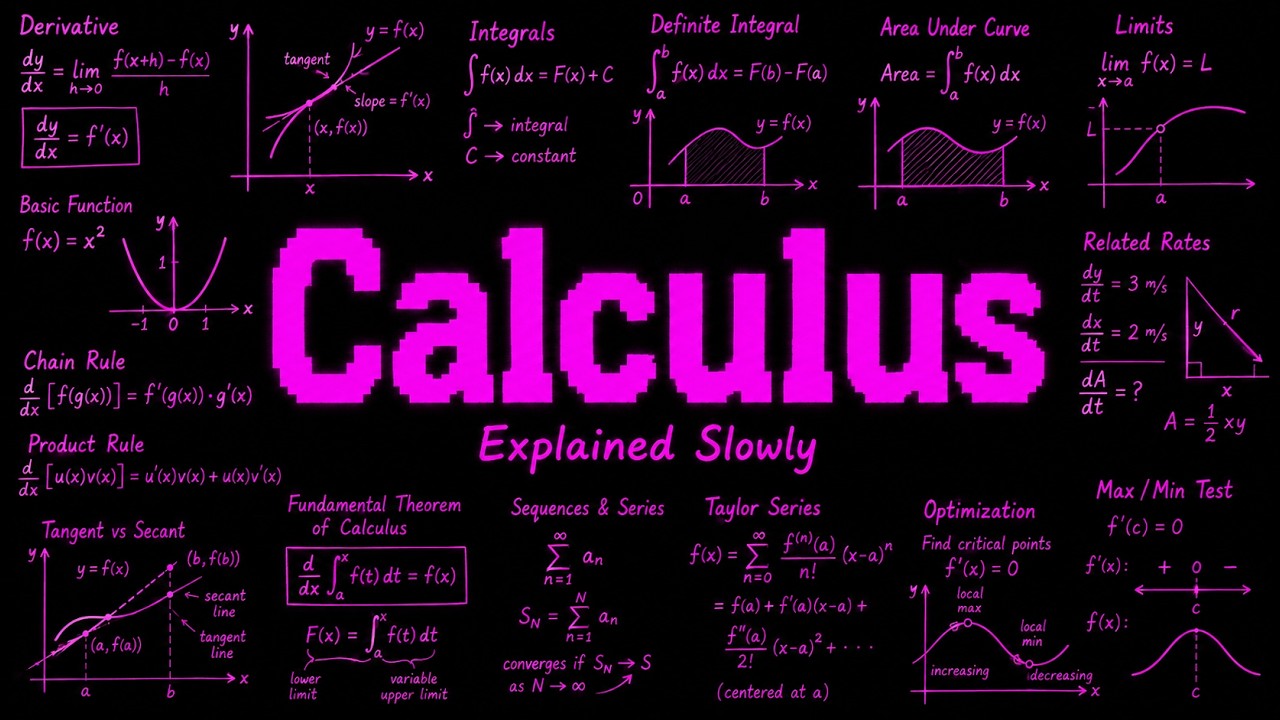
Literally Everything About Calculus Explained Slowly (For Sleep)
Keywords
Summary
155 words
Critical Evaluation
The video offers a comprehensive and engaging overview of calculus, blending historical narrative with mathematical concepts. Its strength lies in its clear explanations of foundational ideas such as limits, derivatives, and integrals, making them accessible to a general audience. The historical context is well-researched, with references to reputable sources like MacTutor and the Stanford Encyclopedia of Philosophy, which enhances its credibility. The argumentation is logical and builds progressively, from ancient methods to modern applications. However, the video’s slow pace and focus on sleep may limit its depth for those seeking a rigorous mathematical treatment. Some concepts, such as the rigorous definition of limits, are mentioned but not fully elaborated, which is appropriate for the intended audience. The inclusion of non-Western contributions, like those from the Kerala school, is commendable and adds a more complete historical perspective. The video’s production quality is high, with a calm narration that suits its purpose. Overall, it serves as an excellent introductory resource for understanding calculus’s significance and history, though it may not satisfy viewers seeking advanced mathematical detail.
174 words
Title / Content Match
The title accurately reflects the content, as the video comprehensively covers the history and concepts of calculus in a slow, relaxing manner suitable for sleep.
Quality & Reliability
8/10
The video provides a historically accurate and mathematically sound overview of calculus, citing reputable sources such as MacTutor, Stanford Encyclopedia of Philosophy, and Cambridge Digital Library. The content is well-researched and aligns with established mathematical knowledge.
Key Moments
Markers derived by PSI from the transcript: the creator did not define chapters.
- Introduction to calculus as the mathematics of change, with examples from everyday life.
- Archimedes and the method of exhaustion for finding the area of a circle, introducing the concept of limits.
- Zeno's paradoxes and the problem of infinite sums, highlighting the need for limits.
- Contributions from Indian and Islamic mathematicians, including Madhava and Alhazen, to early calculus.
- Descartes' connection of algebra and geometry, setting the stage for Newton and Leibniz.
- Development of limits, derivatives, and integrals by Newton and Leibniz, and the fundamental theorem of calculus.
- Applications of calculus in physics, engineering, probability, finance, and artificial intelligence.
- Discussion of the rigorous definition of limits in the 19th century and the formalization of calculus.
- Conclusion summarizing the journey of calculus from ancient geometry to modern applications.
Cited Sources
- MacTutor – A History of Calculus — Referenced as a resource for the history of calculus.
- Khan Academy – Calculus 1 — Referenced as a learning resource for calculus.
- Stanford Encyclopedia of Philosophy – Infinity — Referenced for philosophical background on infinity.
- Cambridge Digital Library – Newton Papers — Referenced for primary sources on Newton's work.
Concurring Sources
- MacTutor – A History of Calculus — Supports the historical narrative of calculus development.
- Stanford Encyclopedia of Philosophy – Infinity — Aligns with the discussion of infinity and limits.
External References
Contribution & Novelties
The video provides a unique synthesis of the history of calculus, emphasizing contributions from non-Western mathematicians and connecting ancient methods to modern applications. It offers a calming, accessible narrative that makes complex ideas approachable.
Pour aller plus loin :
- MacTutor History of Mathematics — Comprehensive biographies and historical articles on mathematicians.
- Stanford Encyclopedia of Philosophy – Infinity — Philosophical analysis of infinity and its mathematical implications.
- Khan Academy – Calculus — Interactive lessons and practice problems for learning calculus.
79 words
Radar Profile
The radar profile shows high scores in quantity and quality of information, with a moderate level of technical depth. This indicates a well-balanced educational video that is informative and reliable, though not highly technical.