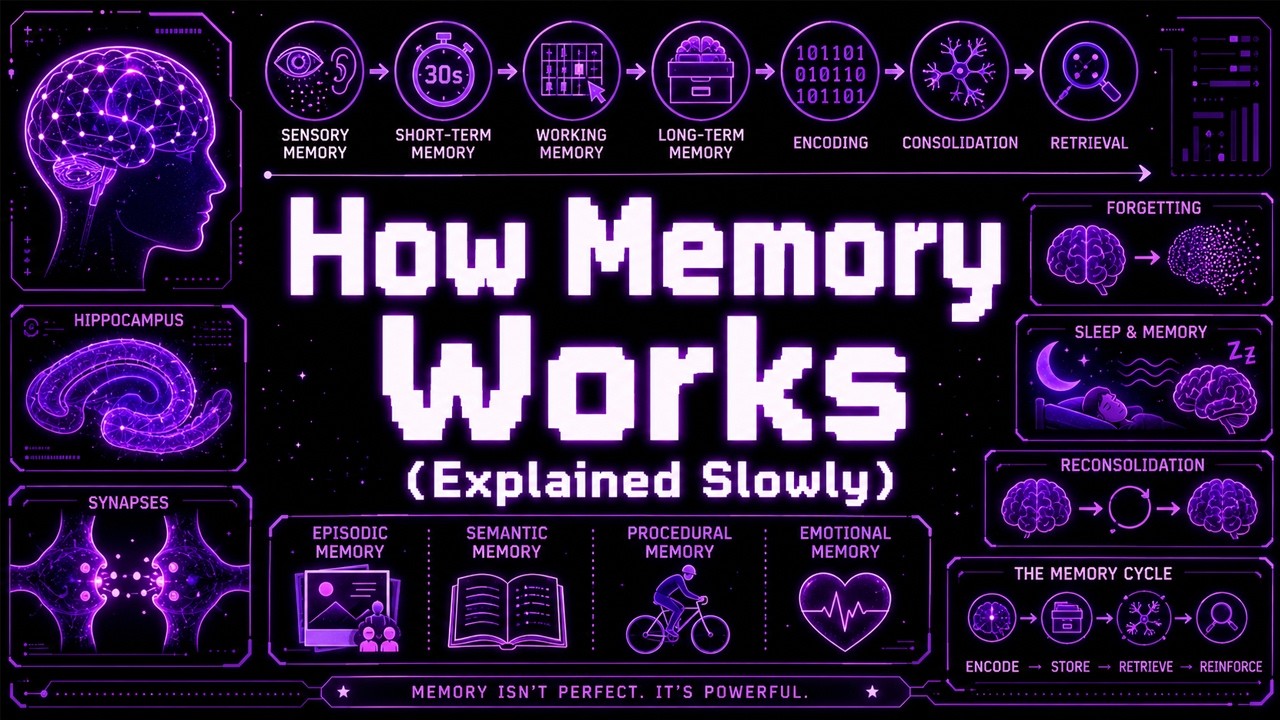
Literally Everything About How Memory Works Explained Slowly (For Sleep)
Keywords
Summary
173 words
Critical Evaluation
The video offers a scientifically rigorous and historically grounded overview of memory research, making it a valuable resource for those seeking a foundational understanding. The narrative is well-structured, tracing the evolution of ideas from Ebbinghaus’s behavioral experiments to the cellular mechanisms discovered by Bliss and Lømo. The explanation of the forgetting curve is accurate and effectively contextualized, helping viewers understand why they forget. The discussion of Lashley’s work correctly highlights the concept of equipotentiality and its limitations, setting the stage for the later realization that memory is distributed across multiple systems. Cajal’s contribution is presented with appropriate reverence, and his hypothesis about synaptic strengthening is correctly identified as a precursor to modern understanding. Hebb’s rule is explained clearly, and the video properly notes that it was a theoretical framework awaiting empirical confirmation. The discovery of long-term potentiation is described in detail, emphasizing its significance as the first direct evidence of synaptic plasticity. The video also touches on the distinction between short-term and long-term memory, and the role of the hippocampus, without delving into overly complex details. The tone is calm and measured, fitting the sleep-focused format. However, the video lacks citations or references to primary sources, which would enhance its credibility for those wishing to verify the information. Additionally, while it covers many key concepts, it omits some recent developments in memory research, such as the role of sleep in memory consolidation, which is ironic given the video’s purpose. The title is accurate, and the content is well-suited for its intended audience. Overall, the video is a reliable and engaging introduction to the science of memory, though it could benefit from more explicit sourcing.
274 words
Title / Content Match
The title accurately reflects the content: a comprehensive, slow-paced explanation of memory mechanisms, suitable for sleep.
Quality & Reliability
8/10
The video presents a historically accurate and scientifically sound overview of memory research, covering key figures and discoveries (Ebbinghaus, Lashley, Cajal, Hebb, Bliss & Lømo) without major errors. It simplifies complex concepts for a general audience but maintains accuracy. The lack of citations in the description slightly reduces the score.
Key Moments
Markers derived by PSI from the transcript: the creator did not define chapters.
- Introduction: The mystery of memory and the plan to explain it slowly.
- Hermann Ebbinghaus and the forgetting curve.
- Karl Lashley's search for the engram and equipotentiality.
- Santiago Ramón y Cajal and the neuron doctrine.
- Donald Hebb's rule and the organization of behavior.
- Bliss and Lømo's discovery of long-term potentiation.
- Memory types and the role of the hippocampus.
- Emotions, dreams, and forgetting.
- Memory as a constructive process.
- Conclusion: The wonder of memory.
Contribution & Novelties
The video provides a comprehensive and accessible synthesis of memory science, tracing the historical development of key concepts from Ebbinghaus to modern neuroscience. Its unique contribution is the calm, slow-paced delivery designed for sleep, which makes complex scientific content approachable without sacrificing accuracy. It effectively connects historical experiments to current understanding, offering a coherent narrative that is rare in popular science content.
Pour aller plus loin :
- Long-term potentiation - Wikipedia — Directly relevant to the core mechanism discussed.
- Hermann Ebbinghaus - Wikipedia — Provides background on the pioneer of memory research.
- Memory consolidation - Wikipedia — Explores how memories are stabilized, a topic hinted at but not detailed in the video.
112 words
Radar Profile
The radar profile shows high scores in information quantity, quality, and reliability, with a moderate technical level. This indicates a well-balanced video that is both informative and accessible, suitable for a general audience interested in neuroscience.