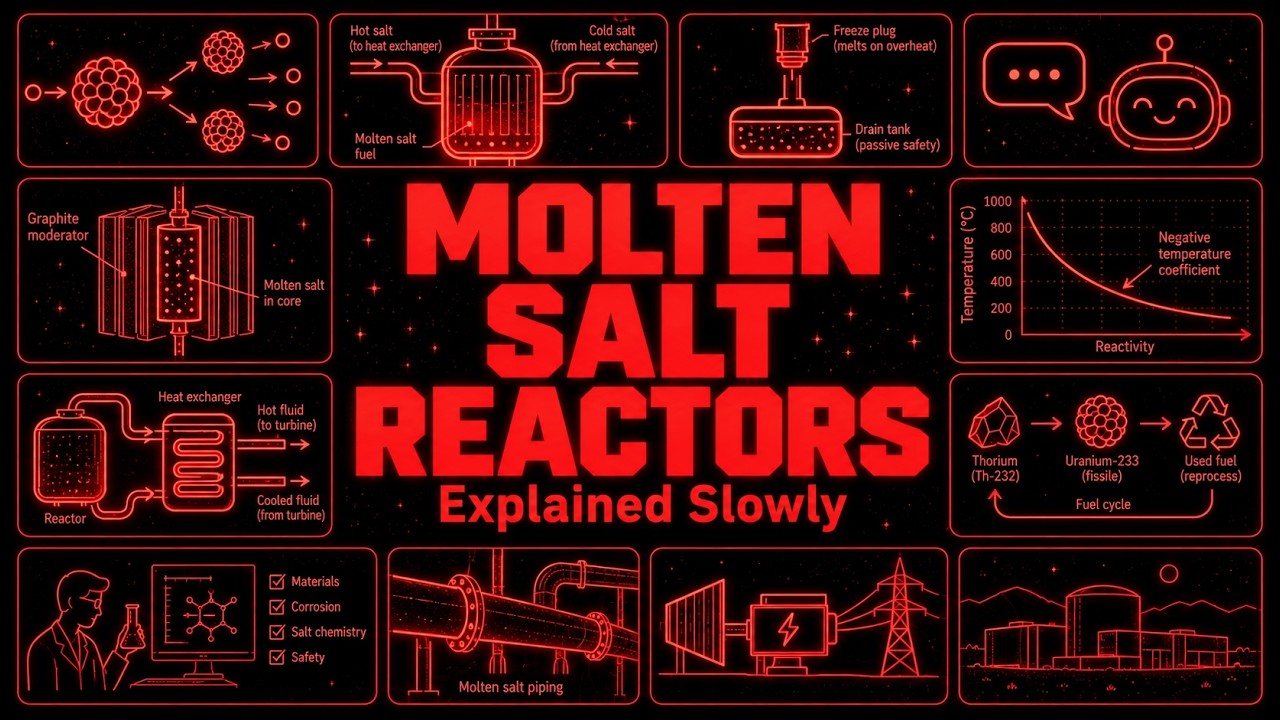
Literally Everything About How Molten Salt Reactors Work Explained Slowly (For Sleep)
Keywords
Summary
160 words
Critical Evaluation
Value of the Information & Strength of the Argument
The video offers substantial informational value, presenting a thorough and well-structured overview of molten salt reactors. It excels at explaining complex technical concepts in an accessible manner, using analogies and clear language. The argumentation is solid, building a logical case for why MSRs were historically sidelined and why they are now being reconsidered. The historical narrative is compelling and well-supported, and the technical explanations are accurate. The video also fairly presents the challenges and drawbacks of MSR technology, avoiding one-sided advocacy.
Scientific Rigor, Source Quality, Title Accuracy
The video demonstrates strong scientific rigor, grounding its explanations in well-established nuclear physics and engineering principles. It cites authoritative sources, including Oak Ridge National Laboratory, the IAEA, the U.S. Department of Energy, and the NRC, which are all directly relevant to the topic. The title accurately reflects the content, which is a detailed and slow-paced educational piece. The video’s credibility is enhanced by its balanced treatment of the subject, acknowledging both the promise and the obstacles of MSRs.
174 words
Title / Content Match
The title accurately reflects the content: a comprehensive, slow-paced explanation of molten salt reactors, suitable for sleep or background listening.
Quality & Reliability
8/10
The video provides a detailed and technically accurate overview of molten salt reactors, based on historical facts and scientific principles. It cites reputable sources (ORNL, IAEA, DOE, NRC) and avoids sensationalism. Minor simplifications are present for accessibility, but the core information is reliable.
Key Moments
Markers derived by PSI from the transcript: the creator did not define chapters.
- Introduction to the basic principles of nuclear fission and chain reactions.
- Explanation of why water is used as a moderator and coolant in conventional reactors.
- Historical context: Admiral Rickover and the choice of pressurized water reactors for submarines.
- Introduction to Alvin Weinberg and the vision of molten salt reactors at Oak Ridge.
- Detailed explanation of how molten salt reactors work, including the use of fluoride salts and the absence of high pressure.
- Discussion of inherent safety features: negative temperature coefficient and freeze plug.
- The Molten Salt Reactor Experiment (MSRE): its operation, success, and fuel switching to uranium-233.
- The thorium fuel cycle and its potential for breeding fuel.
- The cancellation of the MSR program due to political and institutional factors, including the rivalry with the fast breeder reactor.
- Modern revival of interest in MSRs, including current companies and regulatory efforts.
Cited Sources
- Oak Ridge National Laboratory — Molten Salt Reactor Experiment — Referenced as a resource for the MSRE history.
- International Atomic Energy Agency — Status of Molten Salt Reactor Technology — Referenced as a resource for the current status of MSR technology.
- U.S. Department of Energy — Advanced Reactor Systems — Referenced as a resource for advanced reactor systems.
- U.S. Nuclear Regulatory Commission — Kairos Power Hermes Reactor — Referenced as a resource for a specific MSR design under regulatory review.
Concurring Sources
- Oak Ridge National Laboratory — Molten Salt Reactor Experiment — Supports the historical account of the MSRE.
- International Atomic Energy Agency — Status of Molten Salt Reactor Technology — Supports the current status and technical details of MSRs.
External References
Contribution & Novelties
The video provides a comprehensive and accessible synthesis of molten salt reactor technology, weaving together technical explanations, historical context, and modern developments. Its original contribution lies in its slow, detailed pacing, which makes complex nuclear engineering concepts understandable to a broad audience. It effectively explains the ‘why’ behind the technology’s historical abandonment and current revival.
Pour aller plus loin :
- Molten salt reactor - Wikipedia — A comprehensive overview of MSR technology, history, and designs.
- Thorium fuel cycle - Wikipedia — Details on the thorium fuel cycle and its potential.
- Liquid metal fast breeder reactor - Wikipedia — Context on the competing technology that led to the MSR’s cancellation.
109 words
Radar Profile
The radar profile shows a video with high information quantity and good technical depth, but slightly lower scores in quality and reliability, likely due to its accessible, narrative-driven approach. The overall balance indicates a solid educational resource.