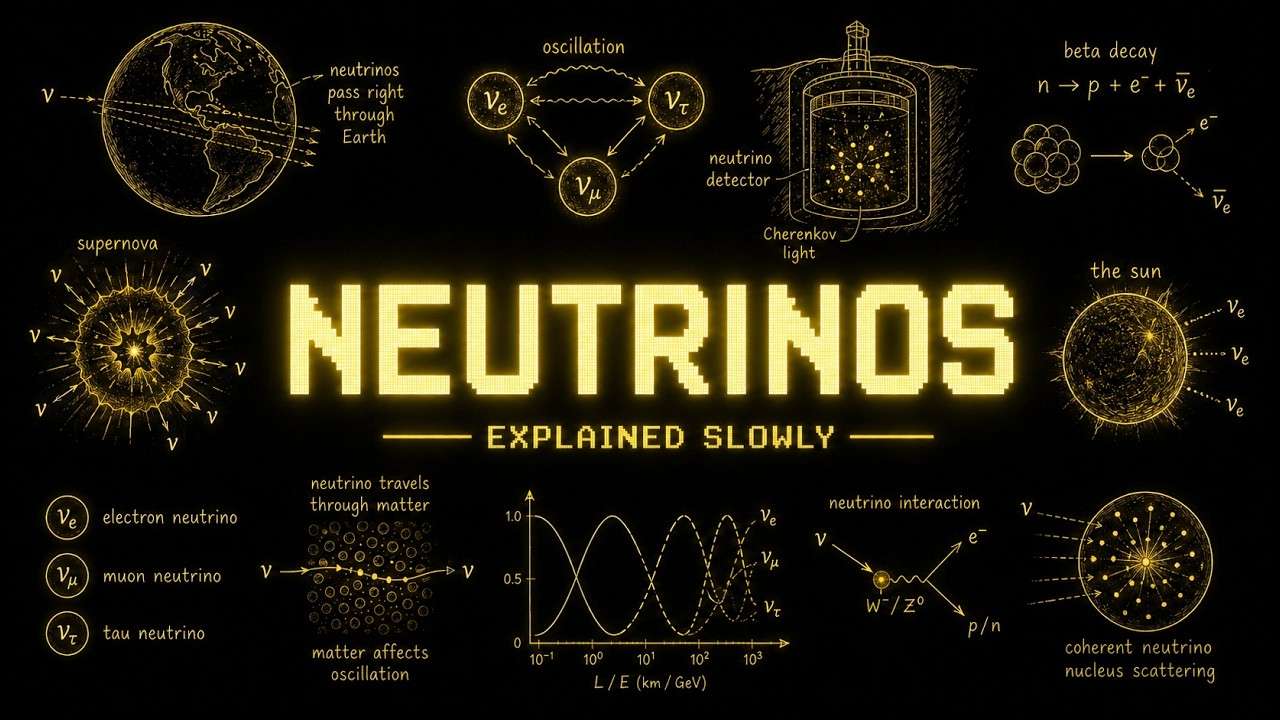
Every Confusing Thing About Neutrinos Explained Slowly (For Sleep)
Keywords
Summary
132 words
Critical Evaluation
Value of the Information & Strength of the Argument
The video provides substantial value by weaving a coherent narrative that connects the historical development of neutrino physics with the underlying scientific concepts. It effectively explains the reasoning behind each major step, from Pauli’s ‘desperate remedy’ to the experimental design of Cowan and Reines, and the theoretical implications of neutrino oscillations. The argumentation is solid, building logically from the problem of beta decay to the solution and its consequences. The video also highlights the human element, such as Pauli’s initial skepticism and the collaborative nature of scientific discovery, which enhances engagement without compromising scientific rigor.
Scientific Rigor, Source Quality, Title Accuracy
The video demonstrates strong scientific rigor by accurately presenting the history and physics of neutrinos. It cites authoritative sources, including the Nobel Prize press release for the 2015 physics prize, the Super-Kamiokande website, the Sudbury Neutrino Observatory, and Fermilab’s DUNE project. These references support the key claims and provide avenues for further exploration. The title accurately reflects the content, as the video indeed explains confusing aspects of neutrinos in a slow, detailed manner. The video does not contain any apparent misinformation or unsupported claims.
194 words
Title / Content Match
The title accurately reflects the content: a slow, detailed, and comprehensive explanation of neutrino physics, suitable for sleep or relaxation.
Quality & Reliability
8/10
The video provides a historically accurate and scientifically sound narrative of neutrino physics, from Pauli's hypothesis to modern experiments. It correctly explains key concepts like beta decay, inverse beta decay, and neutrino oscillations, and references authoritative sources (Nobel Prize, Super-Kamiokande, SNO, DUNE). Minor simplifications for a general audience do not compromise accuracy.
Key Moments
Markers derived by PSI from the transcript: the creator did not define chapters.
- Introduction to neutrinos and their ghostly nature, passing through matter.
- The beta decay energy crisis and Pauli's 1930 letter proposing the neutrino.
- Fermi's theory of beta decay and the weak nuclear force.
- The challenge of detecting neutrinos and the concept of cross-section.
- Cowan and Reines' experiment at Savannah River, using inverse beta decay.
- The discovery of the muon and the question of multiple neutrino flavors.
- Neutrino oscillations and the solar neutrino problem.
- The Sudbury Neutrino Observatory and the confirmation of oscillations.
- Neutrinos in supernovae and their role in the universe.
- Current mysteries: neutrino mass ordering, neutrinoless double beta decay, and the future DUNE experiment.
Cited Sources
- Nobel Prize — Neutrino Oscillations and Neutrino Mass — Referenced for the discovery of neutrino oscillations and the Nobel Prize awarded to Kajita and McDonald.
- Super-Kamiokande — What Is a Neutrino? — Referenced for the Super-Kamiokande detector and its role in observing atmospheric neutrino oscillations.
- Sudbury Neutrino Observatory — SNO — Referenced for the SNO experiment that solved the solar neutrino problem and confirmed neutrino oscillations.
- Fermilab / DUNE — Neutrino Science Goals — Referenced for the DUNE experiment and its goals to study neutrino properties and the matter-antimatter asymmetry.
- Spotify Show — Mentioned as a streaming platform for the content.
Concurring Sources
- Nobel Prize — Neutrino Oscillations and Neutrino Mass — Confirms the discovery of neutrino oscillations and the Nobel Prize award.
- Super-Kamiokande — What Is a Neutrino? — Provides authoritative information on neutrinos and the Super-Kamiokande experiment.
- Sudbury Neutrino Observatory — SNO — Confirms the SNO results on solar neutrinos and oscillations.
- Fermilab / DUNE — Neutrino Science Goals — Supports the discussion of future neutrino research.
Contribution & Novelties
The video offers a unique, slow-paced, and comprehensive narrative of neutrino physics, making complex topics accessible to a broad audience. It synthesizes historical context with modern discoveries, providing a holistic view that is often missing in shorter, more fragmented content. The emphasis on the human stories behind the science adds depth and engagement.
Pour aller plus loin :
- Neutrino on Wikipedia — Provides a comprehensive overview of neutrino properties, history, and research.
- Weak interaction on Wikipedia — Explains the fundamental force responsible for beta decay and neutrino interactions.
- Neutrino oscillation on Wikipedia — Details the phenomenon that revealed neutrinos have mass.
- Super-Kamiokande official site — Information about the detector and its discoveries.
- DUNE experiment official site — Current research on neutrino properties and the future of neutrino physics.
128 words
Radar Profile
The radar profile shows high scores in quantity of information and technical level, indicating a dense and detailed content. The quality and reliability scores are also strong, reflecting accurate and well-sourced information. The overall balance suggests a highly informative and trustworthy video, with a slight emphasis on depth over accessibility.
💬 No comments were provided for analysis.