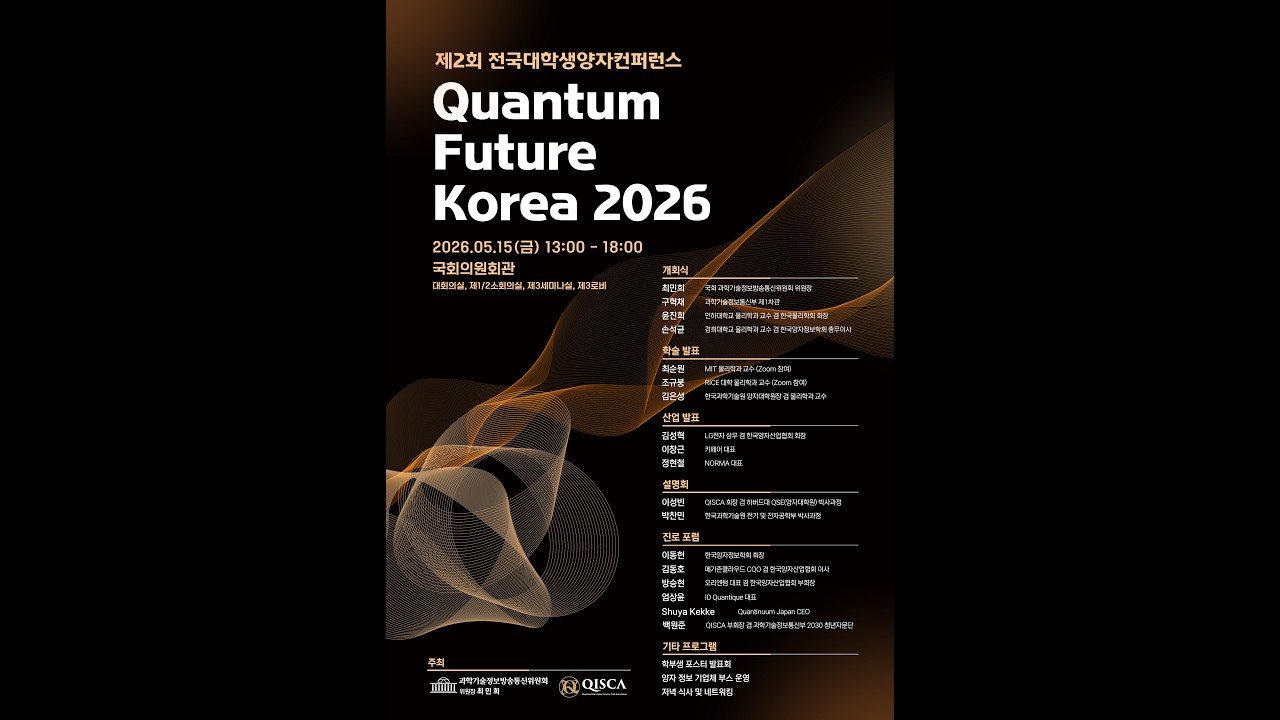
QFK 2026 제2소회의실
Keywords
Summary
149 words
Critical Evaluation
Value of the Information & Strength of the Argument
The first presentation provides a high-value theoretical contribution, presenting a novel algorithm with rigorous proofs of optimality. The argumentation is solid, building from known quantum sensing principles to a new result. The second presentation offers practical industry insights, but its arguments are more anecdotal and less rigorous, relying on personal experience and general trends. Overall, the video offers a mix of cutting-edge research and practical career advice, with the theoretical part being more substantial.
Scientific Rigor, Source Quality, Title Accuracy
The scientific rigor of the first presentation is high, with clear mathematical derivations and references to established concepts like Ramsey spectroscopy and Grover’s algorithm. However, the research is unpublished, so external verification is limited. The second presentation lacks specific sources and relies on industry anecdotes. The title ‘QFK 2026 제2소회의실’ is generic and does not indicate the content, which is a minor drawback. No comments were provided for analysis.
158 words
Title / Content Match
The title is generic and does not reflect the content, which is a scientific conference session.
Quality & Reliability
8/10
The video features two expert presentations: one by MIT professor Choi Soon-won on quantum sensing with a novel algorithm, and another by industry representative Jung Hyun-chul on quantum computing applications. Both are credible, but the content is largely based on unpublished research and industry anecdotes, limiting verifiability.
Key Moments
Markers derived by PSI from the transcript: the creator did not define chapters.
- Introduction and technical setup
- Start of first presentation by Prof. Choi Soon-won
- Introduction to quantum sensing and its importance
- Explanation of standard quantum limit and Heisenberg limit
- Introduction of the new algorithm 'quing sensing' and its advantages
- Discussion of Grover-Heisenberg limit and proof of optimality
- Q&A session on noise and hardware platforms
- Start of second presentation by Jung Hyun-chul
- Career advice: resource occupation and user cases
- Overview of quantum computing applications in various industries
Cited Sources
- No external sources provided in description — The video description contains no links or references.
Concurring Sources
- Quantum sensing and metrology — General background on quantum sensing, consistent with the presentation.
Dissenting Sources
- No discordant sources identified — No conflicting sources were mentioned in the video.
Contribution & Novelties
The video presents a novel quantum sensing algorithm that integrates quantum computing to achieve a quadratic speedup over classical methods, potentially reaching a new fundamental limit. This is a significant theoretical contribution. The industrial presentation offers practical insights into current quantum computing applications and career advice, which is valuable for students.
Pour aller plus loin :
- Grover’s algorithm — The basis for the quantum speedup in the presented algorithm.
- Quantum sensing — Overview of the field and its applications.
- Heisenberg limit — Fundamental limit in quantum metrology, relevant to the discussion.
91 words
Radar Profile
The radar profile shows high scores in information quantity, quality, and technical level, reflecting the dense theoretical content and industry insights. The lower reliability score is due to the unpublished nature of the research and anecdotal industry claims.