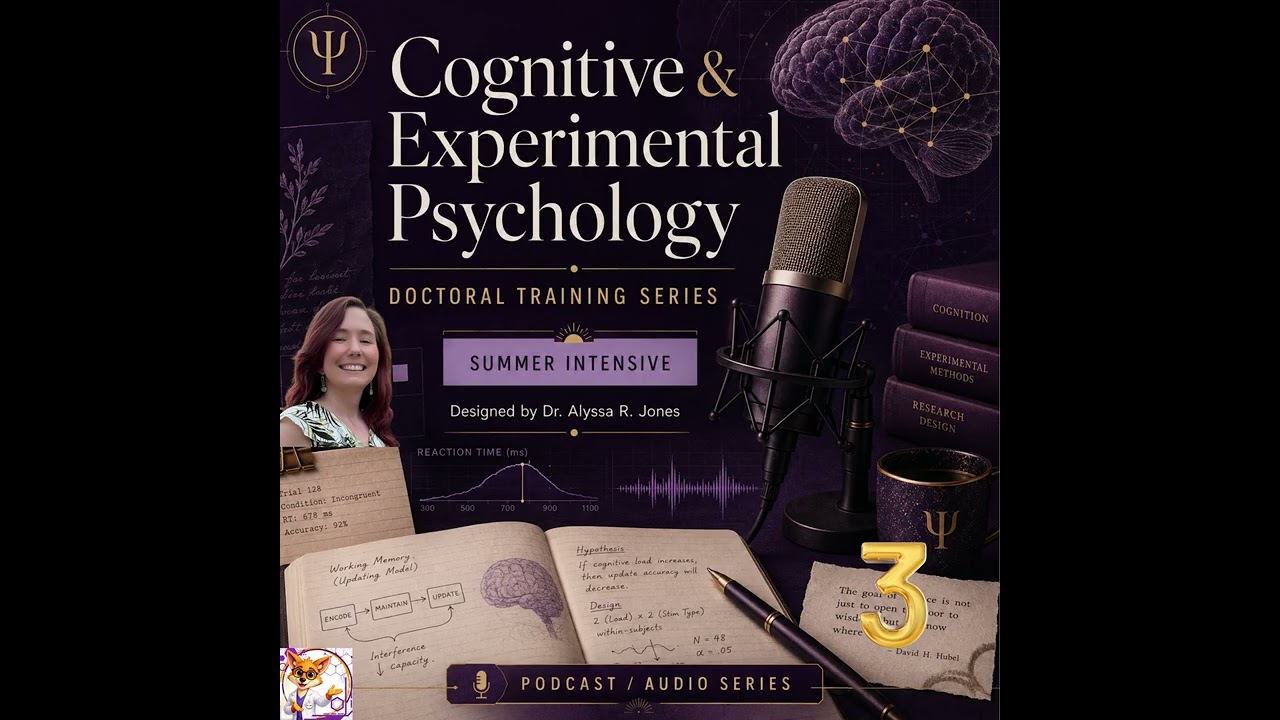
Cognitive Bootcamp Ep 3
Keywords
Summary
201 words
Critical Evaluation
Value of the Information & Strength of the Argument
The value of the information is high, as it synthesizes foundational studies and theoretical frameworks in cognitive psychology, providing a comprehensive overview of memory dynamics. The argumentation is solid, with each concept introduced and then critically evaluated. For instance, the hosts present the encoding specificity principle and immediately follow with a meta-analytic caveat, demonstrating a nuanced understanding. The use of analogies (enzyme lock-and-key, dinosaur skeleton) enhances comprehension without oversimplifying. The discussion of transfer-appropriate processing effectively challenges the levels of processing framework, and the historical context of Bartlett’s work is well-integrated. The argumentation is coherent and builds logically from encoding to retrieval to reconstruction, with clear connections between studies and theoretical implications.
Scientific Rigor, Source Quality, Title Accuracy
The scientific rigor is strong, with references to seminal papers (Tulving & Thomson, 1973; Godden & Baddeley, 1975; Morris et al., 1977; Bartlett, 1932) and a meta-analysis (Smith & Vela, 2001). The hosts accurately describe the methodologies and findings, and they appropriately note limitations, such as the fragility of environmental context effects in recognition tasks. The title ‘Cognitive Bootcamp Ep 3’ is somewhat generic but fits the series’ educational purpose; it does not mislead. The content aligns well with the title, as it is a structured lesson on memory. No comments were provided, so no analysis of public reception is included.
227 words
Title / Content Match
The title 'Cognitive Bootcamp Ep 3' is generic but accurately reflects the series' educational purpose; the episode focuses on memory dynamics, consistent with the bootcamp theme.
Quality & Reliability
8/10
The content is grounded in foundational and well-established research (Tulving & Thomson, Godden & Baddeley, Morris et al., Bartlett) and presents accurate descriptions of key concepts and studies. The discussion includes appropriate caveats and meta-analytic findings, indicating a high level of scientific rigor. Minor limitations include the lack of explicit citations for some claims and the informal conversational format.
Key Moments
Markers derived by PSI from the transcript: the creator did not define chapters.
- Introduction and live memory demonstration with a list of 15 words.
- Overview of session 3: encoding, retrieval, and reconstructive memory.
- Discussion of the encoding specificity principle and Tulving & Thompson's 1973 paper.
- Explanation of availability vs. accessibility and the train-black experiment.
- Godden & Baddeley's scuba diver study and context-dependent memory.
- Caveat on environmental context effects based on Smith & Vela's meta-analysis.
- Introduction to transfer-appropriate processing and Morris et al.'s study.
- Explanation of the rhyming recognition test and inversion of results.
- Shift to reconstructive memory and Bartlett's schema theory.
- Discussion of 'The War of the Ghosts' and rationalization.
- Methodological bridge: extending signal detection theory to ROC analysis.
Cited Sources
- Encoding specificity and retrieval processes in episodic memory — Tulving & Thomson's 1973 paper in Psychological Review, foundational for the encoding specificity principle.
- Context-dependent memory in two natural environments: on land and underwater — Godden & Baddeley's 1975 study in British Journal of Psychology, demonstrating context-dependent memory with scuba divers.
- Levels of processing versus transfer appropriate processing — Morris, Bransford, & Franks' 1977 paper in Journal of Verbal Learning and Verbal Behavior, introducing transfer-appropriate processing.
- Remembering: A Study in Experimental and Social Psychology — Bartlett's 1932 monograph, introducing schema theory and reconstructive memory.
- Environmental context-dependent memory: A review and meta-analysis — Smith & Vela's 2001 meta-analysis, providing a comprehensive review of environmental context effects.
Concurring Sources
- Encoding specificity and retrieval processes in episodic memory — Tulving & Thomson's paper is the primary source for the encoding specificity principle.
- Context-dependent memory in two natural environments: on land and underwater — Godden & Baddeley's study is a classic demonstration of context-dependent memory.
- Levels of processing versus transfer appropriate processing — Morris et al.'s study is the key evidence for transfer-appropriate processing.
- Remembering: A Study in Experimental and Social Psychology — Bartlett's monograph is the foundational work on reconstructive memory.
Dissenting Sources
- Environmental context-dependent memory: A review and meta-analysis — Smith & Vela's meta-analysis shows that environmental context effects are small and unreliable in recognition tasks, which nuances the strong claims from the Godden & Baddeley study.
Contribution & Novelties
The episode provides a clear and structured synthesis of key concepts in memory research, emphasizing the dynamic and reconstructive nature of memory. It effectively bridges theoretical principles with methodological implications, particularly in the discussion of ROC analysis. The use of analogies and live demonstrations enhances understanding. The critical evaluation of classic studies, such as the caveat on environmental context effects, adds depth.
Pour aller plus loin :
- Encoding specificity principle — Overview of the principle and its implications.
- Levels of processing — Background on Craik & Lockhart’s framework.
- Schema (psychology) — Explanation of schemas and their role in memory.
- Receiver operating characteristic — Introduction to ROC analysis, relevant to the methodological bridge.
112 words
Radar Profile
The radar profile shows high scores in information quantity, quality, and technical level, with a slightly lower but still strong score in global reliability. This indicates a well-rounded, informative, and technically sound episode, with minor caveats regarding the generalizability of some findings.