Jones et al. (2026, APLS)
Keywords
Summary
211 words
Critical Evaluation
Value of the Information & Strength of the Argument
The value of the information is high as it addresses a nuanced question in eyewitness identification research: whether the specific content used in description-matched filler selection affects lineup discriminability. The study goes beyond simple fair vs. unfair comparisons and shows that among nominally fair lineups, performance varies. The argumentation is solid, based on a well-designed experiment with multiple conditions and ROC analyses. The presenter carefully distinguishes between confirmatory and exploratory analyses, appropriately tempering conclusions from post-hoc findings. The use of objective similarity measures (FaceNet) adds a novel dimension. However, the study is limited by a single research assistant selecting fillers, no designated innocent suspect, and the exploratory nature of some analyses. Overall, the argument is compelling and contributes to the ongoing debate on lineup construction.
Scientific Rigor, Source Quality, Title Accuracy
The scientific rigor is good: the study is presented at a professional conference, with clear methodology and statistical analyses. The presenter cites relevant literature (e.g., Wells, Lee, McKinley & Peterson) and acknowledges limitations. The sources are not explicitly listed in the video, but the description provides the citation for the conference presentation. The title accurately reflects the content. The video is a presentation of original research, not a review or opinion. The adequacy between title and content is high. No comments were provided for analysis.
225 words
Title / Content Match
The title accurately reflects the content, which is a presentation of a study on filler selection in eyewitness lineups.
Quality & Reliability
8/10
Presentation of original research at a professional conference (APLS), with clear methodology, statistical analyses (ROC, pAUC), and acknowledgment of limitations. However, some analyses are post-hoc and not pre-registered, and the sample size is modest.
Key Moments
Markers derived by PSI from the transcript: the creator did not define chapters.
- Introduction and presenter introduction
- Research questions: broad vs. specific features, internal vs. external, and description quality effects
- Background on lineup construction: match-to-description vs. match-to-suspect, propitious heterogeneity
- Study design: five filler selection conditions, target present/absent, fairness standards
- Method: 149 participants, encoding, distractor, identification, confidence, 20 trials
- ROC analysis explanation and initial null result when collapsing description-match conditions
- Key finding: separated description-match conditions show upper and lower clusters; mixed internal+external best
- Post-hoc comparison: mixed vs. no internal info significantly higher; caution as post-hoc
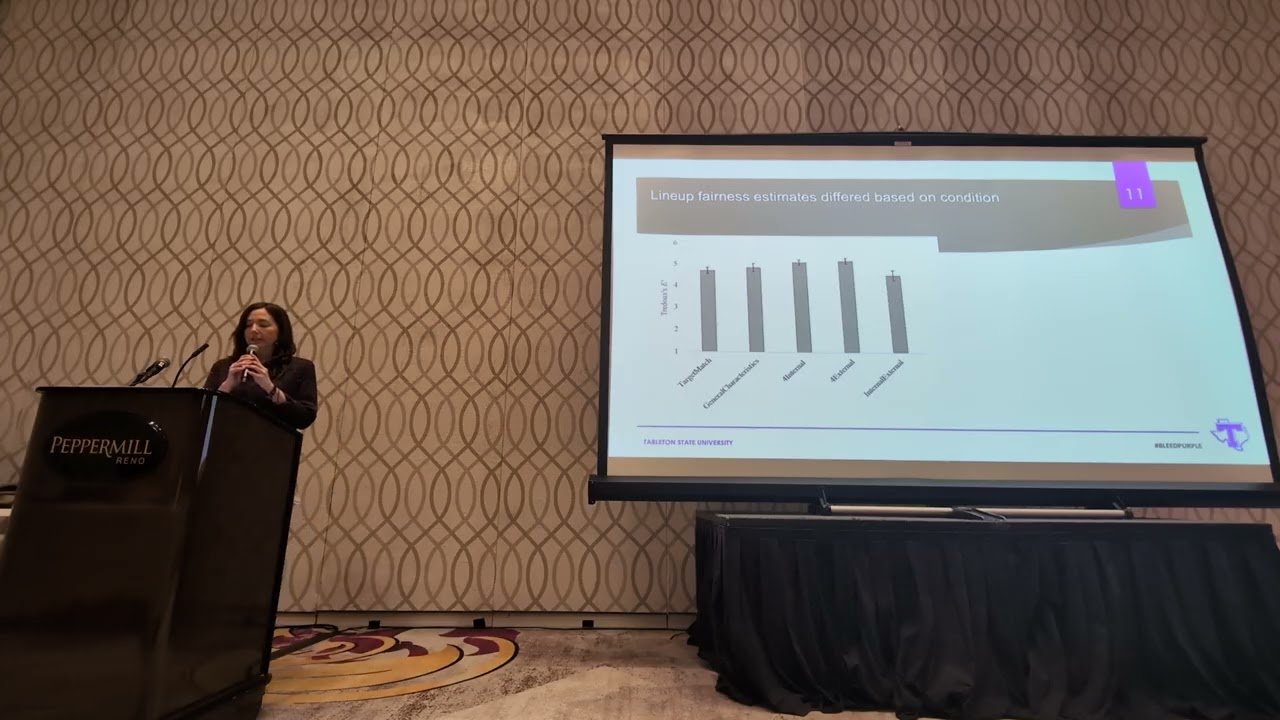
- Fairness estimates varied but didn't map onto discriminability
- Exploratory analysis using FaceNet to quantify similarity; spread and evenness related to discriminability
- Limitations and future directions: pre-registered replication, designated innocent suspect, multiple selectors
- Take-home message and acknowledgments
Cited Sources
- Jones, A. R., Carlson, C. A., Lockamyeir, R. F., Carlson, M. A., Allen, A. R. (2026, March). Match made in fairness? Filler selection influenced on eyewitness discriminability and lineup characteristics. Annual Meeting for the American Psychology-Law Society, Reno, NV. — This is the conference presentation itself, cited in the video description.
Concurring Sources
- Wells, G. L., et al. (1998). Eyewitness identification procedures: Recommendations for lineups and photospreads. Law and Human Behavior, 22(6), 603-647. — Foundational work on lineup construction and propitious heterogeneity.
- Lee, J., et al. (2023). Fairness measures in eyewitness lineups: A critical review. Psychology, Public Policy, and Law. — Referenced in the talk as arguing that fairness measures are not interchangeable.
- McKinley, S., & Peterson, D. (2024). Defining propitious heterogeneity and suspect similarity. Journal of Applied Research in Memory and Cognition. — Referenced in the talk as pointing out loose definitions of key concepts.
Dissenting Sources
- No discordant sources identified — The talk does not present conflicting evidence; it builds on existing literature and identifies gaps.
Contribution & Novelties
The study provides a novel contribution by systematically varying the feature content used in description-matched filler selection and showing that this affects discriminability, even among lineups that are nominally fair. It also introduces objective similarity measures using deep face embeddings to explore the structural properties of lineups. The finding that mixed internal and external features yield the best performance is a new insight that challenges the assumption that any description-matched lineup is equivalent.
Pour aller plus loin :
- Eyewitness identification — Overview of the field and key concepts.
- Receiver operating characteristic — Explanation of ROC analysis used in the study.
- FaceNet — The deep face embedding model used for similarity analysis.
- Propitious heterogeneity — Concept referenced in the talk, though the exact URL may not be precise; consider searching for Wells et al. (1998) on lineup construction.
137 words
Radar Profile
The radar profile shows high scores in information quantity, quality, and reliability, with a slightly lower technical level. This indicates a well-presented, rigorous research talk that is accessible to a professional audience but may require some background in eyewitness research to fully appreciate.