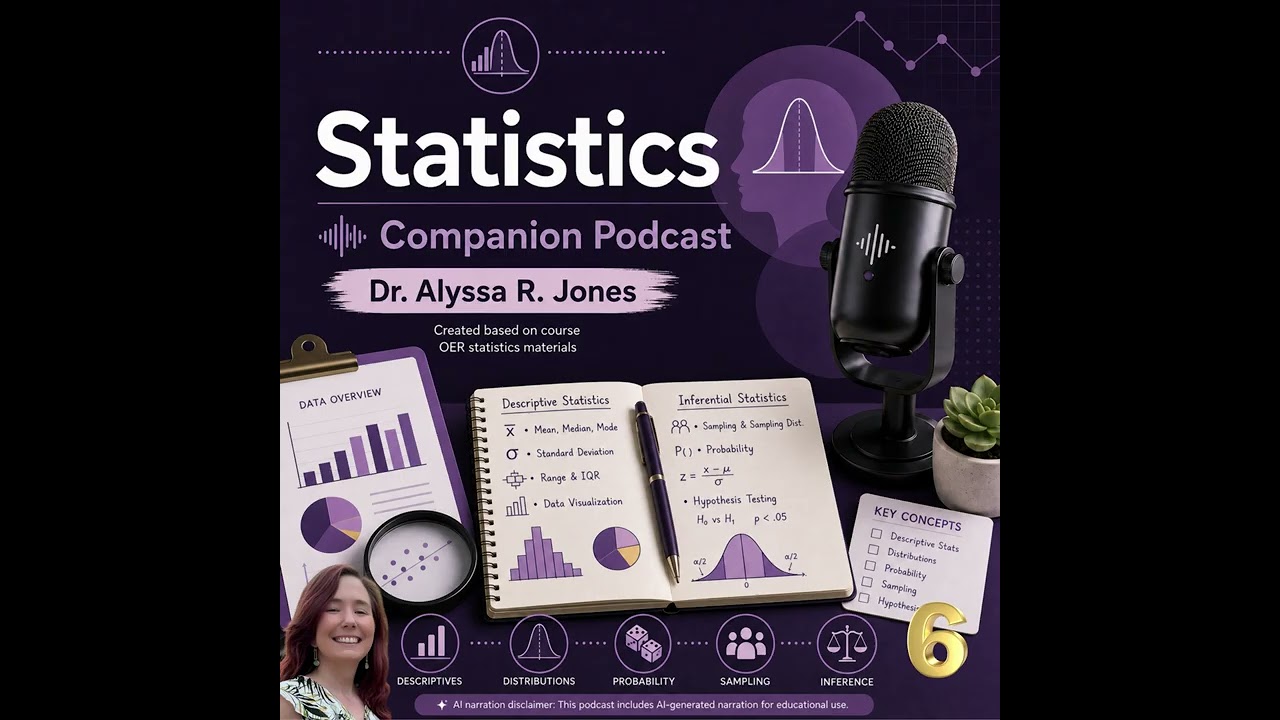
Statistics Chapter 6 Ep. t-tests
Keywords
Summary
199 words
Critical Evaluation
Value of the Information & Strength of the Argument
The video provides a clear and engaging explanation of t-tests, making complex statistical concepts accessible through analogies and real-world examples. The historical anecdote about Guinness adds interest and context. The argumentation is logically structured, moving from the fundamental question of signal versus noise to specific test types. The explanation of standard deviation versus standard error is particularly effective, using the temperature analogy to illustrate the difference. The paired samples t-test is well-explained with a concrete research example, demonstrating how difference scores isolate effects. The discussion of p-values is accurate and addresses common misconceptions, emphasizing the conditional nature of the probability. However, the video does not delve into the mathematical formulas in depth, which may limit its usefulness for students needing to compute t-tests manually. The reliance on AI-generated narration might reduce the perceived authenticity, but the content itself is sound.
Scientific Rigor, Source Quality, Title Accuracy
The video is based on assigned course materials and instructor-developed explanations, indicating a foundation in educational resources. However, no specific sources are cited in the description, and the podcast does not reference external literature beyond the mentioned infant cognition study. The historical account of Gosset and the t-test is accurate, but the lack of citations reduces the verifiability of the content. The title ‘Statistics Chapter 6 Ep. t-tests’ accurately reflects the content, which is a tutorial on t-tests. The video does not include any advertising segments. No comments were provided for analysis.
247 words
Title / Content Match
The title accurately reflects the content, which focuses on t-tests in statistics.
Quality & Reliability
7/10
The content is based on assigned course materials and instructor-developed explanations, with a clear pedagogical structure. The historical anecdote about Guinness and Student's t-test is accurate, and the explanation of statistical concepts is sound. However, the video is a supplementary podcast with AI-generated narration, and no external sources are cited in the description, limiting verifiability.
Key Moments
Markers derived by PSI from the transcript: the creator did not define chapters.
- Introduction to the podcast and the surprising origin of the t-test at Guinness Brewery.
- Explanation of the core logic of t-tests as signal-to-noise ratio.
- Discussion of standard deviation vs. standard error with examples.
- Introduction to the one-sample t-test using a true/false quiz example.
- Explanation of the null hypothesis and the null distribution.
- Introduction to the paired samples t-test and the infant cognition study.
- Detailed walkthrough of the paired samples t-test with difference scores.
- Discussion of p-values and common misconceptions.
- Conclusion and summary of key takeaways.
Cited Sources
- Student's t-test (Wikipedia) — Referenced indirectly through the historical anecdote about William Sealy Gosset and the Guinness Brewery.
- Mare, Song, & Spelke (2016) study on infant cognition — Mentioned as a research example for the paired samples t-test, but no specific citation is provided.
Concurring Sources
- Student's t-test (Wikipedia) — Confirms the historical origin of the t-test and its mathematical formulation.
Contribution & Novelties
The video offers a fresh and engaging perspective on t-tests by framing them as a signal-to-noise ratio and using relatable analogies. It effectively demystifies the historical origin of the t-test, making it memorable. The explanation of standard error as the standard deviation of sample means is particularly clear. The use of a real research study (infant cognition) to illustrate the paired samples t-test adds practical relevance. However, the content is largely instructional and does not present new research or novel insights beyond standard textbook material.
Pour aller plus loin :
- Student’s t-test — Comprehensive overview of the t-test, its assumptions, and variants.
- p-value — Detailed explanation of p-values and common misinterpretations.
- Standard error — Clarifies the concept of standard error and its relation to sample size.
- Null hypothesis — Background on hypothesis testing and the role of the null hypothesis.
140 words
Radar Profile
The radar profile shows high scores in quantity of information and fiabilité globale, indicating a solid educational resource. The niveau technique is moderate, reflecting the accessible approach. The qualite_information is also high, but the lack of external citations slightly reduces the overall score.