Technology Choice for Road Freight Electrification
Keywords
Summary
147 words
Critical Evaluation
Value of the Information & Strength of the Argument
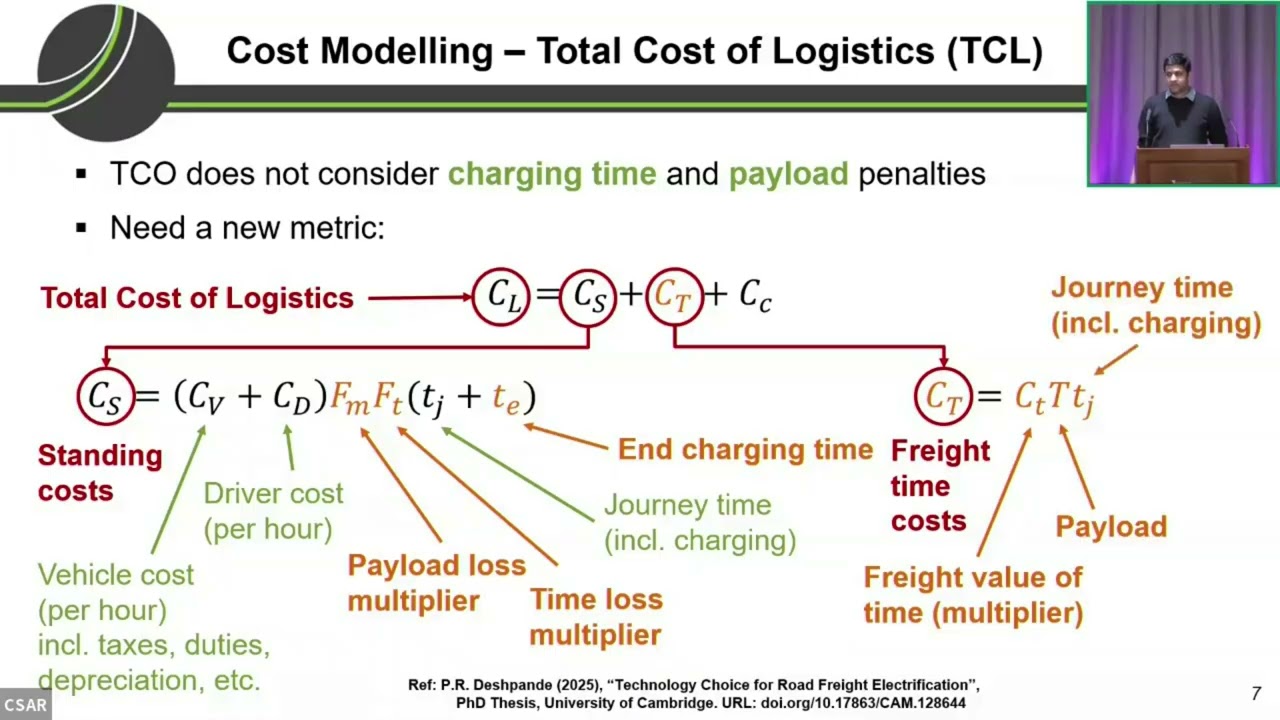
The talk provides valuable insights into the economic and operational challenges of electrifying road freight. The speaker presents a clear argument for the need to move beyond TCO to TCL, which accounts for the unique penalties of electric trucks. The fundamental diagram of electrified logistics is a useful conceptual tool. The argumentation is solid, based on a simplified but well-explained model, and the speaker acknowledges its limitations. The use of real data from Project JOLT for validation strengthens the credibility.
Scientific Rigor, Source Quality, Title Accuracy
The talk is scientifically rigorous, with a clear methodology and transparent assumptions. The speaker references Project JOLT and data from the Department for Transport, but does not provide specific citations or URLs. The title accurately reflects the content, which focuses on technology choices for road freight electrification. The talk is well-structured and the speaker is an expert in the field, which adds to its reliability.
160 words
Title / Content Match
The title accurately reflects the content, which focuses on the technology choices for electrifying road freight, including battery sizing, charging infrastructure, and cost analysis.
Quality & Reliability
8/10
The talk is based on the speaker's PhD research, with a clear methodology and validation against real data from Project JOLT. The speaker is a postdoc at the University of Cambridge, supervised by Professor David Cebon, a leading expert in the field. The content is technical and well-structured, with no obvious bias or unsupported claims.
Key Moments
Markers derived by PSI from the transcript: the creator did not define chapters.
- Introduction: importance of road freight electrification, emissions statistics.
- Three main issues: grid connections, charging downtime, payload penalty.
- Journey model and fundamental diagram of electrified logistics.
- Introduction of Total Cost of Logistics (TCL) metric.
- Application of TCL to optimize battery size for a fleet using Monte Carlo simulation.
- Conclusion and future work, including Project JOLT.
Cited Sources
- Project JOLT — Mentioned as a real-world validation project for the model.
Concurring Sources
- Project JOLT — Real-world data from this project is used to validate the model.
Contribution & Novelties
The talk introduces the Total Cost of Logistics (TCL) metric, which extends TCO by incorporating penalties for payload loss and time loss, providing a more realistic assessment for fleet operators. The fundamental diagram of electrified logistics is a novel visualization of the trade-off between battery size and journey time. The Monte Carlo approach for optimizing battery size over a distribution of journeys is practical and directly applicable.
Pour aller plus loin :
- Total cost of ownership — Relevant to the baseline metric discussed.
- Battery electric vehicle — Context for the technology.
- Monte Carlo method — The simulation technique used for optimization.
101 words
Radar Profile
The radar profile shows high scores in information quantity, quality, and reliability, with a slightly lower technical level, indicating a well-balanced presentation that is accessible yet detailed.