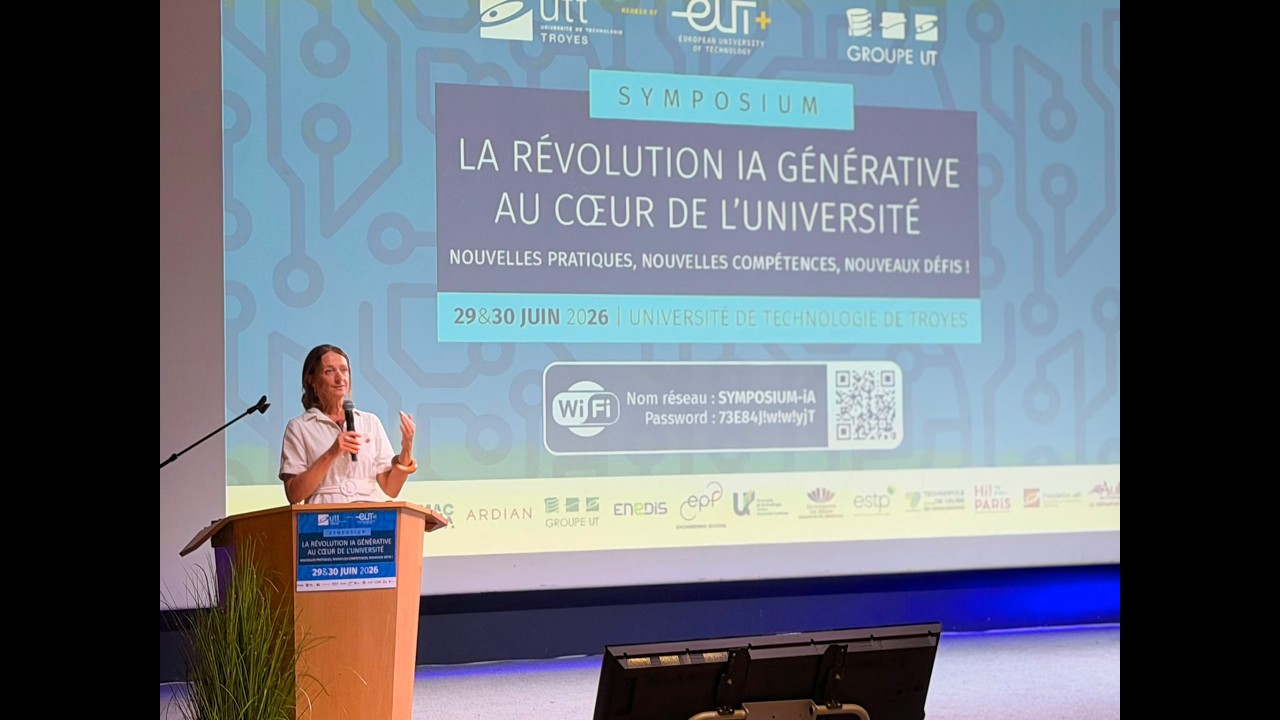
Intervention sur l'IA par Vanina Paoli-Gagin, Sénateur de l'Aube
Keywords
Summary
139 words
Critical Evaluation
Value of the Information & Strength of the Argument
The talk provides valuable insights into the political and philosophical dimensions of AI alignment, drawing on the senator’s extensive hearings with experts. The argumentation is coherent and persuasive, emphasizing the need for a European approach that prioritizes human values and resilience. However, the technical depth is limited, as the speaker openly admits her non-scientific background. The value lies in the strategic and policy-oriented perspective, which is often underrepresented in technical discussions.
Scientific Rigor, Source Quality, Title Accuracy
The speaker references her parliamentary mission and hearings with over a hundred people, including researchers and philosophers, but does not cite specific sources or publications. The title accurately reflects the content. The talk is more of an expert opinion than a rigorous scientific analysis, but it is grounded in extensive consultation and policy experience.
140 words
Title / Content Match
The title accurately describes the content: a senator's intervention on AI at a university event.
Quality & Reliability
7/10
The speaker is a senator with a parliamentary mission on AI alignment, providing informed opinions based on extensive hearings. However, she explicitly states she is not a scientist and uses simplified analogies, which limits the technical depth. The content is more political and philosophical than rigorously scientific.
Key Moments
Markers derived by PSI from the transcript: the creator did not define chapters.
- Introduction and context of the parliamentary mission on AI alignment.
- Discussion on the exponential growth of AI and the inadequacy of current regulation.
- Explanation of the 'four colors' analogy and the role of AI as 'blue' (analytical) while humans should focus on 'red', 'green', 'yellow'.
- Emphasis on the need for a European doctrine of AI alignment, avoiding copying the US.
- Definition of alignment from different perspectives: researchers, public actors, businesses, and civil society.
- Discussion on the risks of AI, including its potential as a weapon and the need for human control.
- Proposal for three pillars of alignment: technical, normative, and systemic.
- Advocacy for a frugal approach to AI and the importance of education to maintain critical thinking.
- Q&A: discussion on the commodification of AI and the risk of anthropomorphizing AI systems.
Cited Sources
- Parliamentary mission on AI alignment — Mentioned as the basis for her work, but no specific URL provided.
Concurring Sources
- AI alignment — Provides background on the technical and ethical issues of AI alignment, consistent with the speaker's emphasis on robustness and control.
- European Union AI Act — The EU's regulatory framework for AI, which the speaker references as a starting point but argues needs to go beyond.
Dissenting Sources
- No specific discordant sources mentioned — The speaker does not cite any sources that contradict her views, but she acknowledges the limitations of her non-scientific perspective.
Contribution & Novelties
The talk offers a political and strategic perspective on AI alignment, emphasizing the need for a European doctrine that integrates technical, normative, and systemic dimensions. It highlights the importance of education and the preservation of human cognitive abilities. The speaker’s unique position as a senator provides a bridge between technical research and policy-making.
Pour aller plus loin :
- AI alignment — Overview of the technical and ethical challenges of aligning AI with human values.
- European Union AI Act — The EU’s regulatory framework for AI, relevant to the discussion on European alignment.
- Digital sovereignty — Concept of controlling digital infrastructure and data, central to the speaker’s argument.
107 words
Radar Profile
The radar profile shows moderate scores across all dimensions, with a slightly higher score in 'quantite_information' and 'qualite_information' reflecting the breadth of the talk, but a lower 'niveau_technique' due to the non-technical approach. The 'fiabilite_globale' is moderate, as the speaker relies on her political experience rather than scientific evidence.
💬 No comments were provided for analysis.