IRENA Insights: Enhancing Resilience: Climate-proofing Power Infrastructure
Keywords
Summary
133 words
Critical Evaluation
Value of the Information & Strength of the Argument
The webinar provides valuable insights into the importance of power system resilience, supported by concrete examples and data. The argumentation is coherent, moving from the problem (extreme weather events) to a proposed solution (ten actions). The speakers effectively argue that proactive investment in resilience is economically justified through cost-benefit analysis, and they emphasize the need for tailored approaches. However, the presentation is high-level and lacks deep technical detail, which may limit its value for specialists. The case studies add practical relevance, but the argumentation could be strengthened by more quantitative evidence on the effectiveness of specific measures.
Scientific Rigor, Source Quality, Title Accuracy
The webinar is based on an official IRENA report, which lends credibility. The sources cited are primarily the report itself and the IRENA website. The title accurately reflects the content. The presentation is scientifically rigorous in its use of examples and data, though it does not provide detailed citations for all claims. The adéquation between title and content is excellent, as the webinar directly addresses climate-proofing power infrastructure. No comments were provided for analysis.
186 words
Title / Content Match
The title accurately reflects the content, which focuses on enhancing resilience of power infrastructure against climate change.
Quality & Reliability
8/10
The webinar is based on an official IRENA report, presented by experts, with references to specific case studies and data. However, it is a high-level overview without detailed methodological explanations, and the sources are limited to the report itself.
Key Moments
Markers derived by PSI from the transcript: the creator did not define chapters.
- Introduction to the webinar and IRENA's role.
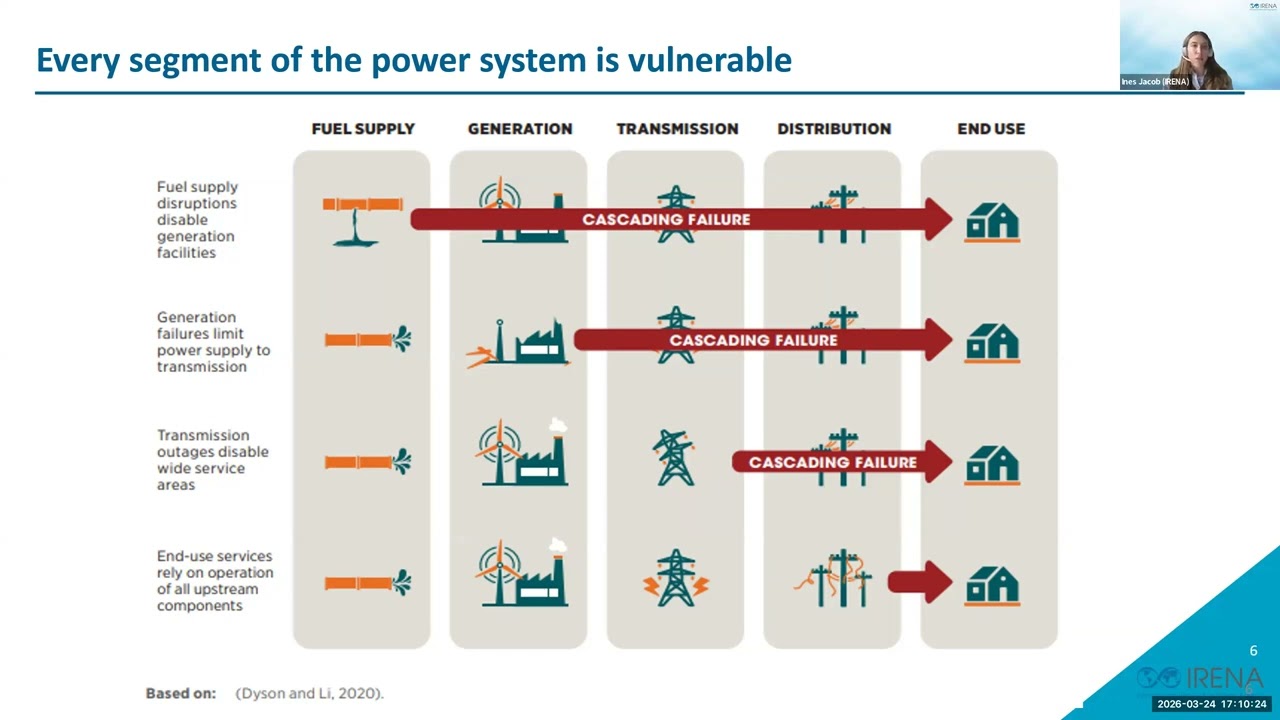
- Overview of extreme weather events in 2025 and their impacts on power systems.
- Examples of recent power outages due to storms and floods.
- Definition of power system resilience and the importance of proactive measures.
- Presentation of the first five actions to climate-proof power infrastructure.
- Presentation of the remaining five actions, including hardening and smart grid solutions.
- Case studies from Mozambique and El Salvador.
- Key takeaways and call to action.
Cited Sources
- IRENA Insights Webinar Series — Mentioned as the series hosting this webinar.
- Enhancing Resilience: Climate-proofing Power Infrastructure (IRENA report) — The report on which the webinar is based.
Concurring Sources
- IRENA report on Enhancing Resilience — The primary source, providing detailed analysis and recommendations.
Contribution & Novelties
The webinar provides a concise overview of IRENA’s recent report, offering a structured framework of ten actions for enhancing power system resilience. It highlights the urgency of proactive measures and provides practical examples from Mozambique and El Salvador. The main novelty is the synthesis of existing knowledge into an actionable roadmap for policymakers and utilities.
Pour aller plus loin :
- Power system resilience — Provides a general overview of the concept.
- Climate change adaptation — Relevant to the broader context of adaptation measures.
- Distributed energy resources — Discusses the role of distributed generation in enhancing resilience.
96 words
Radar Profile
The radar profile shows high scores in information quality and reliability, reflecting the authoritative source and clear presentation. The lower score in technical depth indicates that the content is accessible to a general audience but may not satisfy specialists seeking detailed methodologies.