Enabling a nature-positive energy transition
Keywords
Summary
185 words
Critical Evaluation
Value of the Information & Strength of the Argument
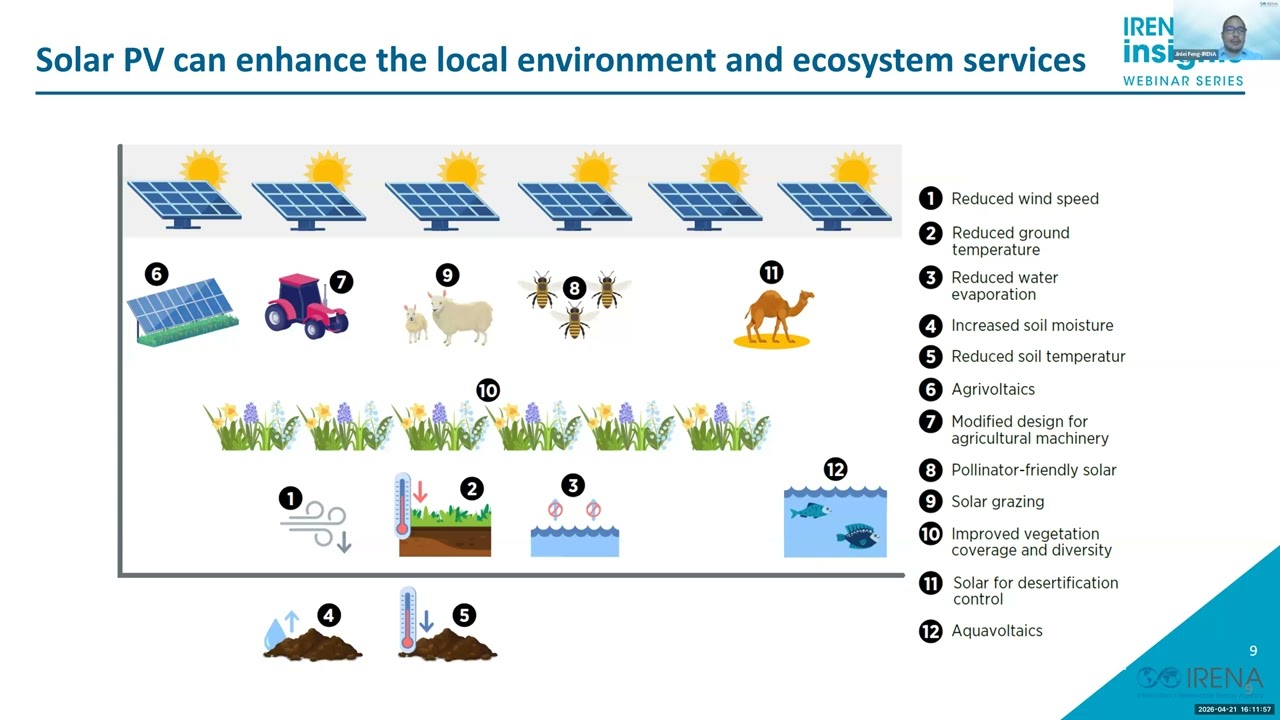
The webinar provides valuable insights into the environmental impacts of renewable energy deployment, particularly solar PV, and offers practical principles for minimizing negative effects and maximizing co-benefits. The argumentation is solid, grounded in two official IRENA reports and supported by concrete examples (e.g., wind speed reduction in Qinghai, agrivoltaics in Japan, floating solar in China). The speakers acknowledge complexities and drawbacks, such as increased costs and potential crop yield reductions in agrivoltaics, which adds credibility. The presentation is well-structured, with clear progression from problem to solutions, and the Q&A session further strengthens the value by addressing audience concerns.
Scientific Rigor, Source Quality, Title Accuracy
The webinar demonstrates high scientific rigor, as it is based on two peer-reviewed reports from IRENA, a reputable intergovernmental organization. The sources are explicitly cited in the description, including links to the reports. The speakers are directly involved in the research, ensuring accuracy. The title accurately reflects the content, focusing on enabling a nature-positive energy transition. The presentation is well-organized, with clear slides and references to specific data. The Q&A session shows responsiveness to audience questions, further enhancing credibility. No significant discrepancies were noted between the title and content.
202 words
Title / Content Match
The title accurately reflects the content, which focuses on how to make the energy transition beneficial for nature.
Quality & Reliability
8/10
The webinar is presented by IRENA, an intergovernmental organization with recognized expertise in renewable energy. The content is based on two official IRENA reports, and the speakers are directly involved in their development. The information is well-structured, references specific data and examples, and includes a Q&A session that addresses potential drawbacks and nuances. However, the webinar format limits depth, and some claims (e.g., specific percentages) are not fully detailed in the presentation.
Key Moments
Markers derived by PSI from the transcript: the creator did not define chapters.
- Introduction by Karan Kochhar, overview of IRENA and webinar series
- Ute Collier introduces the topic of environmental impacts and benefits of renewables
- Jinlei Feng presents the solar PV report, discussing global capacity and potential impacts
- Jinlei explains the mitigation hierarchy and co-benefits like agrivoltaics and land restoration
- Giedre introduces the nature-positive principles and the Coalition for Action
- Giedre details principles 1-3: acceleration areas, dual use, and conservation/restoration
- Giedre covers principles 4-6: adaptive management, extending useful life, and engaging local actors
- Q&A session: drawbacks of agrivoltaics, recycling of solar PV, and solar vs. wind environmental impact
Cited Sources
- Local Environmental Impacts of Large-scale Solar PV Plants — Report discussed in the webinar, providing data on solar PV impacts and co-benefits.
- Nature-positive Energy Principles: Environmental Siting and Permitting of Solar, Wind and Grid Infrastructure — Report discussed in the webinar, outlining six principles for nature-positive energy development.
- IRENA Insights Webinar Series — Webinar series page, where the recording and related materials are available.
Concurring Sources
- IPBES Global Assessment Report on Biodiversity and Ecosystem Services — Supports the claim of alarming biodiversity decline and the need for integrated approaches.
- IEA Report on Renewables 2025 — Provides data on renewable capacity growth, aligning with the webinar's statistics.
Contribution & Novelties
The webinar synthesizes two recent IRENA reports, providing a comprehensive overview of how to make the energy transition nature-positive. It highlights the importance of considering environmental impacts from the outset and offers practical principles for developers, policymakers, and investors. The emphasis on co-benefits, such as agrivoltaics and land restoration, is particularly valuable. The Q&A session adds depth by addressing potential drawbacks and clarifying misconceptions.
Pour aller plus loin :
- Mitigation hierarchy — Core concept in environmental management, central to the webinar’s recommendations.
- Agrivoltaics — Dual use of land for solar PV and agriculture, discussed as a key co-benefit.
- Biodiversity loss — Context for the urgency of nature-positive approaches.
- IRENA — Organization behind the reports, with further publications on renewable energy.
120 words
Radar Profile
The radar profile shows high scores in quality and reliability, reflecting the authoritative source and well-structured content. Quantity and technical level are moderate, appropriate for a webinar aimed at a broad audience. The overall balance indicates a reliable and informative presentation, though not deeply technical.
💬 Sur les 0 commentaires analysés, aucune tendance n'est disponible.