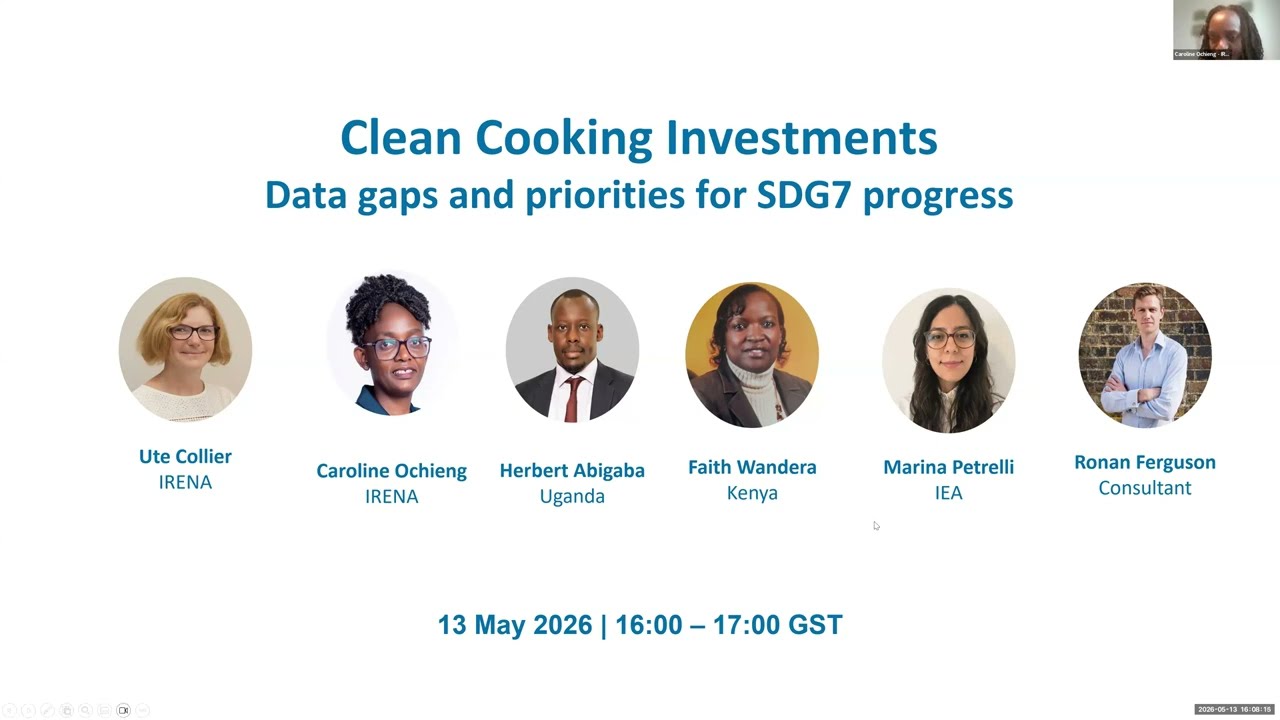
Clean Cooking Investments: Data gaps and priorities for SDG7 progress
Keywords
Summary
176 words
Critical Evaluation
Value of the Information & Strength of the Argument
The webinar provides valuable insights into the complexities of tracking clean cooking investments, highlighting the importance of data for effective capital deployment. The argumentation is solid, grounded in IRENA’s recent report and supported by expert panelists. The presentation of the tiered framework (possible, probable, proven) is a practical approach to dealing with data uncertainty. The panel discussion adds depth, with concrete examples from Uganda and the IEA’s methodology. However, the webinar is more descriptive than analytical, and the discussion could have delved deeper into specific solutions.
Scientific Rigor, Source Quality, Title Accuracy
The webinar demonstrates scientific rigor by referencing IRENA’s report and the OECD DAC database. The sources are credible and relevant. The title accurately reflects the content. The webinar does not include a public Q&A session, so no audience comments are analyzed.
142 words
Title / Content Match
The title accurately reflects the content, which focuses on clean cooking investments, data gaps, and priorities for SDG7 progress.
Quality & Reliability
7/10
The webinar is presented by IRENA, a reputable international agency, and includes expert panelists from IEA and government representatives. The content is based on a recent IRENA report and discusses methodological challenges and data gaps. However, the webinar format limits depth, and the report itself is not fully detailed in the video.
Key Moments
Markers derived by PSI from the transcript: the creator did not define chapters.
- Introduction by Dede, highlighting the challenge of 2.1 billion people lacking clean cooking access.
- Caroline Ochieng begins her presentation on IRENA's report, outlining the three guiding principles.
- Discussion of the three main challenges: ambiguous boundaries, large universe of financial flows, and limited data availability.
- Explanation of the tiered framework (possible, probable, proven) for estimating investments.
- Details on the survey outreach to 100 countries and the response rate of 23%.
- Presentation of results: 65% of finance going to LPG, and the importance of concessional finance.
- Panel discussion begins with Herbert Abi from Uganda, outlining steps to improve data access.
- Maryna Petrelli from IEA discusses complementary approaches to tracking investments.
- Discussion on the need for harmonized definitions and better data collection.
- Conclusion and call for collaboration to improve data quality.
Cited Sources
- IRENA Event Page: Clean Cooking Investments — Official event page for the webinar, providing additional context and resources.
Concurring Sources
- IEA Clean Cooking Report — The IEA's report on clean cooking, which aligns with the webinar's discussion on investment tracking.
Contribution & Novelties
The webinar presents IRENA’s pioneering effort to track clean cooking investments by Global South governments, offering a novel tiered framework to handle data uncertainty. It highlights the importance of data for investment decisions and calls for harmonized definitions and improved collaboration. The discussion provides practical examples from Uganda and the IEA, emphasizing the need for better data infrastructure.
Pour aller plus loin :
- SDG7 Tracking Report — The official SDG7 tracking report, providing global progress data.
- Clean Cooking Alliance — A key organization working on clean cooking access and investment.
- OECD DAC Database — The OECD’s development finance data, used in the report for tracking investments.
106 words
Radar Profile
The radar profile shows a balanced performance with strengths in information quality and reliability, but slightly lower scores in technical depth and quantity of information, reflecting the webinar's focus on high-level discussion rather than detailed technical analysis.