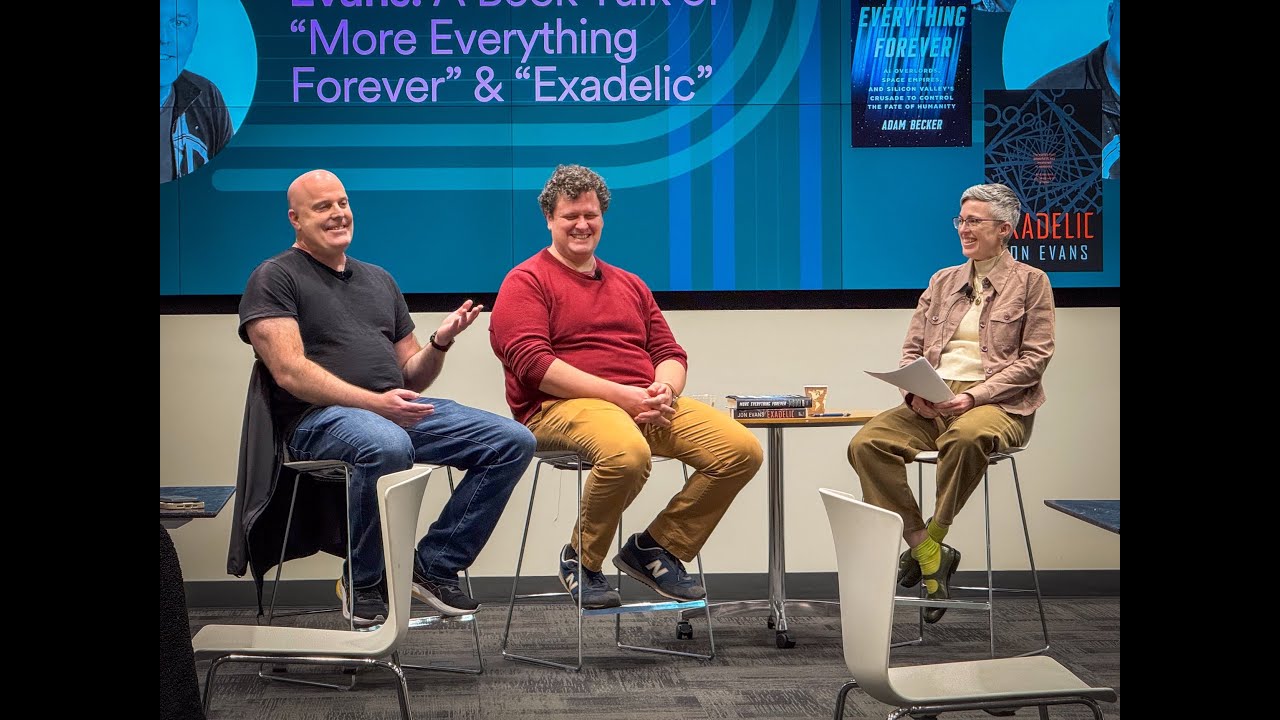
HAI Seminar with Adam Becker & Jon Evans: “More Everything Forever” and “Exadelic”
Keywords
Summary
142 words
Critical Evaluation
The seminar provides a valuable critical perspective on the ideologies driving AI development, particularly within Silicon Valley. Becker and Evans bring complementary backgrounds: Becker’s scientific rigor and Evans’ narrative insight offer a multifaceted analysis. The discussion is well-moderated, allowing for a nuanced exploration of complex topics such as transhumanism, effective altruism, and the simulation hypothesis. The speakers effectively challenge the dominant narratives of AI utopia and dystopia, emphasizing the importance of human agency and ethical considerations. However, the content is largely opinion-based, with limited empirical evidence or data to support their claims. While they reference specific individuals and movements, they do not provide detailed citations or sources, which could be a limitation for viewers seeking verifiable information. The Q&A segment adds value by addressing audience questions, but the overall depth of analysis is constrained by the format. Despite these limitations, the seminar offers a thought-provoking and accessible introduction to critical perspectives on AI, making it a valuable resource for those interested in the societal implications of technology.
167 words
Title / Content Match
The title accurately reflects the content, as the seminar focuses on the two books and their themes.
Quality & Reliability
8/10
The discussion features two authors with relevant expertise (science journalism and tech journalism) and is moderated by a policy fellow. The content is well-structured, with critical analysis of AI ideologies and their societal implications. However, it is primarily opinion-based and lacks empirical data or peer-reviewed sources.
Chapters
Cited Sources
- More Everything Forever: AI Overlords, Space Empires, and Silicon Valley's Crusade to Control the Fate of Humanity — Adam Becker's book discussed in the seminar.
- Exadelic — Jon Evans's novel discussed in the seminar.
- Gradient Ascendant newsletter — Jon Evans's newsletter mentioned in the description.
Concurring Sources
- What Is Real? — Adam Becker's previous book on quantum physics, providing background on his scientific approach.
Contribution & Novelties
The seminar offers a critical examination of AI ideologies, synthesizing perspectives from science journalism and speculative fiction. It highlights the cultural and philosophical roots of AI development, encouraging a more human-centered approach.
Pour aller plus loin :
- Transhumanism — Overview of the movement advocating for human enhancement through technology.
- Effective Altruism — Philosophical and social movement focused on using evidence to do the most good.
- Simulation Hypothesis — The idea that reality could be a simulation, central to Evans’s novel.
80 words
Radar Profile
The radar profile shows high scores in quality of information and global reliability, reflecting the expertise of the speakers. The quantity of information is moderate, and the technical level is accessible, indicating a balance between depth and accessibility.